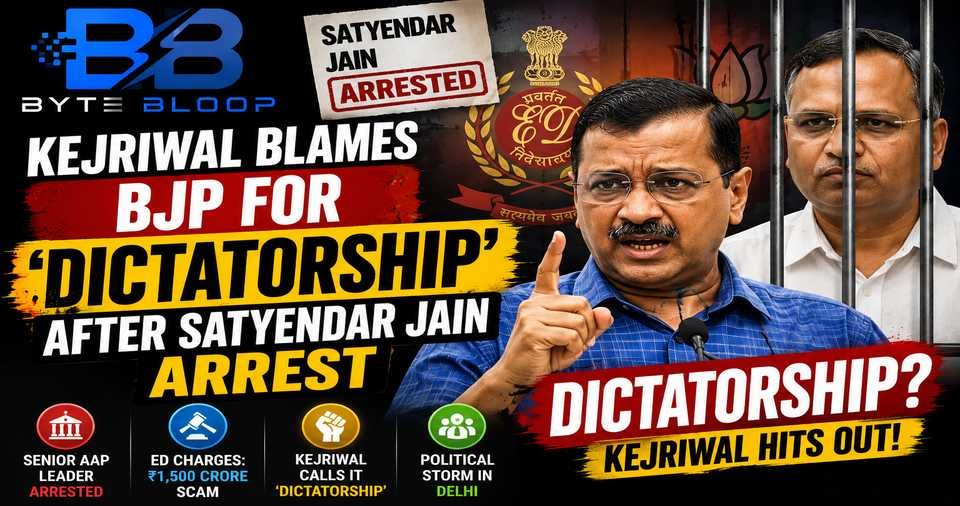
Kejriwal Blames BJP for ‘Dictatorship’ After Satyendar Jain Arrest
Introduction
Delhi’s political landscape erupted this week when AAP leader Satyendar Jain was taken into custody on charges of corruption and land‑grab allegations. The arrest sparked an immediate and fiery response from Chief Minister Arvind Kejriwal, who accused the ruling Bharatiya Janata Party (BJP) of orchestrating a “dictatorship” to silence opposition voices. Kejriwal’s remarks have amplified an already heated debate about the use of law enforcement as a political weapon in India.
As the nation watches, the incident raises crucial questions about democratic norms, the independence of investigative agencies, and the broader implications for upcoming state and national elections. This article delves into the background of the case, examines the key details of the arrest, and analyses the potential impact on India’s political dynamics.
Background & Historical Context
Satyendar Jain, a senior member of the Aam Aadmi Party (AAP) and former Delhi minister for health and urban development, has been a prominent figure in the capital’s governance since the party’s rise to power in 2015. Over the years, Jain has faced multiple allegations of irregularities in land deals and procurement contracts, but many of these cases stalled due to lack of concrete evidence.
The BJP, which currently controls the Union government, has repeatedly accused the AAP of corruption, positioning itself as the anti‑corruption crusader. Critics argue that the BJP’s narrative often intertwines with strategic timing, especially as elections approach. Historically, India has witnessed several high‑profile arrests that were later perceived as politically motivated, fueling public skepticism about the impartiality of agencies like the Enforcement Directorate (ED) and the Central Bureau of Investigation (CBI).
Key Details & Impact Analysis
On Tuesday, the ED seized Jain’s assets worth over ₹1,500 crore and filed a charge sheet alleging that he, along with several co‑accused, siphoned public funds through bogus land acquisitions. Jain was arrested at his residence in Delhi and taken to a detention facility, where he was produced before a magistrate. The court granted a 14‑day custodial remand, allowing investigators to interrogate him further.
Kejriwal’s response was swift and unequivocal. In a press conference, he labeled the BJP’s actions as an attempt to “instill fear” and described the arrest as evidence of a “dictatorship” that seeks to crush dissent. He also claimed that the AAP leader was targeted at the behest of the central government, a charge that the BJP denied, calling it “baseless political rhetoric”. The incident has already triggered protests outside Delhi’s courts, with AAP supporters chanting slogans and demanding Jain’s immediate release.
The arrest could have far‑reaching consequences. For the AAP, it risks losing a key strategist ahead of the 2025 Delhi Assembly elections, potentially weakening its campaign machinery. Conversely, the BJP may view the move as a demonstration of its resolve to tackle corruption, aiming to consolidate its voter base ahead of the 2029 general elections. However, the narrative of political victimisation could backfire, galvanising opposition parties and civil society groups that champion judicial independence.
Frequently Asked Questions (FAQs)
What are the specific charges against Satyendar Jain?
Jain is accused of money laundering, fraud, and illegal acquisition of government land. The Enforcement Directorate alleges that he facilitated the transfer of public assets to private entities in exchange for kickbacks, amounting to approximately ₹1,500 crore.
Has the BJP responded to Kejriwal’s accusations?
Yes. BJP spokespersons dismissed Kejriwal’s claims as political theatrics, emphasizing that the investigation is independent and based on solid evidence. They urged the public to let the legal process run its course.
How might this arrest affect upcoming elections?
The timing could influence voter sentiment. AAP may suffer a setback due to the loss of a senior leader, while the BJP could gain credibility among anti‑corruption voters. However, if the public perceives the arrest as politically driven, it could fuel anti‑incumbency sentiment against the BJP.
Conclusion
The arrest of Satyendar Jain and Kejriwal’s subsequent accusations have thrust India’s political rivalry into the spotlight, underscoring the delicate balance between law enforcement and democratic freedoms. As investigations proceed, both parties will likely leverage the narrative to their electoral advantage. Ultimately, the episode serves as a reminder that the health of India’s democracy hinges on transparent institutions, an impartial judiciary, and a vigilant citizenry that demands accountability from all sides of the political spectrum.
Source: Times Now
