AI Agents Explained: 10 Key Components, Use Cases & Safety in 2026
Introduction
AI agents explained in simple terms, they are software systems that can pursue a goal by interpreting information, deciding what actions are needed, using available tools, and producing results with varying levels of human oversight.
A traditional chatbot usually responds directly to a user message. An AI agent can go further by breaking a task into steps, selecting tools, retrieving information, taking actions, checking results, and continuing until a defined objective is reached. The exact level of autonomy depends on how the system is designed. IBM describes AI agents as systems that can design workflows with available tools, while Anthropic distinguishes agents that dynamically direct their own processes from predefined workflows.
An agent may use a large language model as its reasoning engine, but the model alone is not the whole system. Tools, memory, application logic, permissions, data sources, and runtime controls can all be part of an agent architecture.
In 2026, AI agents are increasingly being explored for software development, customer support, research, enterprise automation, data analysis, and other multi-step workflows. BCG’s 2026 research found that 30% of surveyed respondents said AI agents were already integrated into workflows, while another 50% said their workplace had run agent experiments or pilots.
This guide explains what AI agents are, how they work, their core components, use cases, development approaches, security risks, practical limitations, and what organizations should consider before deploying them.
What Are AI Agents?
An AI agent is a software system that can use models, data, tools, and rules to pursue a defined objective.
Instead of producing only a single response, an agent can perform multiple steps.
For example, an agent assigned to research a topic might:
- Understand the user’s goal.
- Break the request into smaller tasks.
- Search approved information sources.
- Extract relevant information.
- Organize the findings.
- Check whether important tasks remain.
- Produce a final result.
Not every AI agent performs all of these steps, and not every agent is fully autonomous.
Some systems follow fixed workflows with an LLM inserted into specific steps. Others give the model more control over which tools to use and what actions to take. Anthropic specifically distinguishes predefined workflows from agents that dynamically direct their own processes.
AI Agents vs Chatbots
The difference between a chatbot and an AI agent is mainly about action and control.
A chatbot typically:
- Receives a request
- Generates a response
- Waits for another request
An agent can potentially:
- Interpret a goal
- Plan multiple steps
- Call external tools
- Retrieve information
- Modify data
- Perform actions
- Evaluate intermediate results
- Continue working toward the goal
That does not mean agents are always better.
Anthropic recommends starting with the simplest solution that can reliably solve the problem, because agentic systems can introduce additional latency, cost, and complexity.
How AI Agents Work
A typical AI agent follows a loop involving goals, reasoning, tools, observations, and actions.
1. Goal Definition
The system first needs a clearly defined objective.
For example:
“Find the latest sales information and prepare a summary.”
A good goal should define what the agent is expected to accomplish and what actions it is allowed to take.
2. Planning
The agent determines which steps may be necessary.
Planning can involve breaking a large request into smaller tasks and deciding which tools or data sources should be used.
IBM describes planning as the process of determining a sequence of actions required to achieve an objective.
3. Tool Selection
The agent may choose from available tools such as:
- APIs
- Databases
- Search systems
- Calculators
- File systems
- Business applications
- Internal knowledge bases
Tools extend the capabilities of the underlying model by allowing it to interact with external systems.
4. Action Execution
The selected tool is called and returns information or performs an action.
For example, an agent may:
- Search a database
- Retrieve a document
- Create a ticket
- Query an API
- Update a record
- Generate a report
5. Observation and Feedback
The agent receives the result of the action.
It can then determine whether the result was useful and whether another step is necessary.
6. Completion or Replanning
If the objective has been satisfied, the system can produce the final result.
If not, it may revise its plan and continue.
IBM notes that agents can adapt their plans as new information or changing conditions appear.
Core Components of an AI Agent
AI agent architectures vary, but several building blocks appear repeatedly.
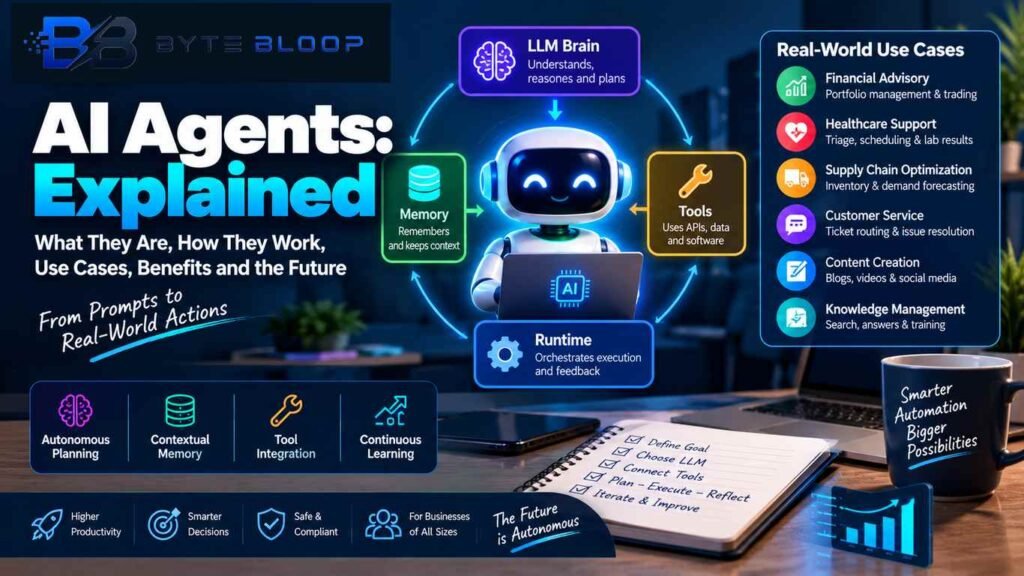
Large Language Model
The LLM often handles natural-language understanding, reasoning, planning, and response generation.
It may determine:
- What the user wants
- Which information matters
- Which tool should be used
- What action should happen next
However, the LLM should not be treated as an unlimited source of truth.
Memory
Memory allows an agent to retain relevant information across interactions or within a task.
Memory can include:
- Current conversation context
- Previous interactions
- User preferences
- Retrieved knowledge
- Task history
- Structured records
IBM notes that memory can help agents retain context, retrieve information, and support more personalized or continuous workflows.
Not every agent requires long-term memory.
Tools
Tools allow the agent to interact with external systems.
Examples include:
- Web search
- APIs
- Databases
- Code execution
- Email systems
- Calendar systems
- CRM platforms
- File storage
The more powerful the tools, the more important permissions and safeguards become.
Runtime and Orchestration
The runtime controls how the agent’s steps are executed.
It may manage:
- Tool calls
- State
- Timeouts
- Retries
- Logging
- Errors
- Permissions
- Human approvals
Guardrails
Guardrails define what the agent can and cannot do.
Examples include:
- Approved tool lists
- Input validation
- Output validation
- Spending limits
- Restricted permissions
- Human approval
- Rate limits
- Content policies
Types of AI Agents
AI agents can be classified in different ways.
Reactive Agents
Reactive agents respond to current information without maintaining substantial long-term state.
They can be useful for simpler tasks where memory is unnecessary.
Model-Based Agents
Model-based agents maintain an internal representation of relevant information about the environment.
This allows them to respond based on more than the immediate input.
Goal-Based Agents
Goal-based agents select actions based on an objective they are trying to accomplish.
They may use external tools and planning mechanisms to reach that objective. IBM identifies goal-based systems as one category within broader agent architectures.
Utility-Based Agents
Utility-based systems consider preferences or measurable criteria when choosing between possible actions.
For example, an agent may need to balance speed, cost, and quality.
Learning Agents
Learning agents can update parts of their behavior or knowledge based on new information and feedback.
However, “learning” does not necessarily mean that every deployed agent continuously retrains its underlying model. Memory, feedback systems, retrieval, fine-tuning, and reinforcement learning are different mechanisms and should not be treated as identical.
AI Agent Use Cases in 2026
AI agents are being explored across a wide range of business and technical tasks.
Software Development
Coding agents can help with:
- Writing code
- Reviewing code
- Running tests
- Debugging
- Documentation
- Repository analysis
- Issue investigation
BCG’s 2026 research reports that agentic AI has moved from concept toward production in a significant share of technology organizations, although deployment levels vary by company and function.
Customer Support
Agents can assist with:
- Ticket classification
- Knowledge retrieval
- FAQ responses
- Issue routing
- Workflow automation
- Escalation to human representatives
Human escalation remains important for sensitive, ambiguous, or high-impact requests.
Enterprise Research
Research agents can retrieve information from approved sources, summarize documents, compare findings, and prepare reports.
For enterprise environments, access controls are particularly important because internal information may contain confidential material.
Financial Workflows
Agents can assist with financial analysis, reporting, document processing, and other business workflows.
High-impact actions such as moving money, executing trades, or approving financial decisions require stricter controls and should not be treated like ordinary text-generation tasks.
Healthcare Administration
Agents can support administrative workflows such as appointment coordination, document organization, and information retrieval.
Clinical decision-making requires appropriate professional oversight and regulatory controls.
Supply Chain Operations
Potential applications include:
- Inventory monitoring
- Demand analysis
- Supplier communication
- Order workflow support
- Exception detection
Systems that can place orders or modify operational data should use tightly controlled permissions.
Content Operations
Agents can support:
- Research
- Drafting
- Editing
- Content organization
- Metadata preparation
- Publishing workflows
Human review remains important for accuracy, originality, and brand consistency.
Enterprise Knowledge Management
Internal agents can retrieve information from approved company sources and answer employee questions.
This can be useful when organizations have large collections of documents, procedures, and internal knowledge.
IBM lists enterprise software design, IT automation, code generation, conversational assistance, and other business functions among agent use cases.
Building Your First AI Agent
Building an AI agent does not require starting with a complicated multi-agent architecture.
Step 1: Define a Narrow Goal
Start with one specific problem.
For example:
“Read support tickets and classify them into approved categories.”
A narrow objective is easier to test and measure.
Step 2: Choose the Model
Select an LLM based on:
- Task complexity
- Cost
- Latency
- Context requirements
- Tool-use capabilities
- Reliability
Step 3: Add Only Necessary Tools
Connect the minimum set of tools required for the task.
This reduces unnecessary complexity and limits the potential impact of mistakes.
Step 4: Define Permissions
Decide which actions the agent can perform.
For example:
- Read customer records
- Search knowledge bases
- Draft responses
might be allowed, while:
- Delete records
- Transfer funds
- Change account ownership
might require human approval.
Step 5: Add Observability
Record useful information such as:
- Tool calls
- Errors
- Execution time
- Outcomes
- Approval events
- Failed tasks
Logs can help developers understand why an agent behaved incorrectly.
Step 6: Test Before Deployment
Test the agent against normal requests, unusual requests, incomplete information, malicious instructions, and tool failures.
Step 7: Start With Human Oversight
For early deployments, human review can provide an additional safety layer while the system’s behavior is being evaluated.
Anthropic recommends matching system complexity to the actual problem and starting with simpler architectures where possible.
AI Agent Workflows vs Autonomous Agents
The terms “workflow” and “agent” are often used interchangeably, but there is a useful distinction.
A workflow uses predefined code paths.
For example:
- Receive document.
- Extract text.
- Summarize text.
- Save summary.
An agent has more freedom to decide which steps to take based on the task and available tools.
For example:
- Understand the objective.
- Decide which information is missing.
- Search for that information.
- Choose another tool if required.
- Evaluate the result.
- Continue until the objective is complete.
Anthropic recommends workflows when predictability and consistency are more important, and agents when flexible model-driven decision-making is actually useful.
Common AI Agent Frameworks
Developers can build agents directly with model APIs or use frameworks that provide orchestration capabilities.
Examples include:
- LangChain
- LlamaIndex
- Semantic Kernel
- Strands Agents
- Claude Agent SDK
Framework choice depends on the application’s requirements.
Anthropic notes that frameworks can simplify common tasks such as model calls, tool definitions, and orchestration, but also recommends understanding the underlying implementation rather than adding unnecessary abstraction.
Multi-Agent Systems
A multi-agent system uses multiple specialized agents instead of one general-purpose agent.
For example:
- Research agent
- Data-analysis agent
- Coding agent
- Review agent
- Coordination agent
One agent may gather information while another checks the output.
Multi-agent architectures can be useful for complex tasks, but they can also increase:
- Cost
- Latency
- Debugging difficulty
- Coordination complexity
- Security exposure
For this reason, multiple agents should not be added unless they provide a clear benefit.
AI Agent Memory Explained
Memory can exist at different levels.
Short-Term Memory
Short-term memory contains the context required for the current task or conversation.
Long-Term Memory
Long-term memory can store information across sessions.
Semantic Memory
Semantic memory stores structured knowledge, facts, or concepts that the system can retrieve later.
Episodic Memory
Episodic memory can represent previous events or interactions.
Not every agent needs all four types.
The appropriate memory architecture depends on the task, privacy requirements, data volume, and expected behavior. IBM notes that memory implementations vary significantly between agent designs and use cases.
AI Agents and Tool Use
Tool use is one of the features that differentiates many agents from ordinary text-generation systems.
An agent can potentially call:
- Search APIs
- Databases
- Financial systems
- Calendars
- Code execution environments
- Business software
A tool call can therefore have a real-world effect.
This creates an important design principle:
The agent should receive only the permissions it actually needs.
NIST’s 2026 work specifically highlights identity, authorization, auditing, non-repudiation, and controls against prompt injection as important considerations for software and AI agents.
AI Agent Security Risks
AI agents introduce many of the security problems already found in software systems, but their ability to interpret untrusted information and call tools creates additional risks.
Prompt Injection
An attacker can place malicious instructions inside information an agent later reads.
For example, a malicious instruction could be hidden in:
- A web page
- An email
- A document
- A code repository
- A database record
NIST’s 2026 AI-agent security work specifically discusses indirect prompt injection and agent hijacking as important threats.
Tool Misuse
An agent could misuse a legitimate tool because of an incorrect interpretation, malicious input, or poorly designed instructions.
Excessive Permissions
An agent with unnecessary access can create a much larger impact when something goes wrong.
Data Exposure
Agents may process confidential documents, internal databases, customer information, or other sensitive data.
Identity and Authorization Problems
Organizations need to know which agent is acting, which user authorized it, what permissions it has, and what actions it performed.
NIST has specifically proposed work around agent identity and authorization because giving agents access to multiple datasets, tools, and applications creates new security and accountability requirements.
Insecure External Dependencies
An agent may rely on third-party tools, models, connectors, or external data sources.
Those dependencies can introduce security or reliability risks.
How to Secure AI Agents
A secure agent architecture should include multiple layers of protection.
Least-Privilege Access
Give the agent only the permissions necessary for its task.
Tool Allowlisting
Allow only approved tools and operations.
Human Approval
Require human confirmation before high-impact actions.
Examples may include:
- Financial transfers
- Deleting information
- Sending sensitive communications
- Changing permissions
- Publishing critical content
Input Validation
Treat external content as untrusted input.
Output Validation
Verify important agent outputs before they are used downstream.
Logging and Auditing
Record relevant actions so organizations can investigate failures or suspicious behavior.
Isolation
Use sandboxing and restricted execution environments for higher-risk tasks.
Security Testing
Test agents against prompt injection, malicious documents, tool failures, excessive permissions, and other attack scenarios.
NIST’s 2026 security analysis emphasizes that AI-agent security requires adaptation of established cybersecurity practices to new agent-specific threats.
AI Agents and Privacy
Agents can process personal or confidential information, especially when connected to email, customer databases, documents, or enterprise systems.
Organizations should determine:
- What data the agent can access
- Why the data is required
- How long information is retained
- Which vendors receive the data
- How users can control access
- How sensitive actions are audited
Privacy requirements vary by jurisdiction and industry.
An AI agent should therefore not be given unrestricted access to all available company or customer data simply because a technical connection exists.
Measuring AI Agent Performance
An agent should be evaluated using measurable criteria.
Useful metrics can include:
- Task completion rate
- Error rate
- Escalation rate
- Tool-call accuracy
- Latency
- Cost per task
- Human intervention rate
- Safety incidents
- User satisfaction
A system that completes tasks quickly but frequently makes dangerous mistakes should not be considered successful.
Evaluation should therefore measure both usefulness and reliability.
Challenges of AI Agents
Reliability
Agents can sometimes choose the wrong tool, misunderstand a goal, or follow an incorrect plan.
Cost
Multi-step reasoning and repeated tool calls can increase model and infrastructure costs.
Latency
A task requiring multiple model calls and external tools can take significantly longer than a single response.
Debugging
The more dynamic the system becomes, the more difficult it can be to reproduce failures.
Security
Tool access expands the potential impact of malicious instructions or compromised dependencies.
Governance
Organizations need clear rules about who can deploy agents, what agents are allowed to do, and who is accountable for their actions.
BCG’s 2026 research notes that agent adoption is increasing while governance, accountability, and organizational redesign are still catching up in many organizations.
AI Agents and Human Oversight
Human involvement remains important even when an agent is designed to act autonomously.
Human oversight can be used for:
- Approval
- Exception handling
- Safety decisions
- Quality review
- Compliance
- High-impact actions
A useful design is often human-in-the-loop, where the agent handles routine steps while people retain control over actions that require judgment or authority.
NIST research specifically explores human-in-the-loop approaches for trustworthy smart-manufacturing and AI systems.
AI Agents in 2026
AI agents have moved beyond early demonstrations into more practical experimentation and deployment.
BCG’s 2026 global AI-at-work survey reported that 30% of respondents said AI agents were already integrated into workflows, more than double the previous year’s 13%, while another 50% said their organizations had run agent experiments or pilots.
At the enterprise level, BCG also reports that adoption is moving from isolated pilots toward broader implementation, although progress differs across companies and industries.
At the same time, security and governance are becoming more important. NIST launched an AI Agent Standards Initiative in 2026 focused on secure adoption, interoperability, and agent identity and security.
This means 2026 is not simply about making agents more autonomous. It is also about making them more controllable, auditable, interoperable, and secure.
Future of AI Agents
Several trends are likely to shape agent development.
Better Tool Integration
Agents are likely to connect with more software, APIs, and structured data sources.
Improved Planning
Models and orchestration systems may become better at handling long multi-step tasks.
More Specialized Agents
Instead of one general agent doing everything, organizations may use specialized agents for specific functions.
Multi-Agent Coordination
Multiple agents may collaborate on complex workflows when the added coordination is justified.
Better Identity and Authorization
As agents receive greater access to systems, organizations will need stronger ways to authenticate, authorize, monitor, and audit those actions. NIST’s 2026 initiative explicitly highlights these areas.
Improved Safety Testing
Security testing is likely to become a larger part of agent development as researchers continue studying agent hijacking, prompt injection, insecure tools, and other failure modes.
More Human-Agent Collaboration
Many useful systems may ultimately combine automated execution with human review instead of removing humans completely from important workflows.
Key Takeaways
- AI agents are software systems that can pursue goals using models, tools, data, and defined rules.
- Agents can plan multi-step tasks instead of simply answering one prompt.
- Tools allow agents to interact with external systems and perform actions.
- Memory can help agents maintain context across tasks or sessions.
- Not every application needs an autonomous agent; simpler workflows can be more predictable and cheaper.
- Common use cases include coding, customer support, research, enterprise knowledge management, and workflow automation.
- High-impact agents need strong permissions, identity, authorization, logging, and human approval.
- Prompt injection and agent hijacking are important security concerns.
- AI-agent adoption is expanding, but enterprise implementation and governance are developing at different speeds.
- The future of AI agents will involve better tools, stronger security, more specialized systems, and closer human-agent collaboration.
Frequently Asked Questions
What is an AI agent?
An AI agent is a software system that can pursue a defined goal by interpreting information, making decisions, using tools, and performing one or more actions with varying levels of human oversight.
How is an AI agent different from a chatbot?
A chatbot typically generates a response to a user request, while an AI agent can plan multiple steps, use external tools, retrieve information, and perform actions as part of completing a goal.
What are the main components of an AI agent?
Common components include a model, planning or reasoning logic, tools, memory or context, a runtime, and guardrails.
Do all AI agents use LLMs?
No. AI agents can be built using different types of models, rules, or combinations of methods. However, many modern software agents use LLMs as their main reasoning or language interface.
Do AI agents need memory?
No. Memory is useful for many applications but is not required for every agent. Simple agents can operate using current inputs and available tools without long-term memory.
Can AI agents use tools?
Yes. Tool use is one of the core capabilities of many modern AI agents. Tools can include APIs, databases, search systems, code execution, business software, and other external resources.
Can AI agents make decisions on their own?
They can make decisions within the goals, rules, tools, and permissions provided by their developers and operators. The level of autonomy depends on the system design.
Are AI agents fully autonomous?
Not necessarily. Some agents operate with human approval or predefined workflows, while others can make more dynamic decisions. “Agent” does not automatically mean completely independent operation.
What are the most common uses of AI agents?
Common applications include software development, customer support, research, workflow automation, enterprise knowledge management, data analysis, and other multi-step tasks.
Can AI agents be used in finance?
Yes, but financial use cases may require strict controls, especially when agents can access financial records, make recommendations, or perform transactions.
Can AI agents be used in healthcare?
Yes. They can support administrative and information workflows, but healthcare applications that affect diagnosis, treatment, or other high-impact decisions require appropriate professional oversight and regulatory controls.
What is prompt injection in AI agents?
Prompt injection occurs when an attacker or untrusted source provides instructions that manipulate an AI system into performing unintended actions. With agents, the risk can increase because the system may also have access to tools and external data. NIST identifies indirect prompt injection as an important AI-agent security concern.
How can AI agents be secured?
Useful controls include least-privilege access, restricted tools, input and output validation, human approval, logging, sandboxing, strong identity and authorization, and security testing.
What is the difference between an AI agent and an AI workflow?
A workflow generally follows predefined code paths, while an agent has greater freedom to determine how it reaches a goal using available tools and information.
What are multi-agent systems?
Multi-agent systems use multiple specialized agents that coordinate or exchange information to complete a larger task.
Are AI agents expensive?
Costs vary according to model usage, number of steps, tool calls, infrastructure, data access, and workload. More complex agents can be more expensive than simple LLM workflows.
Do AI agents always improve productivity?
No. Their value depends on the task, implementation, reliability, workflow design, and level of human supervision. BCG’s 2026 research emphasizes that organizations often need to redesign processes—not simply add AI tools—to capture meaningful value.
Can AI agents replace employees?
AI agents can automate some tasks, but the effect on jobs varies by task, occupation, workflow, and organization. Many deployments combine automation with human review rather than removing people entirely. BCG’s 2026 research also reports that AI adoption is changing how people work and manage AI systems.
What is human-in-the-loop AI?
Human-in-the-loop AI is a design in which people review, approve, correct, or supervise important parts of an AI system’s operation.
What should businesses consider before deploying an AI agent?
Businesses should define the use case, required permissions, data access, security controls, costs, evaluation metrics, human oversight, logging, and accountability before deploying the agent.
Which is better: an AI agent or a simple workflow?
There is no universal answer. A simple workflow may be preferable when tasks are predictable and repeatable, while an agent can be useful when the system genuinely needs flexible planning and tool selection.
Conclusion
AI agents explained simply are software systems that can move beyond generating text and instead use models, tools, data, and defined permissions to work toward a goal.
Their architecture can include an LLM, memory, tools, planning logic, runtime controls, and guardrails. By combining these components, an agent can perform multi-step tasks that would otherwise require several manual actions.
The technology is already being explored across software development, customer service, enterprise research, knowledge management, data analysis, and workflow automation. At the same time, greater autonomy creates new responsibilities around security, identity, authorization, privacy, auditing, and human oversight. NIST’s 2026 work on AI-agent security and standards reflects how these issues are becoming a major part of the technology landscape.
The most practical approach is usually to start with a clearly defined problem, connect only the tools the system actually needs, limit permissions, test the agent against failure and attack scenarios, and keep human approval for high-impact actions.
As agent technologies continue to develop, the focus will increasingly be not just on what agents can do, but on how reliably, safely, transparently, and efficiently they can do it.
Related Reading
Adobe Firefly Explained: Features, Pricing, Uses & AI Tools in 2026
https://bytebloop.com/adobe-firefly-explained/
Laravel Explained: Features, MVC, AI SDK and How It Works in 2026
https://bytebloop.com/laravel-explained/
ByteBloop AI Guides
https://bytebloop.com/category/ai/
Ad Tracking Explained: 8 Types, How It Works & Privacy in 2026
https://bytebloop.com/ad-tracking-explained/
Sources & References
IBM — What Are AI Agents?
https://www.ibm.com/think/topics/ai-agents
IBM — What Is AI Agent Planning?
https://www.ibm.com/think/topics/ai-agent-planning
IBM — What Is AI Agent Memory?
https://www.ibm.com/think/topics/ai-agent-memory
IBM — Components of AI Agents
https://www.ibm.com/think/topics/components-of-ai-agents
IBM — How to Build an AI Agent
https://www.ibm.com/think/topics/how-to-build-an-ai-agent
Anthropic — Building Effective Agents
https://www.anthropic.com/engineering/building-effective-agents
NIST — AI Agent Security RFI Analysis, 2026
https://www.nist.gov/publications/summary-analysis-responses-request-information-regarding-security-considerations-ai
NIST — AI Agent Identity and Authorization Concept Paper
https://csrc.nist.gov/pubs/other/2026/02/05/accelerating-the-adoption-of-software-and-ai-agent/ipd
NIST — AI Agent Standards Initiative, 2026
https://www.nist.gov/news-events/news/2026/02/announcing-ai-agent-standards-initiative-interoperable-and-secure
BCG — AI at Work 2026
https://www.bcg.com/publications/2026/ai-at-work-why-strategy-matters-more-than-tools
BCG — Scaling AI Requires New Processes, Not Just New Tools
https://www.bcg.com/publications/2026/scaling-ai-requires-new-processes-not-just-new-tools