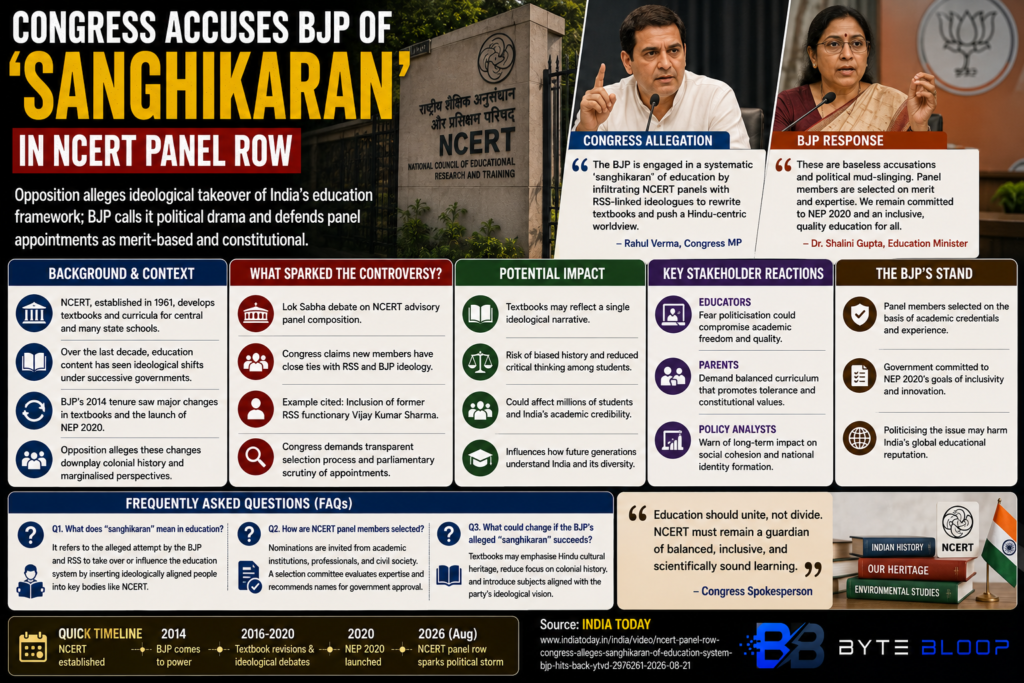
Congress Accuses BJP of ‘Sanghikaran’ in NCERT Panel Row
Introduction
New Delhi – A fresh political storm has erupted around the National Council of Educational Research and Training (NCERT) after the Congress party accused the ruling Bharatiya Janata Party (BJP) of attempting a systematic “sanghikaran” – or takeover – of India’s education framework. The controversy ignited during a parliamentary debate on the composition of the NCERT advisory panel, where opposition members alleged that the government is inserting ideologically aligned members to rewrite textbooks and curricula.
The BJP, meanwhile, has brushed off the accusations as mere political theatrics, insisting that the panel’s composition follows constitutional norms and reflects a broad spectrum of expertise. As the debate intensifies, educators, parents, and policy analysts are watching closely, fearing that the outcome could reshape the narrative taught in schools across the country.
Background & Historical Context
NCERT, established in 1961, has long been the cornerstone of textbook development for India’s central and many state school systems. Historically, its panels have comprised scholars, subject‑matter experts, and representatives from various educational bodies, aiming for a balanced approach to curriculum design. However, the last decade has seen increasing politicisation of education, with successive governments seeking to embed their ideological leanings into school content.
The BJP’s rise to power in 2014 marked a pronounced shift, as the party launched the “National Education Policy (NEP) 2020” and introduced several revisions to school textbooks that emphasized Indian heritage, ancient knowledge systems, and a reinterpretation of historical events. Critics argue that these changes often downplay colonial narratives and marginalised perspectives, prompting opposition parties to label the effort as an attempt at cultural homogenisation.
Key Details & Impact Analysis
During a recent Lok Sabha session, Congress MP Rahul Verma highlighted that the newly appointed members of the NCERT advisory panel include several individuals with close ties to the BJP’s ideological think‑tank, the Rashtriya Swayamsevak Sangh (RSS). He cited the inclusion of former RSS functionary Vijay Kumar Sharma as evidence of a coordinated “sanghikaran” strategy aimed at steering textbook content toward a Hindu‑centric worldview. The opposition demanded a transparent, merit‑based selection process and called for a parliamentary committee to scrutinise the panel’s appointments.
The BJP’s response, delivered by Education Minister Dr. Shalini Gupta, dismissed the allegations as “political mud‑slinging”. She asserted that the panel’s members were chosen based on their academic credentials and that the government remains committed to the NEP’s goals of inclusivity and quality. Gupta also warned that any attempt to politicise the panel could undermine India’s global educational standing and hamper efforts to modernise curricula in line with 21st‑century skills.
Stakeholders are divided on the potential impact. Education experts warn that a panel heavily influenced by a single ideological stream could lead to biased textbooks, affecting millions of students and possibly eroding critical thinking skills. Conversely, supporters argue that a unified narrative can foster national pride and cultural cohesion, especially in a diverse country facing identity debates.
Frequently Asked Questions (FAQs)
What does “sanghikaran” mean in the context of education?
“Sanghikaran” translates to “integration” or “takeover”. In this debate, Congress uses the term to suggest that the BJP is systematically integrating its ideological preferences into the education system by influencing NCERT’s panel composition.
How are NCERT panel members selected?
Under current guidelines, the Ministry of Education invites nominations from academic institutions, professional bodies, and civil society. A selection committee reviews credentials, expertise, and past contributions before recommending members for government approval. Critics claim recent appointments have deviated from this merit‑based approach.
What could change if the BJP’s alleged “sanghikaran” succeeds?
Potential changes include revised textbook narratives emphasizing Hindu cultural heritage, reduced emphasis on colonial history, and the introduction of new subjects aligned with the party’s vision. Such shifts could influence how future generations understand India’s past, present, and place in the world.
Conclusion
The NCERT panel row underscores a broader contest over India’s ideological direction, with education at its epicentre. While the BJP defends its selections as a step toward modernising curricula, the Congress warns of an irreversible “sanghikaran” that could compromise academic neutrality. As the debate unfolds, the ultimate verdict will likely hinge on parliamentary scrutiny, civil‑society advocacy, and the resilience of India’s educational institutions to safeguard a balanced, inclusive learning environment for the nation’s youth.
Source: India Today
