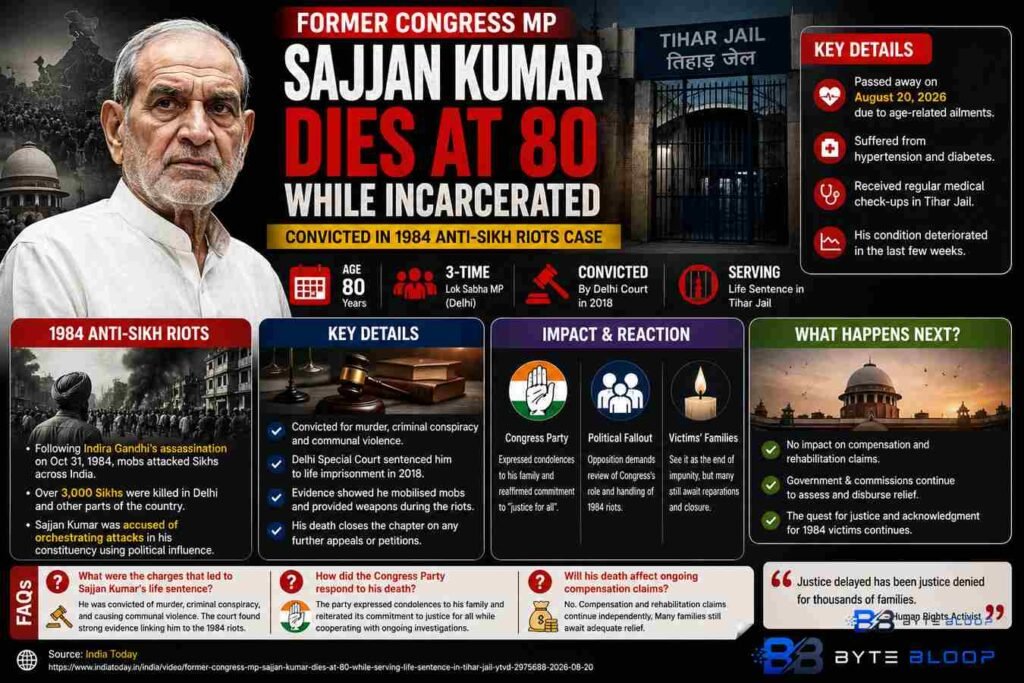
Former Congress MP Sajjan Kumar Dies at 80 While Incarcerated
Introduction
India’s political landscape was jolted on August 20, 2026, when Sajjan Kumar, a former Congress Member of Parliament, died at the age of 80 while serving a life sentence in Delhi’s Tihar Jail. Kumar, a three‑time Lok Sabha representative from the Delhi constituency, had been convicted in 2018 for his alleged involvement in the 1984 anti‑Sikh riots that followed the assassination of Prime Minister Indira Gandhi. His death not only marks the end of a controversial figure’s life but also reignites discussions about the long‑standing quest for justice for the riot victims.
The news, first reported by India Today, quickly spread across national media outlets, prompting reactions from political leaders, human‑rights activists, and the families of the riot survivors. While some viewed his demise as a natural conclusion to a tumultuous career, others saw it as a reminder of the unfinished legal and moral reckoning surrounding the 1984 violence.
Background & Historical Context
The 1984 anti‑Sikh riots remain one of the darkest chapters in independent India’s history. In the immediate aftermath of Prime Minister Indira Gandhi’s assassination by her Sikh bodyguards, mobs across Delhi and other parts of the country targeted Sikh homes, businesses, and places of worship. Official estimates suggest that over 3,000 Sikhs lost their lives, though independent investigations claim the toll could be higher.
Sajjan Kumar, then a rising star in the Indian National Congress, was accused of orchestrating attacks in his constituency, allegedly using his political influence to mobilise mobs and provide them with weapons. After years of legal battles, the Delhi Special Court convicted him in 2018, sentencing him to life imprisonment for murder, criminal conspiracy, and other charges. His conviction was hailed as a landmark verdict, signaling a shift toward accountability for political leaders implicated in the riots.
Key Details & Impact Analysis
According to the prison authorities, Kumar passed away due to natural causes linked to age‑related ailments. He had been incarcerated at Tihar Jail’s maximum‑security wing for eight years, during which he reportedly suffered from hypertension and diabetes. The prison’s medical team confirmed that he received regular health check‑ups, but his condition deteriorated in the weeks leading up to his death.
The impact of his death reverberates on multiple fronts. Legally, his demise closes the chapter on any further appeals or petitions he might have pursued to overturn his conviction. Politically, the Congress Party faces renewed scrutiny over its handling of members implicated in communal violence, with opposition parties demanding a comprehensive review of the party’s historical stance on the 1984 riots. For the victims’ families, Kumar’s death is bittersweet; while it removes a living symbol of impunity, it also underscores the prolonged struggle for closure, as many still await reparations and official acknowledgment.
Frequently Asked Questions (FAQs)
What were the charges that led to Sajjan Kumar’s life sentence?
Kumar was convicted on charges of murder, criminal conspiracy, and causing communal violence under the Indian Penal Code. The court found substantial evidence linking him to the organization of mobs that attacked Sikh families in his constituency during the 1984 riots.
How did the Congress Party respond to his death?
The party released a brief statement expressing condolences to Kumar’s family, describing his death as a personal loss. However, senior Congress leaders also emphasized the party’s commitment to “justice for all” and pledged to cooperate with ongoing investigations related to the 1984 riots.
Will his death affect ongoing compensation claims for riot victims?
No. Compensation and rehabilitation claims are processed independently of the convicted individual’s status. The government and various commissions continue to evaluate and disburse relief to victims, although many families argue that the process remains slow and inadequate.
Conclusion
Sajjan Kumar’s death at 80 marks the end of a contentious political saga that spanned over four decades. While his passing closes the legal chapter on his personal accountability, the broader quest for justice for the 1984 anti‑Sikh riots persists. The episode serves as a stark reminder that the repercussions of communal violence extend far beyond the courtroom, influencing political narratives, societal healing, and the collective memory of a nation still grappling with its past.
Source: India Today
