Karnataka Cabinet Moves to Suspend KPSC Chief After High Court Reinstatement
Introduction
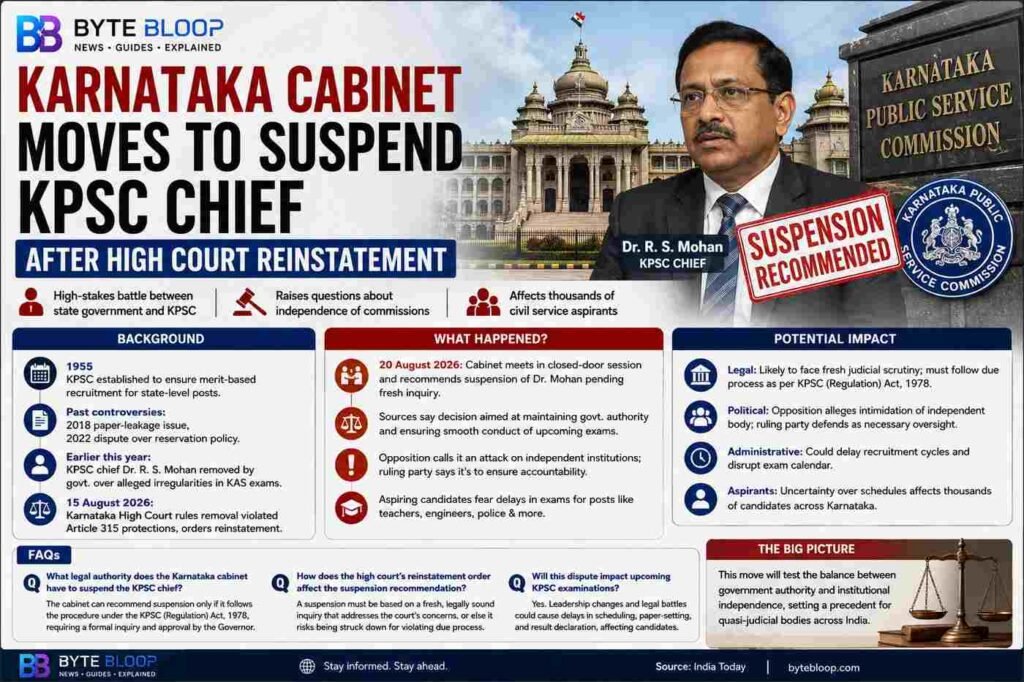
The Karnataka state cabinet has taken the unprecedented step of recommending the suspension of the Karnataka Public Service Commission (KPSC) chief, following a recent order by the Karnataka High Court that reinstated him to his post. The decision, announced in a closed‑door meeting, reflects growing tensions between the state government and the commission, raising questions about the independence of India’s quasi‑judicial bodies.
Stakeholders ranging from political analysts to civil‑service aspirants are closely watching the development, as it could set a precedent for how state governments handle perceived insubordination or alleged misconduct within autonomous commissions. This article unpacks the events leading up to the cabinet’s recommendation, examines the potential legal and administrative ramifications, and answers the most common questions surrounding the controversy.
Background & Historical Context
The KPSC, established in 1955, is tasked with conducting recruitment examinations for state‑level posts, ensuring merit‑based selection across Karnataka’s bureaucracy. Historically, the commission has operated with a degree of autonomy to shield the recruitment process from political interference. However, past incidents—such as the 2018 controversy over alleged paper‑leakage and the 2022 dispute over the commission’s role in the state’s reservation policy—have already tested this independence.
Earlier this year, the KPSC chief, Dr. R. S. Mohan, was removed by the state government on grounds of alleged procedural irregularities in the conduct of the Karnataka Administrative Service (KAS) exams. Dr. Mohan challenged the removal in the Karnataka High Court, arguing that the decision violated the constitutional protection afforded to the commission under Article 315 of the Indian Constitution. In a landmark judgment dated 15 August 2026, the court ruled that the removal lacked sufficient procedural safeguards and ordered his immediate reinstatement.
Key Details & Impact Analysis
Following the high court’s order, the cabinet convened on 20 August 2026 and, after deliberations, recommended the suspension of Dr. Mohan pending a fresh inquiry. Sources within the cabinet indicated that the recommendation was driven by concerns that the chief’s reinstatement could undermine the government’s authority over the commission and potentially delay upcoming recruitment cycles for critical posts such as teachers, engineers, and police officers.
The suspension recommendation carries significant implications. Legally, it may trigger another round of judicial scrutiny, as the high court’s earlier ruling emphasized due‑process requirements. Politically, opposition parties have seized the moment to accuse the ruling coalition of attempting to intimidate an independent body, while the ruling party defends its stance as a necessary check on alleged administrative laxity. For aspiring candidates, the uncertainty could postpone exam schedules, affecting thousands of students who rely on KPSC results for career planning.
Frequently Asked Questions (FAQs)
What legal authority does the Karnataka cabinet have to suspend the KPSC chief?
The cabinet can recommend suspension only if it follows the procedure outlined in the Karnataka Public Service Commission (Regulation) Act, 1978, which requires a formal inquiry and approval by the Governor. Any action taken without adhering to these safeguards can be challenged in court.
How does the high court’s reinstatement order affect the suspension recommendation?
The high court’s order reinstated Dr. Mohan on the basis that his removal lacked procedural fairness. A subsequent suspension, if pursued, must therefore be based on a fresh, legally sound inquiry that addresses the court’s concerns, otherwise it risks being struck down as another violation of due process.
Will this dispute impact upcoming KPSC examinations?
Potentially, yes. Administrative delays caused by leadership changes can affect the scheduling, paper‑setting, and result‑declaring phases of exams. The commission has pledged to maintain the exam calendar, but any prolonged legal battle could force a rescheduling, impacting candidates across the state.
Conclusion
The Karnataka cabinet’s recommendation to suspend the KPSC chief, coming on the heels of a high court reinstatement, underscores a delicate balance between governmental oversight and institutional independence. As legal challenges loom and political narratives clash, the ultimate outcome will likely shape the future relationship between state executives and quasi‑judicial commissions across India. Stakeholders—from policymakers to aspirants—must stay alert to developments, as the resolution will reverberate through Karnataka’s public service recruitment landscape for years to come.
Source: India Today