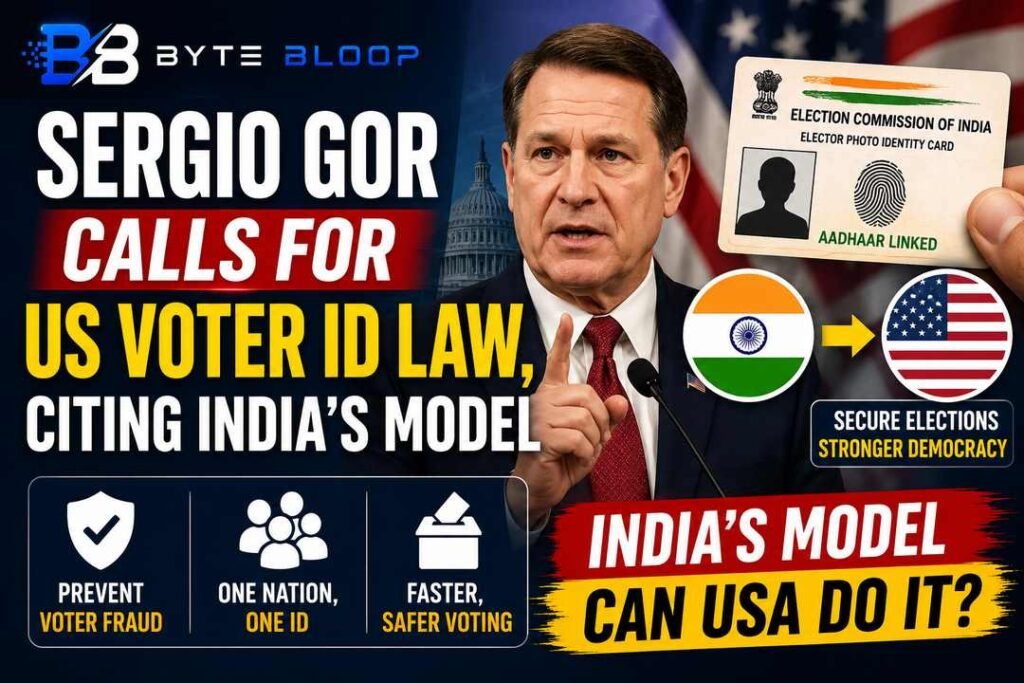
Sergio Gor Calls for US Voter ID Law, Citing India’s Model
Introduction
Former Republican congressman Sergio Gor sparked a fresh debate on election integrity this week by urging the United States to adopt a mandatory voter‑identification requirement. Speaking at a policy forum in Washington, D.C., Gor drew direct comparisons to India’s Aadhaar‑linked voter ID system, arguing that the Indian model offers a practical blueprint for the U.S. to strengthen its electoral process.
Gor’s remarks arrived amid a wave of bipartisan concern over alleged voting irregularities and the growing use of mail‑in ballots. While critics warn that strict ID laws could disenfranchise marginalized voters, Gor maintains that a well‑designed national ID could both protect the ballot box and preserve voter participation.
Background & Historical Context
India introduced its biometric voter ID cards in 2002, linking each citizen’s unique Aadhaar number to a photo and fingerprint. Over the past two decades, the system has been credited with reducing duplicate registrations and streamlining the voting process for a population of over 1.4 billion. Although not without challenges—such as data‑privacy concerns and logistical hurdles—India’s experience is frequently cited by scholars as a case study in large‑scale electoral modernization.
In the United States, the voter‑ID debate dates back to the early 2000s, with several states enacting varying levels of ID requirements. The Supreme Court’s 2008 decision in Harper v. Virginia Board of Elections upheld the constitutionality of voter ID laws, provided they do not impose an undue burden. Since then, the conversation has oscillated between safeguarding elections and protecting voting rights, especially for low‑income, elderly, and minority communities.
Key Details & Impact Analysis
During his remarks, Gor highlighted three core benefits of adopting a national voter ID akin to India’s system: first, the elimination of duplicate or fraudulent registrations; second, the creation of a unified database that can be cross‑checked in real time; and third, the potential to speed up voter verification at polling places, reducing wait times. He cited data from India’s Election Commission, which reported a 30 percent drop in duplicate entries within five years of implementing the biometric IDs.
Gor also addressed common criticisms. He argued that a federal ID program could be designed with robust privacy safeguards, such as encryption and limited data sharing, to mitigate concerns about surveillance. Moreover, he suggested that the government could subsidize ID issuance for low‑income citizens, ensuring that the requirement does not become a barrier to participation. Analysts note that while the U.S. lacks a single, universal ID system, existing infrastructure—like the Social Security Administration and state driver’s license databases—could serve as a foundation for a secure, nationwide voter ID.
Frequently Asked Questions (FAQs)
What is the main difference between India’s voter ID system and current US practices?
India’s system ties a biometric, nationwide ID (Aadhaar) directly to voter registration, creating a single source of truth for every citizen. In the U.S., voter identification requirements vary by state, and there is no federal biometric database that links directly to voter rolls.
Could a US voter ID law disenfranchise certain groups?
Critics warn that strict ID laws may disproportionately affect low‑income, elderly, and minority voters who are less likely to possess the required documents. Gor counters that a federal program could provide free IDs and mobile enrollment units, similar to India’s outreach campaigns, to ensure broad accessibility.
How would privacy be protected under a national voter ID system?
Proponents suggest using encrypted, purpose‑limited data storage, with strict penalties for misuse. The system would only be accessed during voter verification, not for unrelated government functions, thereby balancing security with civil liberties.
Conclusion
Sergio Gor’s call for a US voter‑ID requirement, modeled after India’s Aadhaar‑linked system, adds a new dimension to the ongoing national conversation about election security. While the proposal promises to curb fraud and streamline the voting experience, it also raises legitimate concerns about accessibility and privacy. The challenge for policymakers will be to design a solution that safeguards the integrity of American elections without compromising the fundamental right to vote.
Source: Times Now
