
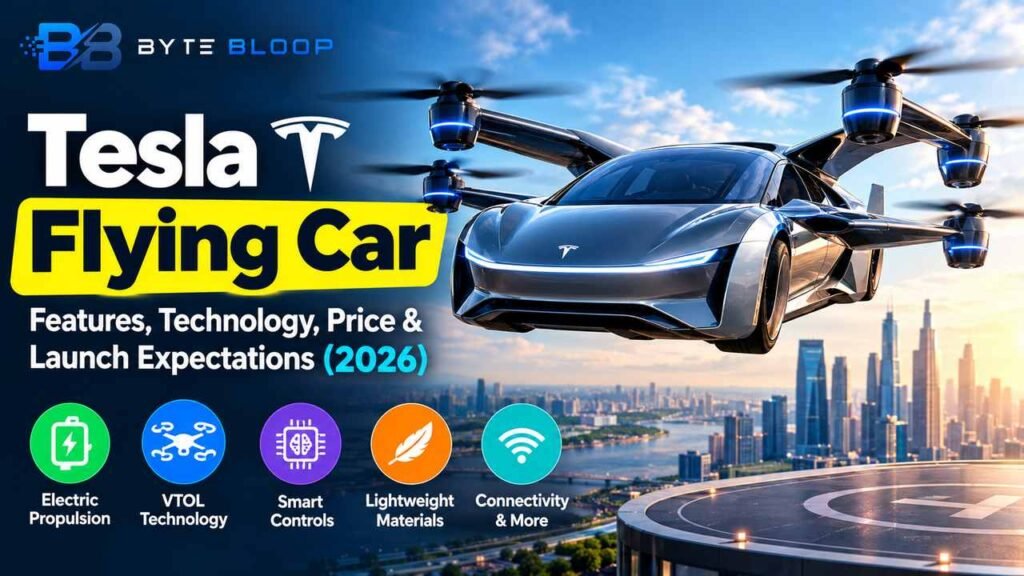
Tesla Flying Car: 7 Exciting Facts, Price & Launch (2026)
Introduction: Tesla Flying Car Explained
The Tesla flying car is an exciting concept for anyone interested in electric vehicles and the future of transportation. Imagine driving through city streets before taking to the sky in a vehicle powered by electric motors. Although this idea sounds futuristic, turning it into a practical transportation solution would require major advances in battery technology, aircraft engineering, and flight safety.
Tesla is known for its electric cars, battery technology, charging infrastructure, and vehicle software. These technologies have encouraged speculation about whether the company might eventually enter the flying-car market. However, as of October 2026, a commercially available Tesla-branded flying car, its official price, and its launch date have not been established through a verified company announcement.
So, what could a Tesla flying car look like? How might it work, what features could it offer, and how much might such a vehicle cost? This guide explores seven important facts about the concept, including electric propulsion, potential flight controls, pricing considerations, and the challenges that could determine whether flying cars become practical in the future.
What Is the Tesla Flying Car?
A flying car is a vehicle designed to combine road transportation with the ability to travel through the air. Some concepts use folding wings, while others resemble compact aircraft that can also operate on roads. Another approach uses electric vertical take-off and landing technology, known as eVTOL.
The Tesla flying car discussed online is generally a futuristic concept rather than a confirmed production vehicle. Illustrations and AI-generated videos sometimes depict sleek Tesla-inspired designs with illuminated rotors, aerodynamic bodies, and advanced autonomous systems. These images demonstrate creative possibilities, but they do not prove that a working vehicle exists.
A genuine road-and-air vehicle would need to satisfy both automotive and aviation safety requirements. Engineers would also need to balance passenger capacity, battery weight, flight performance, and road usability.
7 Exciting Features a Tesla Flying Car Could Have
The following features describe possibilities for a hypothetical vehicle. They are not confirmed specifications of an official Tesla product.
1. Electric Propulsion and Advanced Batteries
Electric propulsion could be an attractive option for a future flying car. Electric motors provide responsive power delivery and can operate without producing exhaust emissions directly at the vehicle.
However, aircraft require substantial energy to generate lift and remain airborne. A flying car would therefore need batteries capable of delivering high power while keeping overall weight manageable.
Battery cooling, charging time, energy reserves, and safe operation would be important engineering considerations. Tesla’s experience with electric vehicles could be relevant to battery development, but it does not establish that the company is developing an electric aircraft.
2. Vertical Take-Off and Landing
One possible design could use eVTOL technology to take off and land vertically. Multiple rotors or other lifting systems could generate the force needed to raise the vehicle without a conventional runway.
This approach could make short-distance aerial transportation more convenient in locations with approved landing facilities. It could also reduce dependence on traditional airports for certain journeys.
Nevertheless, vertical take-off requires considerable power. Rotor noise, landing-site availability, weather conditions, and aviation regulations would remain significant challenges for any Tesla flying car using this approach.
3. Intelligent Flight Controls
A flying vehicle would need a dedicated control system to manage stability, altitude, speed, navigation, and emergency responses.
Sensors and onboard computers could help monitor the surrounding environment and provide flight information. Automation might assist with navigation and control, but safe operation would require reliable backup systems and appropriate human oversight.
Tesla’s automotive software experience could provide relevant engineering knowledge. However, autonomous driving and autonomous aviation involve different hazards and certification requirements. No specific Tesla flying-car flight-control system has been officially established.
4. Lightweight and Aerodynamic Design
Weight plays a major role in aircraft performance. A vehicle designed for both roads and air travel would need a strong structure without carrying unnecessary mass.
Lightweight metals and composite materials could help engineers balance strength and efficiency. Aerodynamic bodywork might reduce drag during flight, while carefully designed road components could help maintain everyday usability.
The difficulty would be combining wheels, suspension, crash protection, passenger seating, batteries, and flight equipment without compromising range or safety.
5. Connected Navigation and Smart Software
A future flying car could potentially combine digital navigation, vehicle diagnostics, route planning, and connected software in one interface.
Drivers might use a central display to monitor battery levels, identify suitable landing locations, and check vehicle status. If the vehicle supported both road and flight modes, its interface would need to make the transition between them clear and safe.
Connectivity could improve convenience, but essential flight controls would need to remain dependable even when internet access was unavailable.
6. Advanced Safety Systems
Safety would be one of the most important requirements for a roadable aircraft. A flying car would need reliable propulsion, structural integrity, emergency procedures, and systems designed to handle component failures.
Depending on its design, it might also require redundant flight controls, obstacle awareness, emergency landing capabilities, and aviation-grade maintenance procedures.
A production vehicle would need appropriate testing and regulatory approval before carrying passengers commercially. Features commonly associated with electric cars would not, by themselves, establish that an aircraft was safe to fly.
7. A Combined Road and Air Experience
The most distinctive feature of a genuine flying car would be its ability to operate in two environments.
In road mode, it would need conventional steering, braking, road lighting, and other required vehicle systems. In flight mode, it would rely on aircraft controls, propulsion, and navigation equipment.
The transition between modes would need to be carefully engineered. Folding components, if used, would have to deploy and lock securely before flight. The vehicle would also need a practical operating plan for take-off, landing, charging, parking, and maintenance.
This combination could be appealing, but it would make development more complicated than building a conventional electric car or a dedicated electric aircraft.
How Would a Tesla Flying Car Work?
A hypothetical Tesla flying car would operate differently depending on its design.
During road travel, an electric powertrain could drive the wheels while onboard software monitored vehicle systems. The vehicle would need to meet applicable road-safety requirements.
For flight, the design might use wings and aircraft propulsion or an eVTOL arrangement with lifting rotors. Sensors and flight-control computers could help maintain stability, while navigation equipment would support operation in approved airspace.
Battery management would be particularly important. The system would need to reserve sufficient energy for flight and safe landing rather than simply relying on the remaining range expected from normal road driving.
The vehicle would also require suitable take-off and landing locations, maintenance inspections, and compliance with aviation rules. It would not be legal or safe to assume that owners could take off from ordinary roads or parking lots.
Tesla Flying Car Price: What Could It Cost?
There is currently no verified official price for a Tesla flying car.
The eventual cost would depend on its engineering, passenger capacity, propulsion system, battery technology, flight range, safety equipment, certification, and manufacturing volume.
A vehicle combining road transportation and flight could be considerably more complex than a conventional electric car. Aviation-grade components, specialist inspections, insurance, pilot training, and access to approved operating locations could add to ownership expenses.
For these reasons, any specific Tesla flying-car price circulating online should be treated as unconfirmed unless supported by an official announcement and published specifications.
Consumers should also be cautious about websites requesting deposits or pre-orders for a supposed Tesla flying car without verifiable authorization from the company.
Tesla Flying Car Launch Date: Is It Coming in 2026?
As of October 2026, there is no verified official launch date for a production Tesla flying car.
Online concept videos and promotional images can make a fictional vehicle look like an announced product. Some posts also circulate unverified delivery dates, performance claims, and prices.
Before trusting such claims, readers should check Tesla’s official website, company announcements, and credible automotive or aviation publications.
Even if a manufacturer develops a working prototype, commercial production would involve additional engineering, extensive safety testing, manufacturing preparation, and regulatory approval. These steps make it difficult to predict a realistic launch date without confirmed development information.
Tesla Flying Car vs Electric Flying Taxis
Electric flying taxis offer a useful comparison when evaluating the future of aerial transportation.
Many eVTOL designs focus on carrying passengers over relatively short distances rather than operating as ordinary road cars. Their structures can be optimized for flight instead of having to accommodate all the equipment required for road use.
A Tesla flying car would face a different challenge if it needed to drive on streets and fly through the air. Wheels, suspension, road crash protection, and other automotive components could increase weight and reduce flight efficiency.
Dedicated electric aircraft and roadable flying cars therefore solve different engineering problems. Progress in electric aviation does not automatically mean that a practical Tesla flying car is ready for production.
Benefits of a Future Tesla Flying Car
If a certified, safe, and practical model became available, it could offer several potential benefits:
- Alternative transportation: Aerial travel could shorten certain journeys where suitable infrastructure exists.
- Electric propulsion: An electric design could eliminate direct exhaust emissions during operation.
- Connected technology: Integrated software could simplify navigation, diagnostics, and vehicle management.
- Flexible mobility: A road-and-air design could combine ground journeys with selected aerial routes.
- New business opportunities: Future vehicles might support specialized transportation and regional mobility.
These advantages remain hypothetical for a Tesla-branded flying car. Actual benefits would depend on its performance, cost, safety, and environmental impact.
Major Challenges Facing Flying Cars
Battery Capacity and Flight Range
Electric aircraft need sufficient energy for take-off, cruising, and landing. Carrying road-car equipment could reduce the battery capacity available for flight or limit the number of passengers.
Safety and Regulation
A roadable aircraft would need to comply with relevant road and aviation requirements. Engineers would have to address emergency landings, propulsion failures, flight-control reliability, and passenger protection.
Infrastructure and Airspace
Flying cars would require suitable operating locations and permission to use the relevant airs