Trump Halts US‑South Korea Drills, Citing ‘Very Good Relationship’ with Kim
Introduction
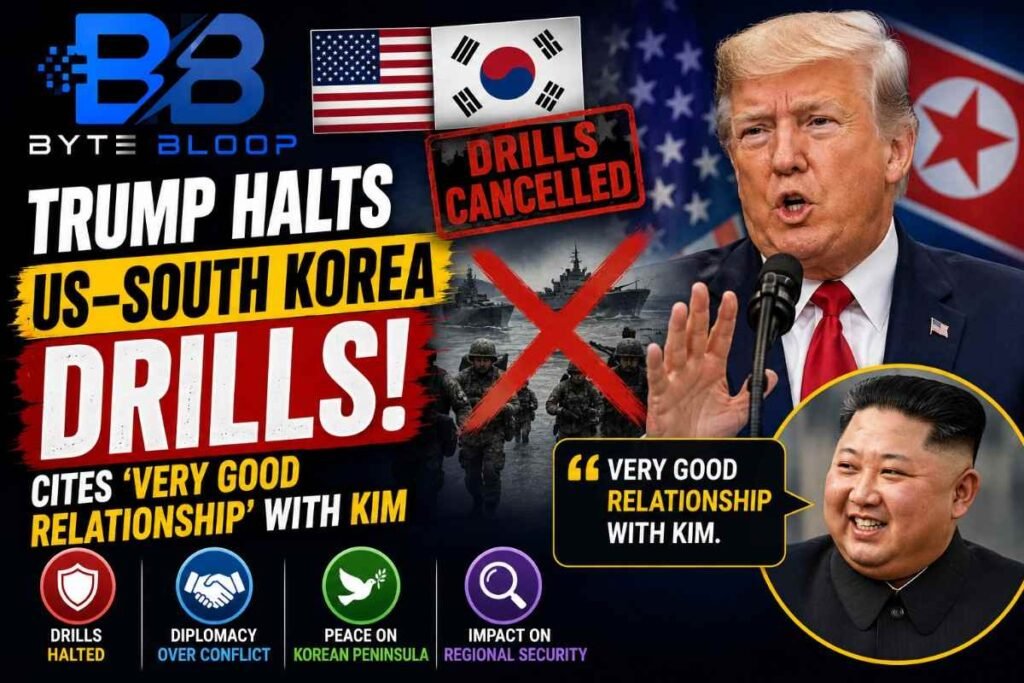
In a surprising turn of events, President Donald Trump ordered an immediate cessation of the annual joint military exercises between the United States and South Korea on Thursday. The decision came after the president publicly referenced his “very good relationship” with North Korean leader Kim Jong‑un, suggesting that the drills were no longer necessary for peace on the Korean Peninsula.
The announcement, made during a press conference at the White House, caught allies and analysts off guard. While the United States and South Korea have long conducted large‑scale maneuvers to deter North Korean aggression, Trump’s remarks hinted at a shift toward diplomatic engagement over conventional deterrence.
Background & Historical Context
The joint exercises, known as Foal Eagle and Key Resolve, have been a staple of the US‑South Korea alliance since the 1970s. Designed to improve interoperability, test readiness, and signal resolve, these drills have often been condemned by Pyongyang as provocative. Over the past decade, North Korea has repeatedly threatened retaliation, using the exercises as a pretext for missile launches and nuclear tests.
President Trump’s relationship with Kim Jong‑un has been a focal point of his administration’s North Korea policy. After a series of high‑profile summits in 2018 and 2019, the two leaders exchanged letters and held a historic meeting in Hanoi, Vietnam, that ended without an agreement. Since then, diplomatic momentum has stalled, and tensions have risen again, making Thursday’s abrupt halt a noteworthy development.
Key Details & Impact Analysis
According to the Department of Defense, the drills were scheduled to run for two weeks, involving thousands of troops, dozens of aircraft, and naval vessels operating in the Sea of Japan. The decision to cut the exercises short was communicated to South Korean officials late on Wednesday night, leaving little time for logistical adjustments. South Korea’s Defense Minister expressed disappointment, emphasizing that the drills are a cornerstone of the alliance’s deterrence posture.
Experts are divided on the potential impact. Some argue that ending the exercises could reduce provocations and open a window for renewed diplomatic talks, aligning with Trump’s stated desire to “talk more, fight less.” Others warn that the move may embolden North Korea, signaling a weakening of the US commitment to regional security and possibly encouraging Pyongyang to resume missile testing. The timing also coincides with heightened US‑China competition, adding another layer of strategic complexity.
Frequently Asked Questions (FAQs)
Why did President Trump decide to stop the drills?
Trump cited his personal rapport with Kim Jong‑un, claiming that the exercises were no longer needed to maintain peace. He suggested that direct dialogue, rather than large‑scale military displays, would be more effective in preventing conflict.
How will the halt affect the US‑South Korea alliance?
While the alliance remains strong, the abrupt decision has strained trust between Washington and Seoul. South Korean officials fear that reduced joint training could degrade readiness, but both nations have pledged to continue other forms of cooperation.
Could this lead to renewed diplomatic talks with North Korea?
Potentially. By removing a source of North Korean grievance, the US may create a more favorable environment for negotiations. However, any progress will depend on North Korea’s willingness to engage without preconditions.
Conclusion
President Trump’s decision to cut short the US‑South Korea joint drills marks a notable shift in the administration’s approach to the Korean Peninsula. While the move underscores his emphasis on personal diplomacy with Kim Jong‑un, it also raises concerns about deterrence, alliance cohesion, and regional stability. As policymakers assess the short‑term benefits of reduced tension against the long‑term risks of a less visible military presence, the world will be watching closely to see whether this gesture paves the way for genuine dialogue or merely reshapes the strategic calculus in East Asia.
Source: Times Now