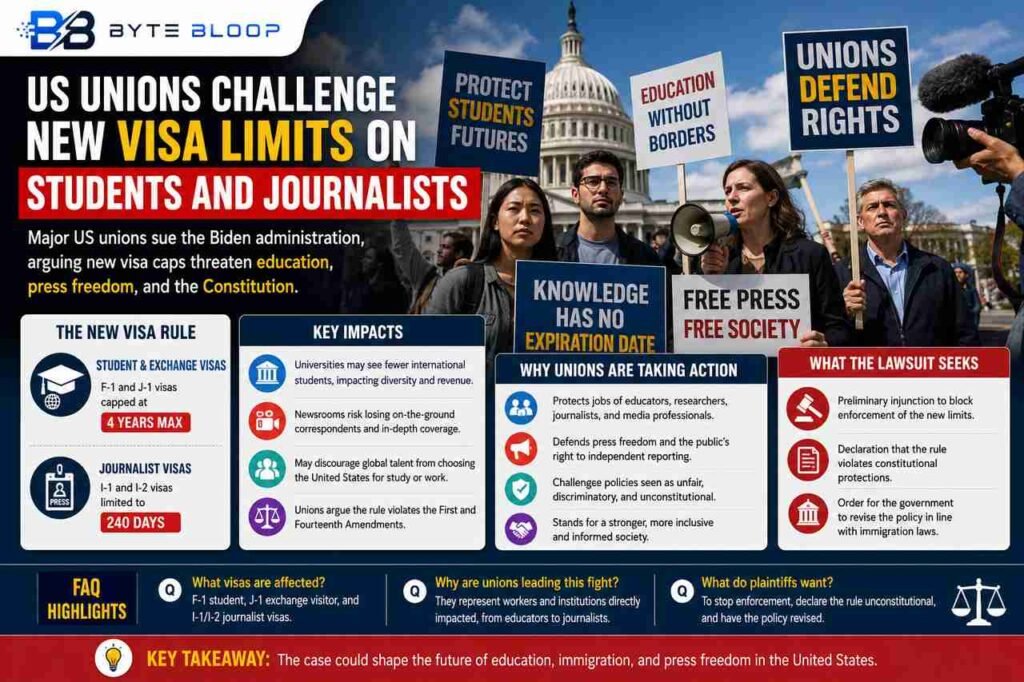
US Unions Challenge New Visa Limits on Students and Journalists
Introduction
The Biden administration announced a sweeping amendment to the United States’ visa policy that will dramatically shorten the stay of foreign students, exchange participants, and journalists. Under the new rule, student and exchange visas are capped at a maximum of four years, while the majority of journalist visas will be limited to just 240 days. In response, a coalition of major labor unions, including the American Federation of Teachers (AFT) and the National Writers Union (NWU), has filed a federal lawsuit claiming the changes violate constitutional protections and undermine both higher‑education institutions and the free press.
Advocates for immigrant rights and press freedom have quickly rallied behind the unions, warning that the rule could deter talented international scholars from enrolling in U.S. universities and cripple the ability of foreign correspondents to cover stories on the ground. The lawsuit, filed in the U.S. District Court for the District of Columbia, seeks an injunction that would halt enforcement of the rule while the courts evaluate its legality.
Background & Historical Context
Visa regulations for students and journalists have long been a point of political contention. The F‑1 student visa, introduced in the 1950s, traditionally allowed scholars to remain in the United States for the duration of their academic program, often extending beyond four years for graduate and doctoral studies. Exchange visitor visas (J‑1) have similarly offered flexible timelines to accommodate research, cultural exchange, and professional training.
Journalist visas, primarily the I‑1 and the more common I‑2, have historically been granted on a case‑by‑case basis, with many recipients staying for up to a year or longer, depending on the nature of their assignment. The new rule, however, imposes a blanket 240‑day limit on most journalist visas, a move critics say is motivated by broader immigration enforcement goals rather than national security concerns.
Key Details & Impact Analysis
The Department of State’s rule, published in the Federal Register last month, states that any student or exchange visitor whose program exceeds four years must either reapply for a new visa or transition to a different immigration status. For journalists, the 240‑day cap applies unless the individual can demonstrate a “critical public interest” that warrants an extension. The administration argues the policy will curb visa overstays and ensure that foreign nationals do not become a permanent labor pool without proper pathways.
Legal experts warn that the rule could have far‑reaching consequences. Universities that rely on international enrollment for both academic diversity and tuition revenue may see a decline in applications, especially for Ph.D. programs that often require five‑year commitments. Meanwhile, newsrooms—particularly those covering international beats—could lose on‑the‑ground correspondents, forcing reliance on freelancers or remote reporting, which may diminish the depth and immediacy of coverage. The unions contend that the rule infringes on the First Amendment by restricting journalists’ ability to gather news, and on the Fourteenth Amendment by creating unequal treatment based on nationality.
Frequently Asked Questions (FAQs)
What specific visa categories are affected by the new rule?
The rule targets F‑1 student visas, J‑1 exchange visitor visas, and most I‑1/I‑2 journalist visas. Student and exchange visas are limited to a maximum of four years, while journalist visas are generally capped at 240 days unless a special exemption is granted.
Why are labor unions filing the lawsuit instead of immigration groups?
Unions represent a broad coalition of educators, journalists, and media workers who directly feel the impact of reduced visa durations. They argue that the rule threatens job security for teachers of English‑as‑a‑Second‑Language programs, research assistants, and newsroom staff who rely on foreign talent. By filing the suit, unions aim to protect both employment conditions and the broader public interest in a well‑educated, informed society.
What relief are the plaintiffs seeking from the court?
The plaintiffs request a preliminary injunction that would suspend enforcement of the four‑year cap and the 240‑day journalist limit while the case proceeds. They also seek a declaratory judgment that the rule violates constitutional protections and an order for the government to revise the policy in line with existing immigration statutes.
Conclusion
The lawsuit filed by U.S. unions marks a pivotal moment in the ongoing debate over immigration policy, educational access, and press freedom. As the case moves through the federal courts, stakeholders from universities, newsrooms, and immigrant advocacy groups will be watching closely. The outcome could reshape how the United States balances security concerns with its long‑standing commitment to attracting global talent and safeguarding a free, independent press.
Source: Al Jazeera
