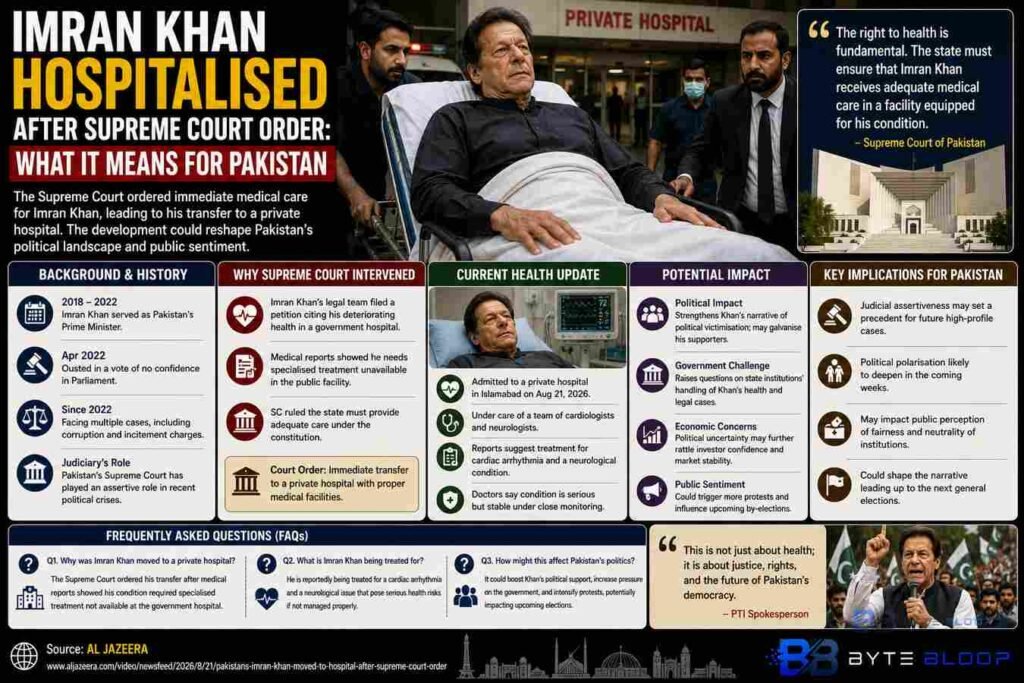
Imran Khan Hospitalised After Supreme Court Order: What It Means for Pakistan
Introduction
Pakistan’s political arena was jolted on Monday when former Prime Minister Imran Khan was moved to a private hospital for urgent medical treatment. The relocation came after the Supreme Court of Pakistan issued a binding order demanding that Khan receive immediate care in a facility equipped to handle his condition. While the former leader’s health has long been a subject of speculation, the court’s intervention adds a new layer of complexity to an already volatile situation.
The episode unfolds against a backdrop of mounting legal battles, ongoing protests, and a fragile coalition government struggling to maintain stability. As the nation watches Khan’s health updates, analysts are scrambling to assess the potential ripple effects on Pakistan’s political dynamics, judicial independence, and public confidence in state institutions.
Background & Historical Context
Imran Khan, a former cricket star turned politician, served as Pakistan’s Prime Minister from 2018 until his ouster in a parliamentary vote of no confidence in April 2022. Since then, he has been at the centre of a series of high‑profile legal confrontations, ranging from corruption charges to accusations of inciting unrest. His supporters claim these cases are politically motivated, while opponents argue they are necessary steps toward accountability.
The Supreme Court’s involvement is not unprecedented. In recent years, the judiciary has played an increasingly assertive role in Pakistan’s power struggles, stepping in to mediate disputes between the military, civilian leadership, and opposition parties. The court’s latest order—mandating Khan’s transfer to a private medical facility—signals a willingness to intervene directly in matters that intersect health, security, and politics.
Key Details & Impact Analysis
According to official statements, Khan’s health deteriorated while he was under the care of a government‑run hospital, prompting his legal team to petition the Supreme Court for a transfer. The court, after reviewing medical reports, ruled that the former prime minister required specialised treatment unavailable at the public facility. Within hours, Khan was escorted to a private hospital in Islamabad, where he is reportedly under the supervision of a team of cardiologists and neurologists.
The move carries several immediate implications. Politically, it strengthens Khan’s narrative of being a victim of state persecution, potentially galvanising his base ahead of upcoming by‑elections. Conversely, the government may view the court’s order as a precedent that could be invoked in future cases involving high‑profile detainees or prisoners, raising concerns about judicial overreach. Economically, the episode adds to investor unease; markets have already reacted to recent political turbulence with a modest dip in the Karachi Stock Exchange.
Frequently Asked Questions (FAQs)
Why did the Supreme Court intervene in Imran Khan’s medical care?
The court acted after Khan’s legal team submitted medical evidence indicating that his condition required specialised treatment not available at the public hospital. The judiciary cited the constitutional right to health and the state’s duty to provide adequate care, especially for a former head of government.
What condition is Imran Khan being treated for?
While exact details remain confidential, sources close to his medical team suggest he is undergoing treatment for a cardiac arrhythmia and a neurological issue that together pose a serious health risk if not managed promptly.
How might this development affect Pakistan’s upcoming elections?
Khan’s supporters are likely to use the hospitalisation as evidence of political victimisation, potentially boosting voter sympathy. The ruling coalition, however, may face criticism for perceived negligence, which could erode its already thin support base. Analysts warn that the situation could intensify protests and further destabilise the electoral environment.
Conclusion
Imran Khan’s transfer to a private hospital under a Supreme Court order underscores the intricate interplay between health, law, and politics in Pakistan. As his condition stabilises, the nation will watch closely to see whether his hospitalisation becomes a rallying point for his political resurgence or a catalyst for further institutional strain. Regardless of the outcome, the episode highlights the judiciary’s growing influence and the fragile balance that defines Pakistan’s democratic trajectory.
Source: Al Jazeera
