Amit Shah Reviews Chicken’s Neck Security and Darjeeling Solution in Siliguri
Introduction
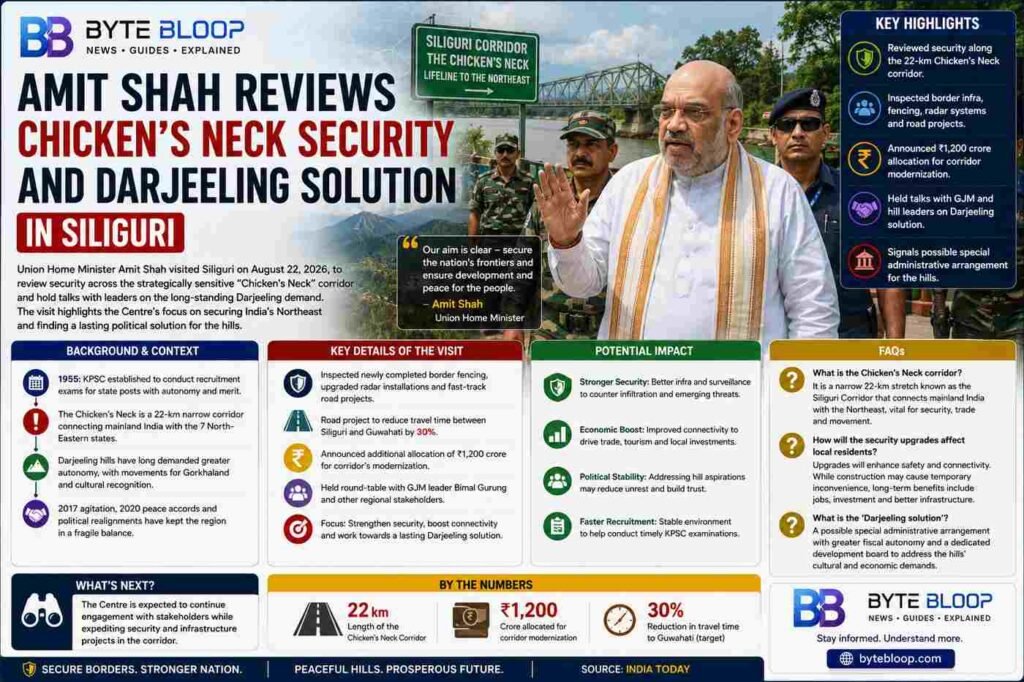
Union Home Minister Amit Shah landed in Siliguri on August 22, 2026, marking a high‑profile trip aimed at tightening security across the strategically sensitive “Chicken’s Neck” corridor and engaging with local leaders on the long‑standing Darjeeling demand. The visit underscores New Delhi’s intent to fortify the narrow land bridge that links mainland India with its northeastern states, while simultaneously seeking a political settlement that could defuse recurring unrest in the hills.
Shah’s itinerary included a comprehensive review of border infrastructure, meetings with senior army and paramilitary officials, and a round‑table with representatives from the Gorkha Janmukti Morcha (GJM) and other regional stakeholders. The dual focus of the mission reflects the government’s broader strategy: secure the nation’s vulnerable frontiers and address the aspirations of a region that has been a flashpoint for political agitation for decades.
Background & Historical Context
The “Chicken’s Neck”—a 22‑kilometre stretch of the Siliguri Corridor—has historically been a logistical chokepoint. It connects the Indian mainland to the seven‑state northeastern region, making it a critical artery for troop movement, trade, and humanitarian aid. Over the past few years, the corridor has faced heightened security concerns, ranging from cross‑border infiltration to infrastructure bottlenecks that hamper rapid deployment of forces.
Parallel to the security narrative, the Darjeeling hills have witnessed a protracted demand for greater autonomy, with various factions oscillating between calls for a separate Gorkhaland state and demands for enhanced cultural and economic concessions within West Bengal. The 2017 Gorkhaland agitation, the 2020 peace accords, and subsequent political realignments have left the region in a fragile equilibrium, making any security initiative inseparable from the political discourse.
Key Details & Impact Analysis
During his Siliguri stop, Shah inspected newly completed border fencing, upgraded radar installations, and a fast‑track road project designed to reduce travel time between Siliguri and Guwahati by 30 per cent. He praised the Indian Army’s “unwavering vigilance” and announced an additional allocation of ₹1,200 crore for the corridor’s modernization, emphasizing the need for “seamless connectivity” in the face of evolving geopolitical threats from neighboring China.
On the political front, Shah engaged in a candid dialogue with GJM leader Bimal Gurung and other hill leaders, signalling the central government’s willingness to explore a “Darjeeling solution” that balances local aspirations with national integrity. While no concrete policy was unveiled, Shah hinted at a possible “special administrative arrangement” that could grant the hills greater fiscal autonomy and a dedicated development board. Analysts predict that such a move could pacify the region, reduce insurgent recruitment, and create a more stable environment for the security upgrades underway.
Frequently Asked Questions (FAQs)
What is the Chicken’s Neck corridor and why is it important?
The Chicken’s Neck, also known as the Siliguri Corridor, is a narrow stretch of land that connects mainland India with its northeastern states. Its strategic importance lies in its role as the primary route for military logistics, trade, and civilian movement, making its security vital for national integrity.
How will the proposed security upgrades affect the local population?
The upgrades—new fencing, radar, and road improvements—aim to enhance safety and reduce illegal infiltration. While construction may cause short‑term disruptions, the long‑term benefits include faster travel, increased investment, and a more secure environment for residents.
What does the “Darjeeling solution” entail?
While details remain under discussion, the solution is expected to involve greater fiscal autonomy, a dedicated development board, and possibly a special administrative status for the hills. The goal is to address cultural and economic grievances without altering state boundaries.
Conclusion
Amit Shah’s Siliguri visit serves as a watershed moment for both security and politics in North‑East India. By bolstering the Chicken’s Neck corridor, the government aims to safeguard a lifeline that is essential for national cohesion. Simultaneously, the overture toward a Darjeeling solution reflects a nuanced understanding that lasting security cannot be achieved without addressing the region’s political aspirations. The coming months will reveal whether these twin strategies can harmonize to deliver stability, development, and peace to a historically volatile frontier.
Source: India Today
