Supreme Court to Hear Challenge on Polygamy Amid Triple Talaq Debate
Introduction
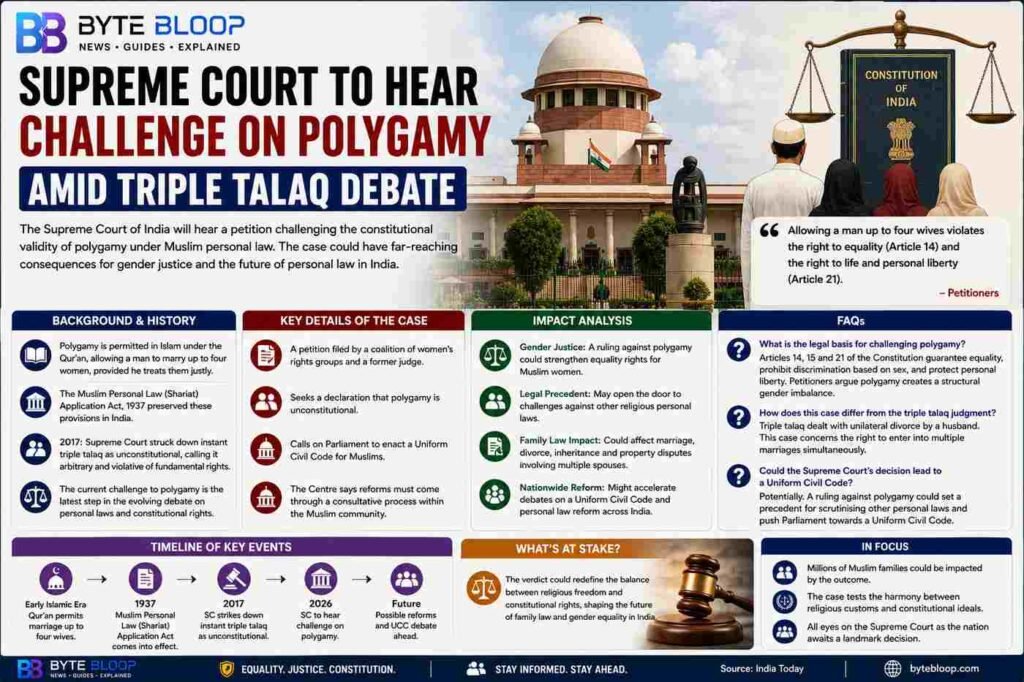
The apex court of India has scheduled a hearing on a petition that questions the constitutional validity of polygamy under Muslim personal law. The move comes just months after the landmark judgment that declared the practice of instant triple talaq unconstitutional. Legal experts, community leaders, and civil‑rights activists are watching closely, as the outcome could redefine the rights and obligations of millions of Muslims across the nation.
At the heart of the petition is a claim that allowing a Muslim man to marry up to four wives violates the right to equality (Article 14) and the right to life and personal liberty (Article 21) guaranteed by the Constitution. The petitioners argue that the practice, rooted in centuries‑old interpretations of the Quran and Sharia, is out of step with contemporary notions of gender justice and the Indian legal framework.
Background & Historical Context
Polygamy has been a feature of Muslim personal law since the time of the early Islamic community, where the Qur’an permits a man to marry up to four women provided he can treat them all justly. In India, the Muslim Personal Law (Shariat) Application Act of 1937 preserved these religious provisions, allowing the practice to continue alongside other personal laws governing marriage, divorce, and inheritance.
The Supreme Court’s 2017 decision on triple talaq marked a turning point, striking down the unilateral practice of instant divorce for being arbitrary and violative of constitutional rights. That verdict sparked a broader conversation about the compatibility of certain religious customs with the nation’s secular constitution. The current challenge to polygamy is the latest chapter in that ongoing dialogue.
Key Details & Impact Analysis
The petition, filed by a coalition of women’s rights groups and a former judge, seeks a declaration that polygamy is unconstitutional and calls for the Parliament to enact a uniform civil code for Muslims. The government, represented by the Centre, has responded that any amendment to personal law must emerge from a consultative process within the Muslim community, emphasizing respect for religious autonomy.
Legal scholars predict that a ruling against polygamy could have far‑reaching implications. First, it would align Muslim personal law with the Uniform Civil Code envisioned in Article 44 of the Constitution, potentially prompting similar challenges to other religious practices. Second, it could affect family law proceedings, property rights, and inheritance disputes that currently hinge on the existence of multiple spouses. Finally, a decision favoring the petition could energize reform movements within other religious communities, accelerating debates on personal law reform across India.
Frequently Asked Questions (FAQs)
What is the legal basis for challenging polygamy in India?
The challenge rests on Articles 14, 15 and 21 of the Indian Constitution, which guarantee equality before the law, prohibit discrimination based on sex, and protect personal liberty. Petitioners argue that allowing a man to have multiple wives creates a structural gender imbalance that contravenes these constitutional guarantees.
How does this case differ from the triple talaq judgment?
While the triple talaq case dealt with the unilateral right of a husband to end a marriage instantly, the polygamy case concerns the right to enter into multiple marriages simultaneously. Both involve Muslim personal law, but the legal questions differ: one focuses on divorce procedures, the other on the very formation of marital relationships.
Could the Supreme Court’s decision lead to a Uniform Civil Code?
Potentially, yes. A ruling that declares polygamy unconstitutional would set a precedent for scrutinising other religious personal laws. It could pressure Parliament to draft a Uniform Civil Code that applies uniformly to all citizens, irrespective of faith, thereby fulfilling a long‑standing constitutional directive.
Conclusion
The Supreme Court’s upcoming hearing on the polygamy challenge is more than a legal contest; it is a litmus test for India’s ability to reconcile religious traditions with constitutional ideals of equality and liberty. As the nation awaits the verdict, the case underscores the evolving nature of personal law in a diverse democracy and may pave the way for broader reforms that shape the future of family law in India.
Source: India Today