Post-Quantum Security: Explained
Introduction
Quantum computing is no longer a distant theoretical possibility; it is steadily advancing toward practical, large‑scale machines that can break the cryptographic algorithms underpinning today’s internet. Post‑quantum security refers to cryptographic systems designed to resist attacks from both classical and quantum computers. The shift is urgent because many widely used public‑key schemes—RSA, ECC, and Diffie‑Hellman—are vulnerable to Shor’s algorithm, which can factor large integers or solve discrete logarithms in polynomial time. A quantum‑powered adversary could decrypt HTTPS sessions, compromise digital signatures, and expose sensitive data in seconds. Consequently, industry leaders, governments, and standards bodies are accelerating the development and deployment of quantum‑safe algorithms. NIST’s Post‑Quantum Cryptography (PQC) project is the cornerstone of this effort, selecting candidate algorithms that promise strong security proofs and practical performance. The transition to PQC is not merely a technical upgrade; it demands a holistic strategy that includes key management, protocol redesign, and supply‑chain validation. By understanding the fundamentals of post‑quantum security, organizations can begin to build resilient defenses that will endure in a quantum future.
What Makes Post‑Quantum Algorithms Different?
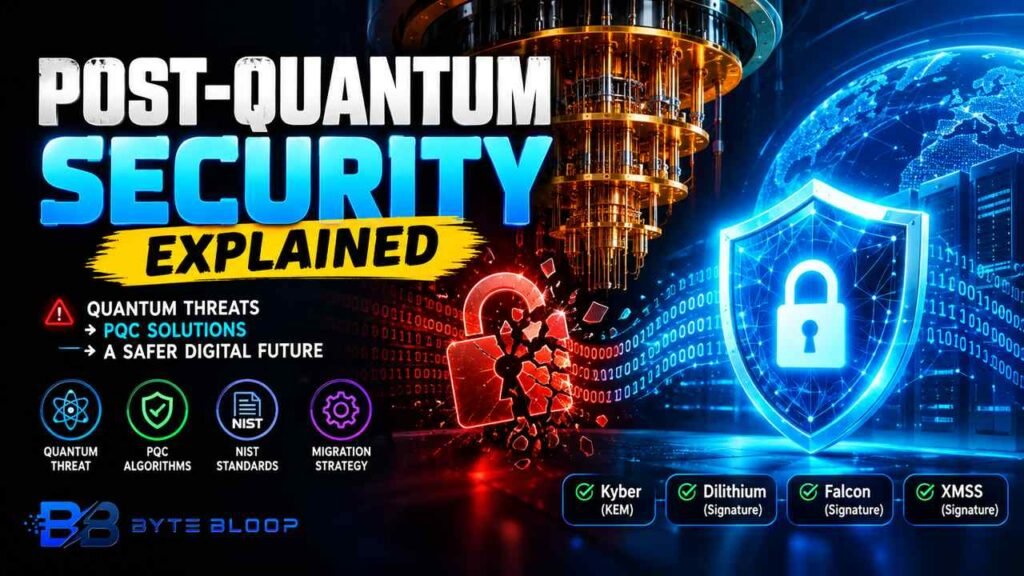
Traditional public‑key schemes rely on mathematical problems—factoring or discrete logarithms—that are hard for classical computers but easy for quantum machines. Post‑quantum algorithms pivot to problems believed to remain hard even for quantum processors. These include lattice‑based, hash‑based, code‑based, multivariate, and supersingular isogeny cryptography. Lattice‑based schemes, such as Kyber and Dilithium, have become leading candidates because they offer efficient key sizes and operations while providing strong security proofs against known quantum attacks. Hash‑based signatures, like XMSS, provide forward‑secrecy and are attractive for low‑resource devices. Code‑based systems, exemplified by Classic McEliece, offer large key sizes but are resistant to quantum attacks due to the hardness of decoding random linear codes.
How the NIST PQC Process Works
Since 2016, NIST has run a multi‑round competition to evaluate and standardize PQC algorithms. The process involves public submissions, rigorous cryptanalysis, and performance testing on diverse hardware. According to the NIST PQC project, the first round of finalists included Kyber for key encapsulation, Dilithium for digital signatures, and Falcon for signature schemes. In 2024, NIST announced the final set of standards, mandating that new cryptographic products adopt these algorithms by 2028. The project also emphasizes crypto‑agility, encouraging developers to design systems that can swap algorithms without major redesigns.
Practical Steps for Organizations
1. Audit Current Cryptography: Identify all systems using RSA, ECC, or other vulnerable algorithms.
2. Plan Migration Paths: Map out where PQC can replace existing primitives, prioritizing high‑risk assets like TLS, VPN, and code signing.
3. Implement Crypto‑Agility: Use libraries that expose algorithm choice at runtime, such as OpenSSL 3.0’s provider model.
4. Validate Supply Chain: Verify that vendors’ PQC implementations meet NIST standards and have undergone independent security reviews.
5. Educate Stakeholders: Train developers, architects, and security teams on PQC concepts and best practices.
Emerging Trends Beyond Encryption
Quantum key distribution (QKD) offers a physical layer solution, leveraging entanglement to detect eavesdropping. While QKD is still limited by distance and infrastructure costs, its integration with PQC could provide layered defense. Additionally, quantum‑safe identity solutions, such as quantum‑resistant password‑based key exchange, are gaining traction. Governments in India and the EU are already drafting regulatory frameworks that require PQC compliance for critical infrastructure. These developments underscore that post‑quantum security is becoming a regulatory as well as a technical imperative.
Key Takeaways
- Quantum computers threaten current public‑key schemes like RSA and ECC.
- NIST’s PQC competition has finalized standards for key encapsulation and digital signatures.
- Migrating to PQC requires audit, planning, crypto‑agility, and supply‑chain validation.
- Lattice‑based algorithms dominate current PQC choices due to performance and security proofs.
- Quantum key distribution offers complementary physical‑layer security but remains nascent.
- Regulatory bodies worldwide are mandating PQC compliance for critical systems.
Frequently Asked Questions
What is post‑quantum security?
Post‑quantum security refers to cryptographic systems designed to remain secure even when quantum computers are available, protecting data against quantum‑powered attacks.
What are the key features of NIST’s PQC standards?
NIST’s PQC standards specify algorithms for key encapsulation and digital signatures that resist quantum attacks, provide strong security proofs, and support efficient implementation across platforms.
What are the best use cases for post‑quantum cryptography?
High‑value assets such as TLS connections, VPNs, code signing, and digital certificates are prime candidates for PQC, as are systems that must guarantee long‑term confidentiality.
What are the pros and cons of adopting PQC?
Pros include future‑proof security and compliance with emerging regulations; cons involve larger key sizes for some algorithms, integration complexity, and the need for crypto‑agility.
Conclusion
Based on the available information and industry analysis, post‑quantum security provides a robust framework to safeguard digital assets against the imminent threat of quantum computing. By adopting NIST‑standardized algorithms, organizations can ensure long‑term confidentiality, integrity, and availability while meeting evolving regulatory mandates. The transition, though complex, is essential for maintaining trust in the digital infrastructure of tomorrow.
Related Reading
- Quantum Key Distribution Explained
Sources & References
- Post-Quantum Cryptography PQC — NIST’s Post-Quantum Cryptography (PQC) project leads the national and global effort to secure electronic information against the future threat …
- Quantum Security Reference — The essential quantum security concepts — from Shor’s algorithm to PQC migration — explained for CISOs and security leaders.
- 10 Quantum Cybersecurity Trends 2026 – PQC, QKD & Q- … — Discover 10 critical quantum cybersecurity trends 2026: NIST PQC mandates, crypto-agility strategies, QKD expansion, …
- Beyond encryption: post-quantum cryptography and the … — IntroductionThe rapid advancement of quantum computing presents an existential threat to the mathematical foundations of modern internet security.
- What post-quantum means for cybersecurity — ‘Post-quantum’ refers to security technologies that are designed to remain secure, even in the presence of powerful quantum computers.
- Guide to Mastering Data Security in Post-Quantum World — Master data security for the post-quantum era: stop harvest-now attacks with PQC readiness, crypto-agility, and Fortanix assessment + …
- Implementation of Quantum Safe Ecosystem in India — The existing TEC approval framework for quantum-safe products will continue until the new infrastructure and processes are operational. • …
- Post-Quantum Cryptography: What It Is and How It Works — Learn what post-quantum cryptography is, how it works, and why it’s essential to secure data against future quantum computing threats.