AI Ethics: Explained
Introduction (Ai Ethics Explained)
Ai Ethics Explained is a topic worth understanding well. Artificial intelligence is reshaping industries from healthcare to finance, yet its rapid deployment raises profound ethical questions. At its core, AI ethics seeks to ensure that automated systems respect human rights, preserve dignity, and operate transparently. Key principles—such as fairness, accountability, and environmental stewardship—guide developers in designing trustworthy technology. Practical examples include bias‑mitigated hiring tools, privacy‑preserving data pipelines, and energy‑efficient model training. The stakes are high: unchecked algorithms can reinforce discrimination, erode privacy, and exacerbate climate impacts.
Consequently, governments, academia, and industry are converging on shared standards to safeguard society. Understanding these frameworks is essential for anyone building or deploying AI today. This article breaks down the foundations of AI ethics, highlights real‑world applications, and outlines the future trajectory of regulatory and technical safeguards.
Foundations of AI Ethics
AI ethics is a framework that guides data scientists and researchers to build AI systems in an ethical manner to benefit society as a whole. According to IBM’s Think article, it encompasses values, principles, and techniques that align with widely accepted standards of right and wrong. The UNESCO recommendation emphasizes respect for human rights and dignity, while also stressing transparency, fairness, and environmental responsibility. These principles form the bedrock of responsible AI design.
Key Ethical Principles
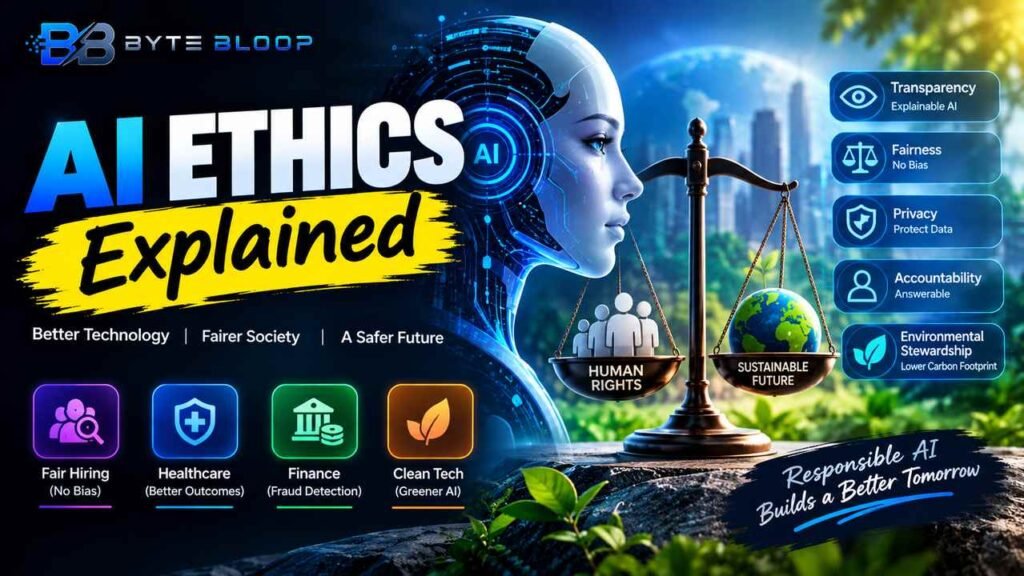
- Transparency: Systems should be explainable so users understand how decisions are made.
- Fairness: Algorithms must avoid bias that could discriminate against protected groups.
- Privacy: Data collection and usage should protect individual confidentiality.
- Accountability: Developers and deployers must be answerable for AI outcomes.
- Environmental Stewardship: AI training and inference should minimize carbon footprints.
Practical Applications
In hiring, AI tools that screen resumes can be tuned to eliminate gender or ethnicity bias, as demonstrated in several case studies reviewed by Coursera. In healthcare, predictive models that flag high‑risk patients must be transparent to clinicians, ensuring trust and compliance with regulations. Financial institutions use AI for fraud detection while safeguarding consumer data through privacy‑preserving techniques like differential privacy, a practice highlighted by Turing Institute guidance.
This matters directly for anyone exploring ai ethics explained.
Regulatory Landscape
Governments worldwide are drafting AI regulations that embed these ethical principles. The European Union’s AI Act proposes a risk‑based framework, while the United States is exploring federal standards through the National AI Initiative. These efforts aim to create a global baseline for ethical AI deployment, as discussed in Gisma’s blog on navigating challenges and opportunities.
Getting ai ethics explained right can make a real difference.
Future Directions
By 2030, engineers will need to understand AI ethics deeply, as the industry anticipates stricter regulations and higher public scrutiny. Interdisciplinary collaboration—combining computer science, law, sociology, and environmental science—will be crucial to develop robust safeguards. Research by NK Corrêa and colleagues reviews 200 global guidelines, underscoring the growing consensus on reliability, safety, and trustworthiness.
That is a core part of understanding ai ethics explained.
Key Takeaways
- AI ethics centers on transparency, fairness, privacy, accountability, and environmental responsibility.
- Regulatory frameworks are emerging worldwide to enforce these principles.
- Responsible design reduces bias, protects privacy, and mitigates climate impact.
- Engineers must integrate ethical thinking early in the development cycle.
- Interdisciplinary collaboration is key to future AI governance.
Frequently Asked Questions
What is AI ethics?
AI ethics is a framework that guides the design and deployment of artificial intelligence systems to ensure they respect human rights, maintain fairness, protect privacy, and operate transparently.
Many readers look into ai ethics explained for exactly this reason.
What are the key features of AI ethics?
The core features include transparency, fairness, privacy protection, accountability, and environmental stewardship, all aimed at building trustworthy AI.
It is worth revisiting ai ethics explained as things develop.
What are the best use cases for AI ethics?
Use cases span hiring tools that eliminate bias, healthcare diagnostics that explain decisions, and financial fraud detection that safeguards consumer data while reducing carbon footprints.
Ai Ethics Explained remains highly relevant here.
What are the pros and cons of implementing AI ethics?
Pros include increased public trust, reduced legal risk, and better societal outcomes. Cons can be higher development costs, slower deployment, and the challenge of defining universal standards.
Conclusion
Based on the available information and industry analysis, AI ethics provides a structured approach to designing and deploying intelligent systems that respect human rights, promote fairness, and minimize environmental impact. By embedding transparency, accountability, and interdisciplinary collaboration into every stage of AI development, stakeholders can ensure that emerging technologies serve society responsibly and sustainably.
Related Reading
- The Role of AI in Climate Change Mitigation
Sources & References
- Recommendation on the Ethics of Artificial Intelligence – AI
- AI Ethics: What It Is and Why It Matters
- Understanding artificial intelligence ethics and safety
- What is AI Ethics?
- AI Ethics: Why Every Engineer Will Need It by 2030
Related Articles