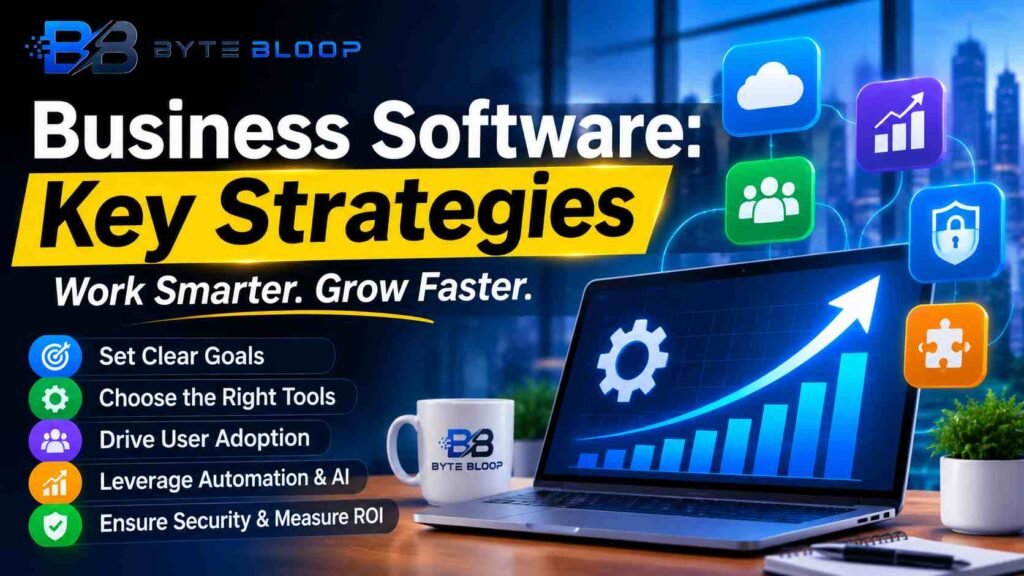
Business Software: Key Strategies
Introduction (Business Software Key Strategies)
Business Software Key Strategies is a topic worth understanding well. In today’s fast‑moving marketplace, the right business software can be the difference between stagnation and sustainable growth. Companies that align technology with strategic goals not only streamline operations but also unlock new revenue streams and competitive advantages. Selecting the proper tools, integrating them seamlessly, and continuously refining usage are essential steps that many firms overlook. This article explores the core strategies for mastering business software, from needs assessment to post‑deployment optimization, and illustrates each with real‑world examples.
1. Define Clear Business Objectives
Before any software purchase, leaders must articulate specific objectives—whether it’s reducing cost per transaction, improving customer satisfaction, or accelerating product time‑to‑market. According to the Create Digital IT Strategy for Business guide, aligning technology with business goals drives transformation and yields lasting competitive advantage.
2. Conduct a Comprehensive Needs Assessment
Identify pain points across departments: finance, sales, inventory, and HR. Map out required functionalities and prioritize them. For instance, a retail chain may need real‑time inventory tracking, while a SaaS provider focuses on robust CRM and subscription billing.
This matters directly for anyone exploring business software key strategies.
3. Evaluate Software Ecosystems, Not Just Features
Modern businesses thrive on integrated ecosystems. The Top 5 Best Comprehensive Business Software Solutions article highlights the importance of selecting platforms that offer modular add‑ons and API connectivity, reducing data silos and manual work. Odoo, cited in the Best Business Management Software in 2026 video, exemplifies a unified suite that scales from small startups to multinational enterprises.
Getting business software key strategies right can make a real difference.
4. Prioritize User Adoption and Change Management
Even the most sophisticated tools fail if users resist. Implement training programs, create champions within each department, and provide ongoing support. The Ultimate Guide to Business Management stresses that effective project management and clear communication are critical for smooth transitions.
That is a core part of understanding business software key strategies.
5. Leverage Automation, Analytics, and AI
Automation reduces repetitive tasks, while analytics turn data into actionable insights. The Business Transformation Strategy Guide for Success in 2026 emphasizes cloud computing and artificial intelligence as pillars for future‑proofing operations. Generative AI, noted in the 16 Business Trends for 2026 article, can accelerate content creation, predictive maintenance, and personalized customer interactions.
Many readers look into business software key strategies for exactly this reason.
6. Adopt a Subscription‑Based Pricing Model
Subscription models provide predictable revenue and lower upfront costs, aligning with the subscription‑based pricing trend identified in the 2026 business trends report. They also enable continuous updates and feature rollouts, keeping software competitive.
It is worth revisiting business software key strategies as things develop.
7. Implement Robust Security and Compliance Measures
Data breaches can cripple a company. Ensure that chosen solutions comply with industry regulations (GDPR, HIPAA, PCI‑DSS) and incorporate multi‑factor authentication, encryption, and regular security audits.
Business Software Key Strategies remains highly relevant here.
8. Measure ROI and Iterate
Set KPIs such as cost savings per employee, cycle time reduction, or customer churn rate. Use these metrics to refine processes, retire underperforming modules, or invest in new capabilities. Continuous improvement turns software from a cost center into a strategic asset.
Key Takeaways
- Align software choices with clear business goals
- Prioritize integrated ecosystems over isolated tools
- Invest in user training and change management
- Leverage automation, analytics, and AI for competitive edge
- Adopt subscription models for scalability and continuous improvement
Frequently Asked Questions
What is the first step in selecting business software?
Identify and articulate specific business objectives that the software must support.
What are the key features to look for in a comprehensive business software suite?
Modularity, API connectivity, real‑time data integration, and scalability across departments.
What are the best use cases for subscription‑based business software?
Startups and growing companies that need predictable costs and continuous updates.
What are the pros and cons of adopting AI in business software?
Pros include faster decision‑making and personalized customer experiences; cons involve data privacy concerns and the need for skilled staff to manage AI tools.
Conclusion
Based on the available information and industry analysis, a strategic approach to business software—rooted in clear objectives, integrated ecosystems, and continuous optimization—transforms technology from a cost center into a growth engine, empowering organizations to adapt swiftly to market shifts and emerging trends.
Related Reading
- Maximizing ROI with Cloud‑Based ERP Solutions
Sources & References
- Create Digital IT Strategy for Business – Complete Guide …
- Top 5 Best Comprehensive Business Software Solutions …
- Business Management Software: Complete Guide for …
Related Articles