DMK Intensifies Critique of Mekedatu as Karnataka Vows Water‑Sharing Support
Introduction
In a dramatic turn of inter‑state politics, the ruling Dravida Munnetra Kazhagam (DMK) in Tamil Nadu has amplified its attack on Karnataka’s controversial Mekedatu water‑diversion project. The party alleges that the project threatens the equitable distribution of the Cauvery River’s waters, a long‑standing flashpoint between the two states. While the DMK ramps up its rhetoric, Karnataka’s government has issued a conciliatory statement, promising to honor existing water‑sharing agreements and to cooperate with Tamil Nadu on future allocations.
The Mekedatu project, envisioned to divert water from the Cauvery to Bengaluru and surrounding regions, has sparked protests, legal battles, and diplomatic tussles for years. The latest statements from both sides underscore how deeply water security has become entwined with regional politics, electoral calculations, and the livelihoods of millions.
Background & Historical Context
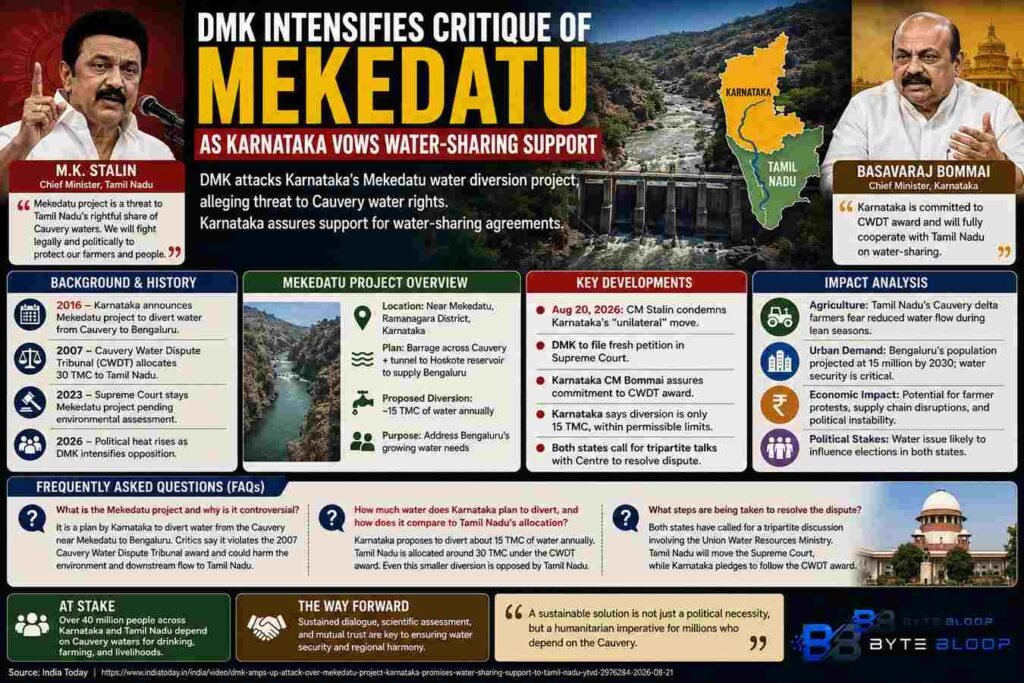
Karnataka’s Mekedatu initiative was first announced in 2016 as a solution to the capital’s chronic water shortage. The plan involves constructing a barrage near the village of Mekedatu, followed by a tunnel that would channel water to a reservoir at Hoskote, ultimately feeding Bengaluru’s supply network. Proponents argue that the project is essential for the city’s growth, while opponents claim it violates the 2007 Cauvery Water Dispute Tribunal (CWDT) award, which allocates a fixed share of the river to Tamil Nadu.
The dispute escalated in 2023 when the Supreme Court stayed the project’s construction pending a detailed environmental impact assessment. Tamil Nadu’s DMK, now in power at the state level, has leveraged the issue to rally public sentiment, portraying the Mekedatu scheme as an encroachment on the state’s rightful water entitlement. The political backdrop is further complicated by the upcoming state elections, where water politics often become a decisive factor.
Key Details & Impact Analysis
During a press conference on August 20, 2026, DMK leader and Chief Minister M.K. Stalin condemned Karnataka’s “unilateral” actions, accusing the neighboring state of ignoring the CWDT verdict and the Supreme Court’s stay order. Stalin emphasized that any diversion of Cauvery water without Tamil Nadu’s consent would exacerbate agrarian distress in the delta region, where farmers already grapple with erratic monsoons and dwindling groundwater levels. The DMK also announced plans to file a fresh petition in the Supreme Court, seeking a comprehensive review of the project’s legality.
Karnataka’s Chief Minister Basavaraj Bommai responded the following day, assuring that Karnataka remains committed to the CWDT award and will cooperate with Tamil Nadu on water‑sharing mechanisms. Bommai highlighted that the Mekedatu project, as currently designed, would divert only a modest volume of water—approximately 15 TMC (thousand million cubic feet) annually—far below the 30 TMC allocated to Tamil Nadu under the tribunal’s order. He urged the central government to facilitate a tripartite dialogue involving the Union Water Resources Ministry, Karnataka, and Tamil Nadu to resolve the impasse.
The economic implications are significant. Bengaluru’s burgeoning tech industry and its projected population of 15 million by 2030 demand reliable water supplies. Conversely, Tamil Nadu’s Cauvery delta, home to over 10 million people, relies heavily on river water for rice cultivation and drinking water. Any perceived imbalance could trigger large‑scale farmer protests, disrupt supply chains, and influence voter sentiment in both states.
Frequently Asked Questions (FAQs)
What is the Mekedatu project and why is it controversial?
The Mekedatu project aims to divert water from the Cauvery River near the village of Mekedatu to Bengaluru via a tunnel and reservoir system. Controversy stems from concerns that the diversion violates the 2007 Cauvery Water Dispute Tribunal award, which grants Tamil Nadu a larger share of the river, and from environmental worries about ecosystem disruption.
How much water does Karnataka plan to divert, and how does it compare to Tamil Nadu’s allocation?
Karnataka’s current design proposes diverting roughly 15 TMC of water per year. Under the CWDT award, Tamil Nadu is entitled to about 30 TMC annually. Critics argue that even this smaller diversion could affect downstream flow during lean seasons, while Karnataka maintains the volume is within permissible limits.
What steps are being taken to resolve the dispute?
Both state governments have called for a tripartite discussion involving the Union Water Resources Ministry. Tamil Nadu’s DMK is preparing a Supreme Court petition, whereas Karnataka has pledged to adhere to the CWDT award and to conduct a thorough environmental impact assessment before proceeding.
Conclusion
The Mekedatu saga epitomizes the delicate balance between developmental aspirations and inter‑state water rights in India. As the DMK sharpens its political offensive and Karnataka extends an olive branch, the outcome will hinge on legal interpretations, environmental safeguards, and the willingness of both states to engage in constructive dialogue. With millions depending on the Cauvery for survival and growth, a sustainable, mutually agreeable solution is not just a political necessity but a humanitarian imperative.
Source: India Today
