Punjab Bandh Calls for Bandi Singh’s Release: Transport and Markets Brace for Disruption
Introduction
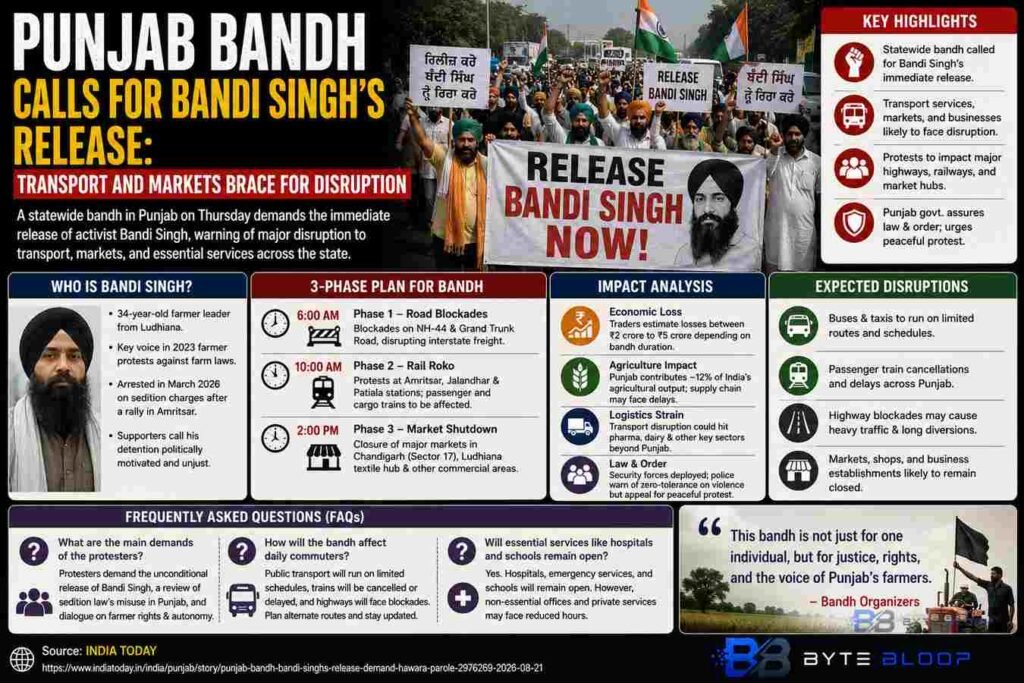
On Thursday, a coalition of farmer unions, student groups, and local political outfits announced a statewide bandh in Punjab to demand the immediate release of Bandi Singh, a prominent activist currently detained on charges of sedition. The organizers warned that the shutdown would affect public transport, market operations, and essential services across the state, potentially bringing daily life to a standstill.
State officials have already issued advisories urging citizens to avoid non‑essential travel and to stock up on essential supplies. While the Punjab government has pledged to maintain law and order, the scale of the protest—spanning major highways, railway stations, and bustling market districts—has raised concerns about supply chain interruptions and economic losses.
Background & Historical Context
Bandi Singh, a 34‑year‑old farmer leader from Ludhiana, rose to national prominence during the 2023 agrarian protests against the central government’s farm laws. His outspoken criticism of the policies earned him a reputation as a firebrand organizer, and he was subsequently arrested in March 2026 on allegations of inciting violence during a rally in Amritsar. Human rights groups have labeled his detention as politically motivated, arguing that due process was compromised.
The call for a bandh is not unprecedented in Punjab’s recent history. Similar shutdowns have been employed during the 2020 farmer protests and the 2022 anti‑corruption movement, each resulting in significant economic impact but also drawing national attention to local grievances. The current demand for Singh’s release taps into a broader sentiment of perceived governmental overreach, especially among the state’s rural constituencies.
Key Details & Impact Analysis
Organizers have outlined a three‑phase plan for the bandh. Phase one, beginning at 6 a.m., will see road blockades on National Highway 44 and the Grand Trunk Road, disrupting interstate freight. Phase two, at 10 a.m., targets railway stations in Amritsar, Jalandhar, and Patiala, with protesters planning to halt passenger services and delay cargo trains. Phase three, commencing at 2 p.m., focuses on market closures in major commercial hubs such as Chandigarh’s Sector 17 market and Ludhiana’s textile district. Traders have reported potential losses ranging from ₹2 crore to ₹5 crore, depending on the duration of the shutdown.
Economists warn that the cumulative effect could ripple beyond Punjab’s borders. The state contributes roughly 12 % of India’s agricultural output, and any interruption in the transport of wheat, rice, and dairy products could affect national food‑grain pricing. Moreover, the shutdown threatens to strain the already‑tight logistics network that supports the burgeoning pharmaceutical sector in Mohali. Security forces have been deployed at key junctions, and the Punjab Police have announced a “zero‑tolerance” stance toward any acts of violence, while simultaneously urging demonstrators to keep the protest peaceful.
Frequently Asked Questions (FAQs)
What are the main demands of the protesters?
The core demand is the unconditional release of Bandi Singh, whom the protestors claim is being held without a fair trial. They also seek a review of the sedition law’s application in Punjab and a broader dialogue on farmer rights and state autonomy.
How will the bandh affect daily commuters?
Public buses, state‑run transport, and private taxis are expected to operate on a limited schedule. Major railway stations will see cancellations of passenger trains, and road traffic on highways will be heavily restricted. Commuters are advised to use alternative routes, consider remote work where possible, and stay updated via official transport department alerts.
Will essential services like hospitals and schools remain open?
Essential services, including hospitals, emergency medical facilities, and schools, have been instructed to stay operational. However, ancillary services such as canteens, private clinics, and non‑essential government offices may experience reduced hours or temporary closures.
Conclusion
The impending Punjab bandh underscores the volatile intersection of regional politics, farmer activism, and legal controversies surrounding Bandi Singh’s detention. While authorities aim to preserve order and minimize economic fallout, the protest’s scale suggests a deepening rift between the state’s populace and the central government’s policies. As the day unfolds, the true impact on transport, markets, and public sentiment will become clearer, potentially shaping the political narrative in Punjab for months to come.
Source: India Today