Ranchi Student Protests Ignite Over Exam Fraud Scandal
Introduction
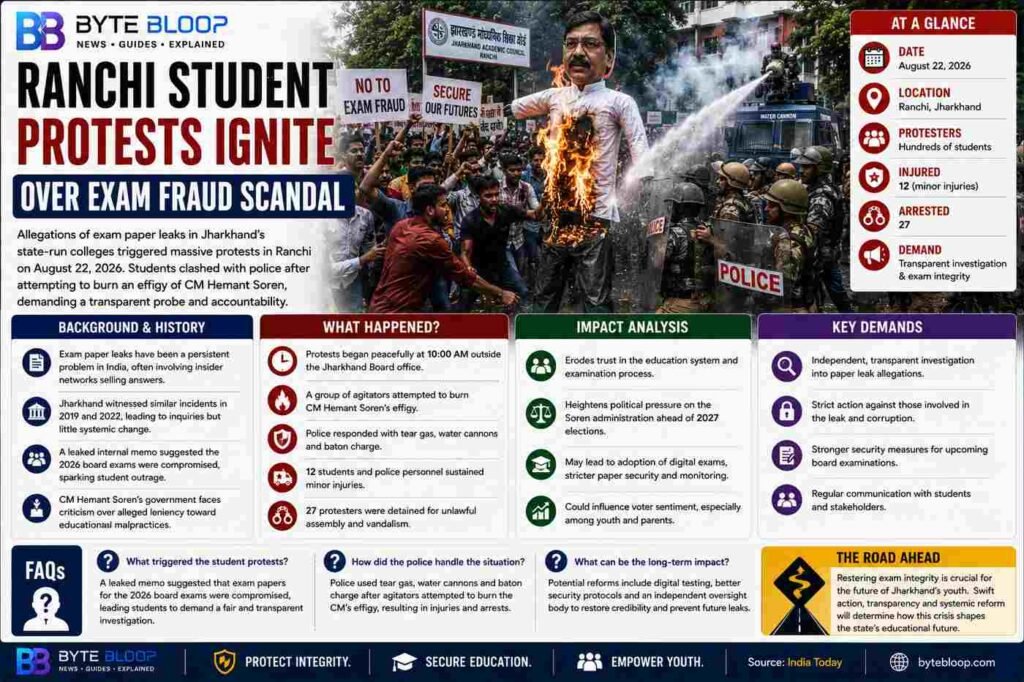
On August 22, 2026, a volatile student demonstration erupted in Ranchi, the capital of Jharkhand, after allegations surfaced that exam papers for several state-run colleges had been illegally leaked. The protest quickly turned confrontational, with demonstrators attempting to set fire to an effigy of Chief Minister Hemant Soren, prompting a heavy police response. The incident underscores growing anxiety among youth about the credibility of the education system and the perceived impunity of those behind the alleged fraud.
Video footage captured by local media shows hundreds of students gathering outside the Jharkhand Board of Secondary Education office, chanting slogans, and demanding a transparent investigation. As tensions rose, police deployed tear gas and water cannons, leading to a series of clashes that left several injured and dozens arrested.
Background & Historical Context
Exam paper leaks have plagued Indian states for years, often linked to corrupt networks of insiders who sell answers to the highest bidders. In Jharkhand, previous incidents in 2019 and 2022 triggered statewide inquiries, yet many observers argue that systemic loopholes remain unaddressed. The current uproar follows a leaked internal memo that suggested the upcoming 2026 board examinations were compromised, prompting students to preemptively organize a protest.
The political climate adds another layer of complexity. Chief Minister Hemant Soren, a member of the Jharkhand Mukti Morcha (JMM), has faced criticism for alleged leniency toward educational malpractices. Opposition parties have seized the moment, accusing the government of turning a blind eye to corruption that jeopardizes the futures of thousands of students.
Key Details & Impact Analysis
According to eyewitness accounts, the protest began peacefully at 10:00 AM, with students holding placards that read “No to Exam Fraud” and “Secure Our Futures.” Within an hour, a faction of agitators attempted to set ablaze a life‑size effigy of CM Soren, a symbolic act that escalated police intervention. Riot police arrived in full gear, firing tear‑gas shells and using batons to disperse the crowd. Local hospitals reported treating 12 individuals for minor injuries, while the police announced the detention of 27 protesters for unlawful assembly.
The fallout from the clash is likely to reverberate across the state’s education sector. Parents and student bodies have demanded an independent probe, fearing that the alleged leak could invalidate the upcoming board results. If the accusations hold merit, the scandal could trigger a re‑evaluation of examination security protocols, potentially leading to the adoption of digital testing platforms and stricter monitoring of paper handling. Politically, the incident puts pressure on the Soren administration to demonstrate decisive action, lest it lose credibility ahead of the upcoming state elections slated for early 2027.
Frequently Asked Questions (FAQs)
What triggered the student protests in Ranchi?
The protests were sparked by a leaked internal memo suggesting that exam papers for the Jharkhand Board of Secondary Education were compromised. Students feared that the leak would affect the fairness of the upcoming examinations, prompting them to demand a transparent investigation.
How did the police respond to the attempt to burn the CM’s effigy?
Police deployed tear‑gas canisters, water cannons, and riot squads to disperse the crowd. The crackdown resulted in 12 minor injuries and the arrest of 27 individuals for unlawful assembly and vandalism.
What are the possible consequences for the education system?
If the fraud allegations are confirmed, Jharkhand may overhaul its examination processes, potentially shifting toward digital testing, tightening paper security, and establishing an independent oversight committee. The scandal could also influence voter sentiment in the upcoming 2027 state elections.
Conclusion
The Ranchi clashes serve as a stark reminder that academic integrity remains a fragile pillar in India’s education landscape. As students continue to demand accountability, the government’s response will be closely watched by both the electorate and educational stakeholders. A swift, transparent investigation could restore confidence, while failure to act may deepen distrust and fuel further unrest across the state.
Source: India Today
