Pune Police Regulate Chhatro Ki Goonj Amid BJP’s Allegations of Paid Influencers
Introduction
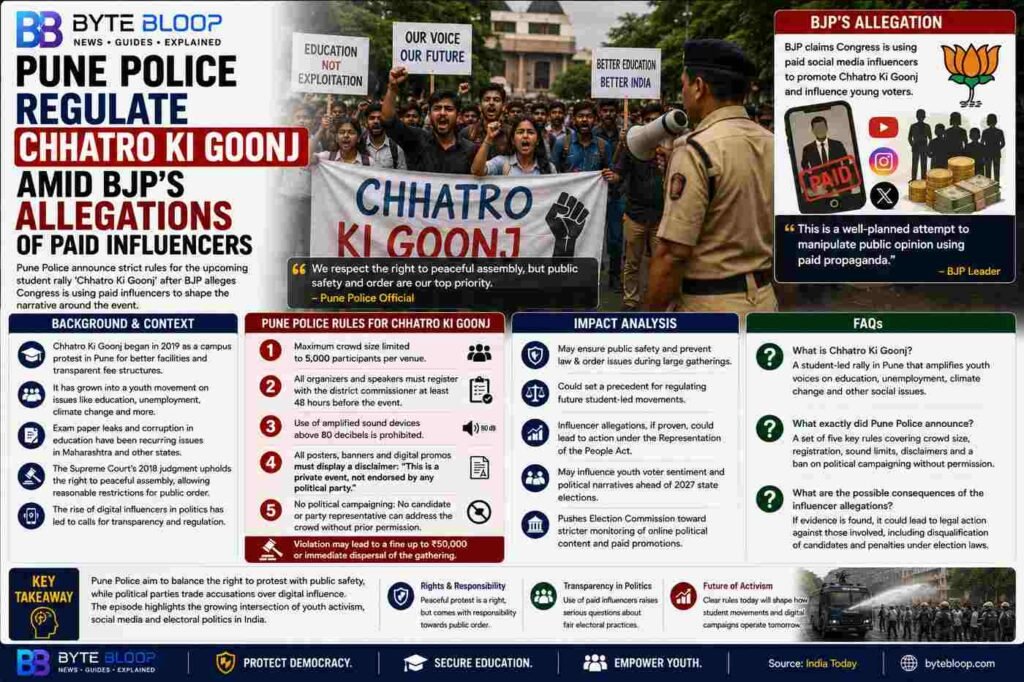
In a surprising turn of events, the Pune Police Department announced a set of detailed rules governing the upcoming student rally, Chhatro Ki Goonj, scheduled for later this month. The announcement came just hours after the Bharatiya Janata Party (BJP) publicly accused the Indian National Congress of employing paid social media influencers to shape the narrative around the event. The clash between law‑enforcement directives and political accusations has ignited a heated debate on the limits of free expression, electoral campaigning, and the role of digital influencers in Indian politics.
Both the police and the BJP have framed their statements as protective measures for public safety and democratic integrity. While the police claim the rules are designed to prevent crowd‑control issues and ensure a peaceful demonstration, the BJP argues that the Congress’s alleged use of influencers is an attempt to manipulate voter sentiment ahead of the upcoming state elections. This article delves into the background, the specifics of the police guidelines, and the potential impact on the political landscape.
Background & Historical Context
Chhatro Ki Goonj, which translates to “Echo of Students,” began as a modest campus protest in 2019, demanding better infrastructure and transparent fee structures in Pune’s higher‑education institutions. Over the past few years, the rally has evolved into a broader platform for youth voices on national issues, ranging from unemployment to climate change. Its growing popularity has attracted the attention of major political parties, each seeking to align themselves with the youthful energy the movement represents.
Historically, Indian police forces have intervened in large public gatherings, especially when political overtones are evident. The Supreme Court’s 2018 judgment on the right to peaceful assembly set clear parameters: authorities may impose reasonable restrictions for public order, but they cannot stifle legitimate expression. In recent years, the rise of digital campaigning has added a new layer of complexity, with parties increasingly turning to social media influencers to amplify their messages. This trend has prompted calls for clearer regulations, a conversation that now surfaces in Pune’s latest controversy.
Key Details & Impact Analysis
The Pune Police’s rulebook for Chhatro Ki Goonj includes five core provisions: (1) a maximum crowd size of 5,000 participants per venue, (2) mandatory registration of all speakers and organizers with the district commissioner at least 48 hours before the event, (3) a ban on amplified sound devices exceeding 80 decibels, (4) a requirement that all promotional material display a clear disclaimer stating “This is a private event, not endorsed by any political party,” and (5) a strict no‑political‑campaigning clause that prohibits any candidate or party official from addressing the crowd without prior permission. Violations could result in fines up to INR 50,000 or immediate dispersal of the gathering.
The BJP’s allegation adds a political twist. Party leaders released a video claiming that several popular YouTubers and Instagram personalities were paid by the Congress to post supportive content about Chhatro Ki Goonj, thereby influencing young voters. While the Congress has denied the accusations, demanding evidence, the BJP insists that the influencers’ posts are part of a coordinated “paid propaganda” campaign. If proven true, the allegations could trigger an investigation under the Representation of the People Act, which prohibits paid advocacy during election periods.
Analysts suggest that the police guidelines could set a precedent for future student-led movements, potentially curbing spontaneous activism but also ensuring safety. On the political front, the controversy may force parties to re‑evaluate their digital strategies, especially as the Election Commission moves toward stricter monitoring of online political content. The outcome could reshape how Indian politics engages with the influencer economy, balancing freedom of speech with the need for transparency.
Frequently Asked Questions (FAQs)
What are the main restrictions imposed by Pune police for Chhatro Ki Goonj?
The police have limited crowd size to 5,000, required pre‑registration of organizers, capped sound levels, mandated disclaimer notices on all promotional material, and banned any direct political campaigning without prior clearance.
Has any evidence been presented to support BJP’s claim that Congress paid influencers?
As of now, the BJP has released only a short video montage of influencer posts. No official financial documents or contracts have been made public, and the Congress has demanded a transparent investigation before any conclusions are drawn.
How could these developments affect upcoming state elections in Maharashtra?
If the influencer allegations are substantiated, the Election Commission could file disqualification petitions against involved candidates. Even without formal penalties, the controversy may sway undecided youth voters, making the issue a potential flashpoint in the election narrative.
Conclusion
The Pune Police’s new regulations for Chhatro Ki Goonj and the BJP’s accusations against the Congress highlight a growing intersection of public protest, digital influence, and electoral politics in India. While the police aim to maintain order and protect democratic rights, political parties are scrambling to control the narrative in an increasingly online‑driven arena. How authorities, influencers, and voters navigate this complex terrain will likely shape not only the outcome of the Chhatro Ki Goonj rally but also the broader conduct of political campaigning in the country’s next election cycle.
Source: India Today