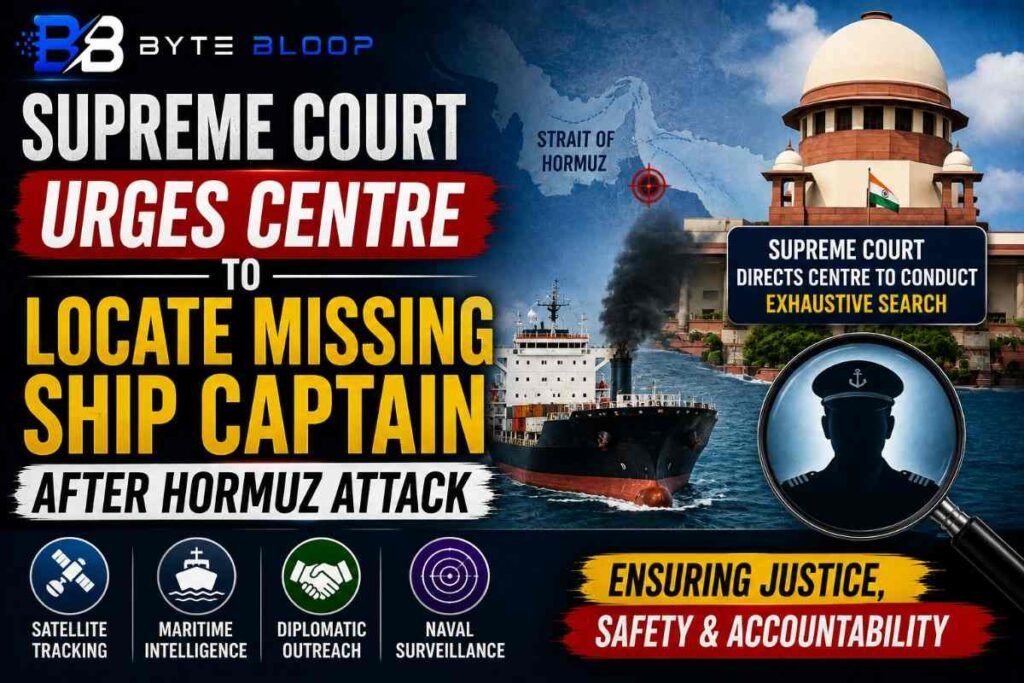
Supreme Court Urges Centre to Locate Missing Ship Captain After Hormuz Attack
Introduction
In a decisive step that highlights the judiciary’s growing involvement in maritime security, India’s Supreme Court has asked the central government to launch an exhaustive search for the captain of a merchant vessel that went missing after a suspected attack in the Strait of Hormuz in March. The court’s intervention comes amid heightened tensions in the region, where geopolitical rivalries and piracy threats have surged, putting global trade routes at risk.
The missing captain, whose identity has been kept confidential for security reasons, was aboard a cargo ship that reported an explosion and subsequent loss of communication while transiting the narrow waterway. While the vessel itself was later recovered, the captain remains unaccounted for, prompting families, maritime unions, and human‑rights groups to demand urgent action.
Background & Historical Context
The Strait of Hormuz, a chokepoint that funnels roughly 20% of the world’s petroleum shipments, has long been a flashpoint for naval confrontations. In recent months, a series of unexplained blasts and missile sightings have raised alarms among shipping companies and governments alike. The March incident, which involved a sudden blast that disabled the ship’s navigation systems, is believed to be part of a broader pattern of asymmetric attacks targeting commercial vessels.
India, a major user of the Hormuz route for its oil imports, has historically maintained a diplomatic balance with both Iran and the United States. However, the disappearance of a senior seafarer has shifted the narrative from a purely commercial concern to a humanitarian and legal one, compelling the Supreme Court to intervene under its constitutional mandate to protect the right to life and personal liberty.
Key Details & Impact Analysis
According to court documents, the Supreme Court has instructed the Ministry of Shipping, the Ministry of External Affairs, and the Indian Navy to coordinate a joint task force. This task force is expected to employ satellite tracking, maritime intelligence, and diplomatic channels to locate the missing captain. The court also emphasized the need for transparent reporting to the captain’s family and the broader maritime community.
The implications of this directive are far‑reaching. First, it signals a robust judicial stance that could set a precedent for future cases involving maritime casualties. Second, it may pressure the government to strengthen its maritime surveillance infrastructure, including the deployment of unmanned aerial vehicles (UAVs) and enhanced Automatic Identification System (AIS) monitoring. Finally, the move could influence international cooperation, prompting neighboring states and global powers to share intelligence on threats in the Hormuz corridor.
Frequently Asked Questions (FAQs)
What exactly happened to the ship and its captain in March?
The vessel was sailing through the Strait of Hormuz when an unexplained explosion damaged its communication equipment. While the ship managed to reach a nearby port under emergency protocols, the captain was reported missing after the incident, and no confirmed sighting has been recorded since.
Why is the Supreme Court involved in a maritime incident?
The Supreme Court invoked its constitutional responsibility to safeguard the right to life, which extends to citizens stranded at sea. By ordering a coordinated search, the court aims to ensure that the government fulfills its duty to protect Indian nationals and uphold international maritime obligations.
How will the government conduct the search?
The court directed a multi‑agency task force comprising the Ministry of Shipping, the Ministry of External Affairs, the Indian Navy, and intelligence agencies. The task force will use satellite imagery, AIS data, naval patrols, and diplomatic outreach to locate the captain and gather evidence about the attack.
Conclusion
The Supreme Court’s directive to trace the missing captain underscores the intersection of law, security, and human rights in today’s volatile maritime environment. As India ramps up its investigative and surveillance capabilities, the case serves as a reminder that the safety of seafarers is not just a commercial issue but a matter of national and international responsibility. The outcome of this search will likely shape future policies on maritime safety, diplomatic engagement, and judicial oversight in the high‑stakes arena of global shipping.
Source: Times Now
