Business Security: Explained
Introduction
Business security is the umbrella term that covers all measures a company takes to protect its data, systems, and people from digital and physical threats. In 2026, cyberattacks have evolved from simple phishing emails to sophisticated ransomware campaigns that can cripple operations overnight. Small and medium enterprises (SMEs) are increasingly targeted because they often lack the resources of larger firms, yet their data can be just as valuable. Understanding the core components of business security—network protection, endpoint defense, data encryption, and human vigilance—is essential for any organization that wants to maintain trust and continuity. Practical examples show that a single weak password can expose an entire supply chain, while a well‑implemented multi‑factor authentication system can block most intrusions. This guide breaks down the key concepts, offers real‑world strategies, and answers common questions to help you build a resilient security posture.
What Is Business Security?
At its simplest, business security is the practice of safeguarding an organization’s assets—information, technology, and personnel—against threats that could disrupt operations or compromise confidentiality. It spans physical security (access control, CCTV), IT security (firewalls, intrusion detection), and human factors (training, policies). The goal is to create a layered defense that deters attackers, detects breaches early, and enables rapid recovery.
Common Threat Landscape in 2026
According to recent industry reports, the most prevalent attacks on businesses today include:
- Phishing and social engineering – deceptive emails that trick employees into revealing credentials.
- Ransomware – malware that locks data until a ransom is paid.
- Supply‑chain attacks – compromising third‑party vendors to infiltrate a target.
- Insider threats – employees or contractors misusing access.
These threats underline the need for a comprehensive security strategy that addresses both technology and people.
Core Pillars of Business Security
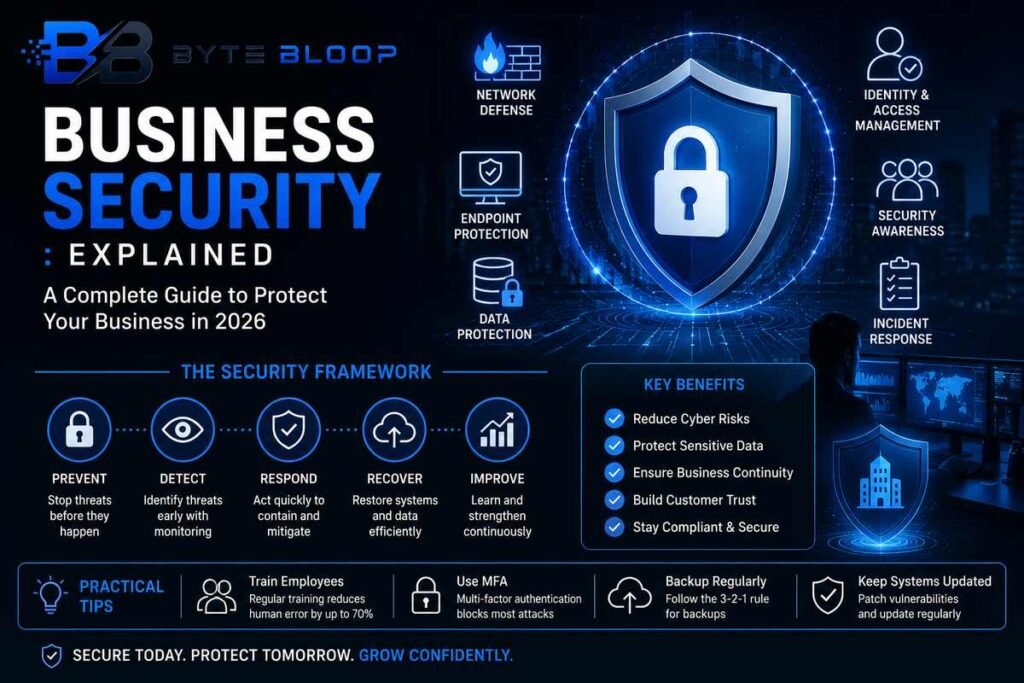
1. Network Defense
Firewalls, segmentation, and secure VPNs form the first line of defense. Implementing a zero‑trust network architecture forces continuous verification of every device and user, reducing the attack surface.
2. Endpoint Protection
All devices—laptops, smartphones, IoT sensors—must run up‑to‑date antivirus and endpoint detection and response (EDR) tools. Regular patching eliminates known vulnerabilities that attackers exploit.
3. Data Protection
Encryption at rest and in transit protects sensitive information from unauthorized access. Regular backups stored offline or in a separate cloud region ensure data can be restored after an incident.
4. Identity & Access Management (IAM)
Strong, unique passwords are a baseline, but multi‑factor authentication (MFA) and role‑based access control (RBAC) add critical layers. Periodic access reviews prevent privilege creep.
5. Security Awareness Training
Employees are often the weakest link. Structured training programs that simulate phishing attempts and teach safe browsing habits can reduce human error by up to 70%.
6. Incident Response Planning
A documented, rehearsed response plan ensures that, when a breach occurs, the organization can contain, investigate, and recover quickly. Regular tabletop exercises test the plan’s effectiveness.
Practical Implementation for SMEs
Small businesses can adopt a phased approach that balances cost and protection:
- Baseline Hygiene – Enable MFA on all accounts, enforce password complexity, and install reputable antivirus software.
- Network Segmentation – Use VLANs or cloud‑based firewalls to isolate critical servers from general office traffic.
- Backup Strategy – Implement the 3‑2‑1 rule: three copies of data, on two media types, with one off‑site.
- Vendor Risk Management – Require security questionnaires and regular penetration testing for third‑party providers.
- Continuous Monitoring – Deploy a security information and event management (SIEM) system that aggregates logs and triggers alerts.
These steps are supported by the 2026 cybersecurity checklist for small businesses, which emphasizes automated monitoring, employee education, and encryption.
Choosing Security Tools Wisely
Tool selection should be guided by risk assessment and integration capability. For example, a unified threat management (UTM) appliance can consolidate firewall, antivirus, and intrusion prevention, simplifying management for teams that lack dedicated security staff. Cloud‑native security services—such as zero‑trust identity platforms—offer scalability and reduce on‑premises overhead.
Measuring Security Effectiveness
Metrics such as mean time to detect (MTTD) and mean time to respond (MTTR) provide quantitative insight into how well defenses perform. A target of <10 minutes for MTTD and <30 minutes for MTTR is considered best practice for high‑risk sectors. Regular penetration testing and red‑team exercises help validate these metrics.
Future Trends to Watch
Artificial intelligence is increasingly used both by attackers and defenders. AI‑driven phishing can craft convincing emails, while AI‑powered threat hunting can identify anomalies faster than human analysts. Staying ahead means investing in adaptive security platforms that learn from new attack patterns.
Key Takeaways
- Layered defenses—network, endpoint, data, IAM, awareness, response—are essential for robust protection.
- SMEs can start with MFA, antivirus, and basic backups before scaling to SIEM and zero‑trust models.
- Regular training and phishing simulations reduce human error by up to 70%.
- Measuring MTTD and MTTR helps quantify security performance and guide improvements.
- AI is reshaping both threat tactics and defensive capabilities; adaptive platforms are the future.
Frequently Asked Questions
What is business security explained?
Business security refers to the comprehensive set of policies, technologies, and practices that protect an organization’s digital and physical assets from threats such as cyberattacks, data breaches, and insider misuse.
What are the key features of a solid security strategy?
Key features include network segmentation, endpoint protection, data encryption, identity and access management, security awareness training, and an incident response plan.
What are the best use cases for zero‑trust architecture?
Zero‑trust is ideal for remote work environments, cloud‑based services, and organizations with high regulatory compliance needs, as it continuously verifies every access attempt.
What are the pros and cons of adopting a unified threat management appliance?
Pros: simplified management, consolidated logging, and cost savings. Cons: single point of failure, potential performance bottlenecks, and limited flexibility for specialized security tools.
Conclusion
Based on the available information and industry analysis, business security explained reveals that a layered defense strategy—combining technology, policy, and people—is the most effective way to safeguard assets in 2026. By prioritizing MFA, encryption, and continuous monitoring, even small enterprises can reduce breach risk and ensure rapid recovery. Ongoing training and adaptive tools will keep defenses ahead of evolving threats, making security a competitive advantage rather than a burden.
Related Reading
- Top 10 Cybersecurity Tools for Small Businesses