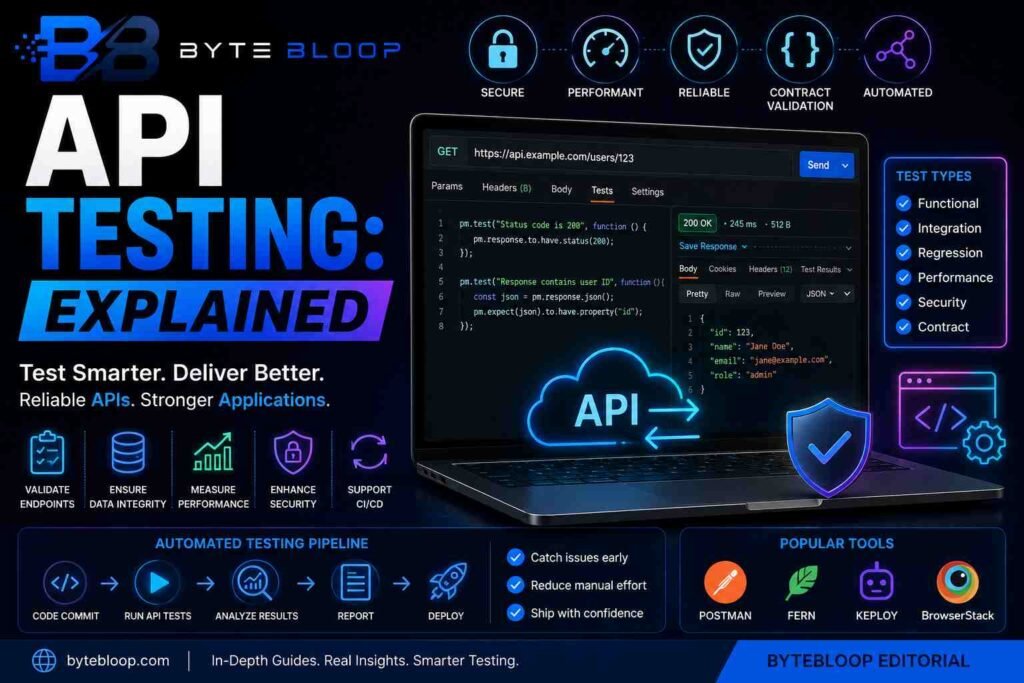
API Testing: Explained
Introduction
In today’s microservices landscape, APIs are the backbone of modern applications, enabling disparate systems to communicate seamlessly. API testing verifies that these endpoints behave as expected, returning correct data, status codes, and handling edge cases. It bridges the gap between developers and QA, ensuring that integration points are reliable before they hit production. As services evolve, automated API tests become essential for continuous delivery pipelines, catching regressions early and reducing manual effort. This guide walks through the fundamentals of API testing, the types of tests you should run, and the tools that make automation efficient. We’ll also explore common pitfalls and best practices so you can build a robust testing strategy that scales with your architecture.
Why API Testing Matters
APIs expose business logic to the outside world; any flaw can propagate downstream, affecting user experience and revenue. By testing at the API level, you validate contract compliance, data integrity, and performance under load. In 2026, teams rely on automated API tests to support rapid feature releases, making it a critical component of DevOps.
Core Types of API Tests
1. Unit or Functional Tests – Verify individual endpoints with known inputs and expected outputs. 2. Integration Tests – Ensure that multiple services interact correctly, often using mock data or stubs. 3. Regression Tests – Run after code changes to confirm that existing functionality remains intact. 4. Performance Tests – Measure response times, throughput, and error rates under simulated load. 5. Security Tests – Check authentication, authorization, and common vulnerabilities like injection or XSS. 6. Contract Tests – Validate that the API adheres to its documented schema, useful in consumer‑producer scenarios.
Setting Up a Test Environment
Start by selecting a testing framework that supports HTTP requests and assertions. Popular choices in 2026 include Postman, Fern, Keploy, and BrowserStack’s API test runner. Create a dedicated test environment that mirrors production but uses test data. Store environment variables (base URLs, tokens, headers) in a secure vault or CI secret store.
Writing a Simple Test in Postman
pm.test("Status code is 200", function () {
    pm.response.to.have.status(200);
});

pm.test("Response contains user ID", function () {
    var json = pm.response.json();
    pm.expect(json).to.have.property("id");
});
In this snippet, Postman’s JavaScript runtime checks the status code and the presence of an “id” field. By chaining multiple tests, you can validate payload shape, headers, and authentication tokens.
Automating Tests with Continuous Integration
Integrate your API tests into your CI pipeline (GitHub Actions, GitLab CI, Jenkins). Use the framework’s CLI to run tests on every push. For example, a GitHub Actions workflow might look like:
name: API Tests
on: [push, pull_request]
jobs:
  test:
    runs-on: ubuntu-latest
    steps:
      - uses: actions/checkout@v3
      - name: Install Postman CLI
        run: npm install -g newman
      - name: Run tests
        run: newman run api-tests.postman_collection.json -e environment.json
Automated runs surface failures early, keeping the main branch stable.
Common Pitfalls and How to Avoid Them
- Hard‑coding values – Use environment variables or data files to keep tests maintainable.
- Ignoring authentication flows – Implement token refresh logic or mock auth endpoints to keep tests reliable.
- Neglecting contract validation – Add schema assertions or use tools like OpenAPI‑Validator to catch structural changes.
- Skipping performance tests – Even small latency spikes can degrade user experience; schedule regular load tests.
Best Practices for Scalable API Testing
- Modularize tests: separate authentication, data setup, and assertions.
- Use data-driven testing: feed test cases from CSV or JSON files.
- Leverage AI‑powered test generation: tools like Keploy can auto‑create tests from runtime traces.
- Maintain a shared library of common assertions to reduce duplication.
- Document test coverage: map tests to API specifications to identify gaps.
Future Trends in API Testing
2026 sees a rise in AI‑driven test maintenance, where models suggest updates when APIs evolve. Additionally, serverless and event‑driven architectures demand testing of asynchronous flows, pushing tools to support message queue and webhook validation. Embracing these trends early positions teams to handle complex, distributed systems with confidence.
Key Takeaways
- API tests validate contract, data integrity, and performance before production
- Automated tests integrate seamlessly with CI/CD pipelines
- Use environment variables to keep tests maintainable
- AI tools can auto‑generate and update tests as APIs evolve
- Modular, data‑driven testing scales with growing API surface
Frequently Asked Questions
What is API testing explained?
API testing is the process of sending requests directly to an API and validating its responses for correctness, performance, security, and compliance with specifications.
What are the key features of API testing tools?
Modern tools support HTTP request construction, assertion libraries, data‑driven execution, CI integration, and sometimes AI‑powered test generation or contract validation.
What are the best use cases for automated API testing?
Automated tests excel in regression testing, continuous delivery pipelines, contract enforcement between services, and performance monitoring across multiple environments.
What are the pros and cons of manual vs. automated API testing?
Manual testing offers flexibility for exploratory scenarios but is slow and error‑prone. Automated testing provides repeatability, speed, and integration with CI, but requires upfront effort to design and maintain test suites.
Conclusion
Based on the available information and industry analysis, API testing provides a critical safety net that ensures services communicate reliably, meet contractual expectations, and perform under load. By adopting automated, data‑driven practices and leveraging modern tools, teams can detect regressions early, accelerate releases, and maintain high quality across complex microservice ecosystems.
Related Reading
- Postman vs. Fern: Choosing the Right API Testing Tool