AI RAG Systems: Explained
Introduction
What Is a RAG System?
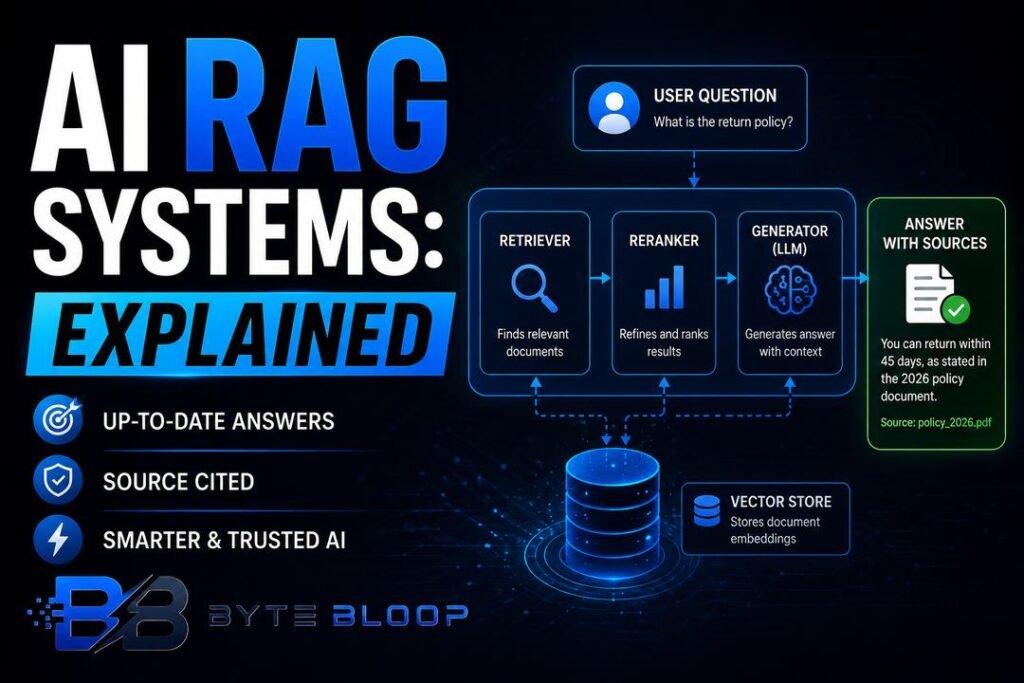
Retrieval Augmented Generation, or RAG, marries a large language model (LLM) with an external knowledge base so that the model can fetch up‑to‑date facts before it writes an answer. The idea is simple: instead of relying solely on the static knowledge baked into the LLM’s weights, the system pulls in fresh data from documents, databases, or APIs, then generates a response that cites that data. This approach was first popularized in 2020 but has become mainstream in 2026, as enterprises demand AI that can answer policy questions, troubleshoot product issues, and comply with regulatory changes in real time.
In practice, a RAG pipeline starts with a chunker that slices long documents into manageable pieces. Those chunks are then encoded by an embedder into vectors stored in a fast vector store. When a user asks a question, a retriever pulls the most relevant vectors, a reranker refines the list, and the generator (the LLM) produces a final answer that references the retrieved content. The result is a chatbot that can answer “What is the new return policy?” with a citation from the latest policy PDF, rather than guessing from its training data.
Key Features of Modern RAG Systems
- Real‑time Knowledge Refresh – Because the retrieval step happens at inference, the model always uses the newest documents.
- Source Transparency – Answers can include links or identifiers to the original documents, improving trust and auditability.
- Hybrid Retrieval – Many systems combine keyword search with semantic vector search, boosting recall and precision.
- Access Control Integration – Enterprise deployments now respect role‑based permissions, ensuring sensitive data is only retrieved for authorized users.
- Scalable Architecture – The vector store can be sharded or replicated across cloud regions, supporting millions of concurrent queries.
Best Use Cases
RAG shines in scenarios where up‑to‑date accuracy and source traceability matter:
- Customer support chatbots that must reference the latest product manuals.
- Compliance assistants that pull in the newest regulatory filings.
- Internal knowledge workers who need quick access to corporate policy documents.
- Content generation tools that cite recent research papers or news articles.
Pros and Cons
Pros
- Improved factual correctness compared to pure generative models.
- Ability to handle niche or proprietary data.
- Audit trails via source citations.
Cons
- Higher latency due to retrieval step.
- Complexity of maintaining vector indices and embeddings.
- Potential cost of storage and compute for large knowledge bases.
Practical Example: A Retail FAQ Bot
Imagine a retailer that updates its return policy every quarter. A traditional LLM might answer “You can return within 30 days” based on its training data, which could be out of date. A RAG bot instead retrieves the latest policy PDF, extracts the relevant clause, and generates a response: “You can return within 45 days, as stated in the 2026 policy document.” The bot also provides a link to the PDF, satisfying customer confidence and compliance auditors.
Pricing and Tooling Landscape
Major cloud providers offer managed RAG services. AWS’s Retrieval-Augmented Generation service bundles an LLM with a managed vector store, starting at $0.10 per 1,000 tokens for generation plus $0.02 per 1,000 vectors for storage. Azure’s OpenAI service adds a retrieval layer at an additional $0.03 per 1,000 queries. Open‑source options like LangChain and RetrievalKit let developers build custom pipelines on top of open‑source embeddings and vector databases such as Pinecone or Milvus.
Alternatives to RAG
Some organizations opt for a purely generative approach, training domain‑specific LLMs on internal data. While this can reduce latency, it requires frequent re‑training to stay current. Others use knowledge graphs that encode facts explicitly, but these lack the flexible natural language generation of RAG. In many cases, a hybrid approach—RAG for general queries and a knowledge graph for highly structured data—delivers the best balance.
Key Takeaways
- RAG blends retrieval and generation for up‑to‑date answers
- Hybrid retrieval improves recall and precision
- Source citations boost trust and auditability
- Latency and complexity trade‑offs exist
- Managed cloud services lower entry barriers
Frequently Asked Questions
What is a RAG system?
A Retrieval Augmented Generation system connects a large language model to an external knowledge base so the model can fetch current information before generating a response.
What are the key features of RAG systems?
Real‑time knowledge refresh, source transparency, hybrid retrieval, access control integration, and scalable vector storage.
What are the best use cases for RAG?
Customer support, compliance assistance, internal knowledge workers, and content generation that requires up‑to‑date citations.
What are the pros and cons of RAG?
Pros include improved factual accuracy and audit trails; cons involve higher latency, maintenance complexity, and storage costs.
How does a RAG system differ from a purely generative LLM?
A purely generative LLM relies only on its training data, while a RAG system actively retrieves external documents at inference time, ensuring answers reflect the latest information.
Conclusion
Based on the available information and industry analysis, Retrieval Augmented Generation systems provide a robust framework for delivering accurate, source‑grounded AI responses that adapt to evolving knowledge bases. By integrating real‑time retrieval with advanced language models, enterprises can build chatbots, compliance tools, and knowledge assistants that meet both user expectations and regulatory demands. The trade‑offs in latency and complexity are outweighed by the gains in factual correctness, transparency, and scalability, making RAG a cornerstone of modern AI deployments in 2026.
Related Reading
- How to Build a RAG Pipeline from Scratch
- Comparing Managed RAG Services: AWS vs Azure