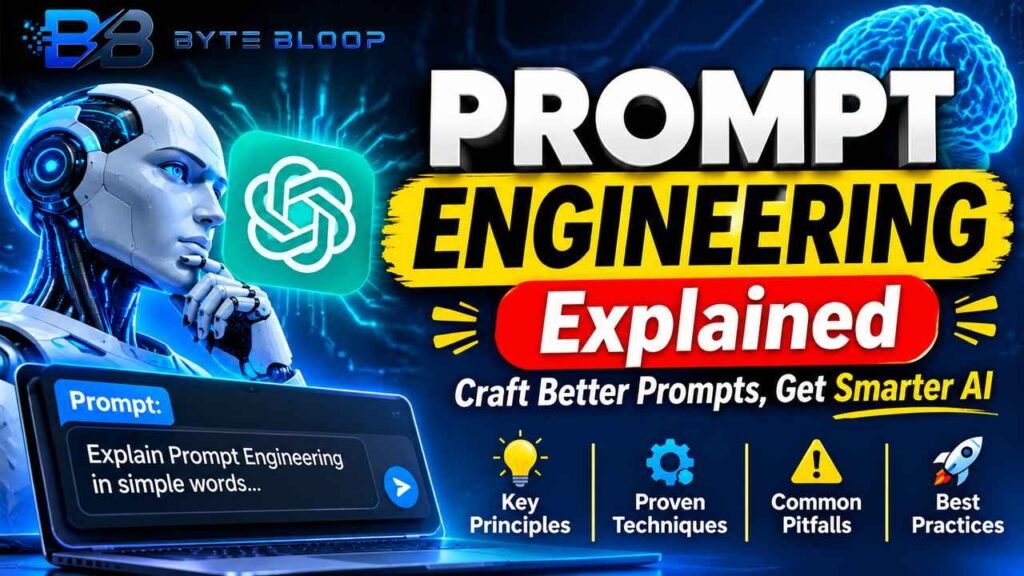
Prompt Engineering: Explained
Introduction (Prompt Engineering Explained)
Prompt Engineering Explained is a topic worth understanding well. Prompt engineering sits at the intersection of linguistics, software design, and artificial intelligence. It is the craft of creating and refining the textual or structured inputs that guide large language models (LLMs) to produce the exact responses developers need. As LLMs grow in size and capability, the quality of the prompt directly influences accuracy, relevance, and safety.
Researchers at Google describe it as the art and science of designing prompts to steer models toward desired outputs, while IBM’s 2026 guide frames it as a practical resource for interacting with AI. This discipline has become essential for building reliable conversational agents, content generators, and data‑analysis tools. Understanding prompt engineering empowers developers to harness AI more effectively, reduce hallucinations, and maintain control over model behavior.
Why Prompt Engineering Matters
Large language models are powerful but opaque. A single word or phrase can shift a model’s response from useful to nonsensical. Prompt engineering provides a systematic way to reduce uncertainty, improve consistency, and embed domain knowledge into the AI’s reasoning process. Without thoughtful prompts, developers risk generating biased or unsafe content, wasting compute resources, or misaligning outputs with business objectives.
Core Principles of Prompt Design
1. Clarity: State the task explicitly. Vague prompts like “Explain X” often produce generic answers. Specify format, length, and perspective.
This matters directly for anyone exploring prompt engineering explained.
2. Contextualization: Provide relevant background. For example, “As a senior software engineer, explain how to use dependency injection in Java.”
Getting prompt engineering explained right can make a real difference.
3. Iterative Refinement: Test, observe, and tweak. Small changes—adding constraints or rephrasing—can dramatically improve output.
That is a core part of understanding prompt engineering explained.
4. Safety Constraints: Embed disallowed content filters or tone guidelines to avoid hallucinations and policy violations.
Many readers look into prompt engineering explained for exactly this reason.
Practical Prompting Techniques
Template Prompting uses a fixed structure with placeholders. Example:
It is worth revisiting prompt engineering explained as things develop.
Prompt: "Write a {length} summary of {topic} in {tone} style."
Replace {length}, {topic}, and {tone} with concrete values before sending to the model.
Prompt Engineering Explained remains highly relevant here.
Chain‑of‑Thought Prompting encourages the model to reason step‑by‑step, improving accuracy on complex tasks. Example:
Prompt: "Solve the following math problem step by step: 12 × 8 = ?"
Zero‑Shot vs. Few‑Shot – Zero‑shot relies on the model’s general knowledge, while few‑shot supplies example inputs and outputs to prime the model. Few‑shot can dramatically increase precision when the task is niche.
Common Pitfalls and How to Avoid Them
- Over‑prompting: Adding too many constraints can confuse the model and lead to truncated or incomplete answers.
- Implicit Bias: Unchecked assumptions in the prompt can propagate bias. Use neutral language and explicit diversity instructions.
- Version Drift: Prompt effectiveness can change as models update. Regularly test prompts against the latest API version.
Best Practices for Production
- Version your prompts and store them in a centralized repository.
- Automate prompt testing with unit tests that compare output against expected patterns.
- Monitor for drift in response quality and retrain prompts as needed.
- Document the rationale behind each prompt to aid future developers.
Key Takeaways
- Design prompts with clarity and context to guide LLMs effectively
- Iterative refinement and testing reduce hallucinations and improve accuracy
- Embedding safety constraints protects against policy violations
- Using templates and chain‑of‑thought techniques enhances consistency
Frequently Asked Questions
What is prompt engineering?
Prompt engineering is the practice of crafting and optimizing textual inputs to guide large language models toward desired outputs, balancing clarity, context, and safety.
What are the key features of effective prompts?
Effective prompts are clear, context‑rich, concise, and include safety constraints; they often use templates or chain‑of‑thought structures.
What are the best use cases for prompt engineering?
Common use cases include conversational agents, content generation, data analysis, code synthesis, and educational tools where precise, reliable AI responses are critical.
What are the pros and cons of prompt engineering?
Pros: improves accuracy, reduces compute waste, and enables fine‑grained control. Cons: requires iterative testing, can be time‑consuming, and may need frequent updates as models evolve.
Conclusion
Based on the available information and industry analysis, prompt engineering provides a structured framework for directing large language models, enabling developers to produce consistent, safe, and high‑quality outputs. By applying clear design principles, iterative testing, and safety constraints, teams can unlock the full potential of generative AI while mitigating risks associated with hallucinations and bias.
Related Reading
- Building Conversational AI with Prompt Engineering
Sources & References
- Prompt Engineering for AI Guide
- Prompt Engineering Guide
- The 2026 Guide to Prompt Engineering
- Prompt Engineering Full Course 2026 | Generative AI
- Prompt Engineering Guide: 2026 Edition (Steal My System)
- Prompt Engineering 2026 — Series 0: Introduction
- Prompt Engineering Guide 2026 — Master prompt engineering in 2026
Related Articles