Adventure Games Explained: 10 Key Features, Types & Tips in 2026
Introduction
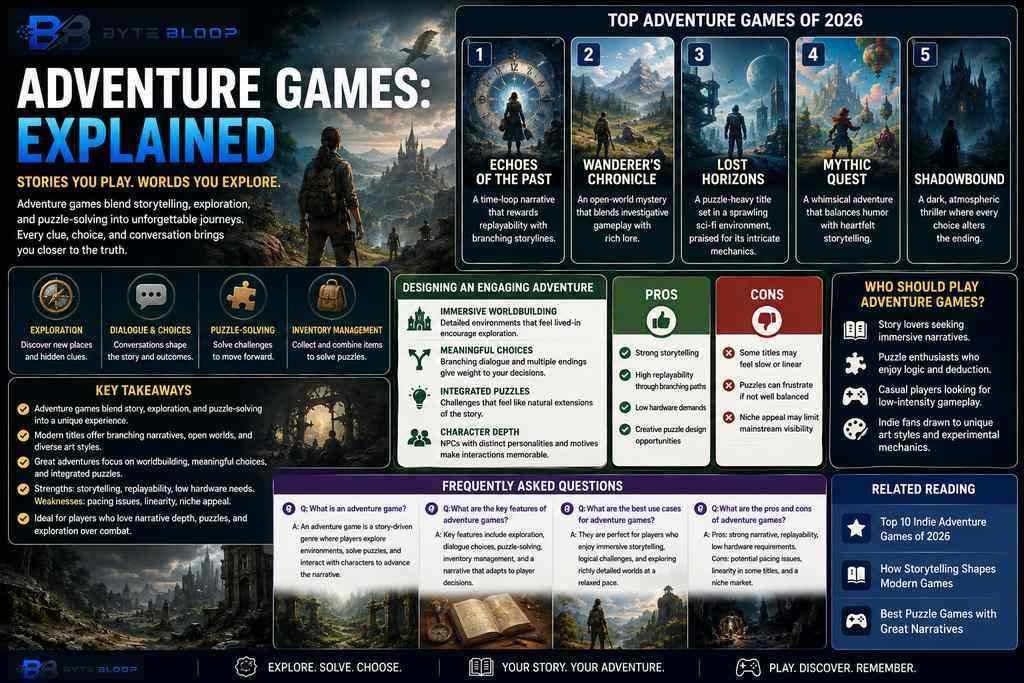
Adventure games explained in simple terms, they are games that put storytelling, exploration, puzzle-solving, investigation, and interaction at the center of the experience. Instead of making combat or fast reflexes the only focus, adventure games often ask players to explore environments, talk to characters, examine clues, solve problems, and discover what happens next.
The genre has a long history that can be traced back to early text adventures and later graphic and point-and-click games. Over time, adventure games expanded into mystery games, narrative adventures, detective experiences, exploration-focused titles, puzzle adventures, and hybrid games that combine adventure mechanics with horror, action, role-playing, or other genres. Adventure Gamers describes narrative, puzzles, and exploration as core characteristics of the genre, while current game catalogs show how broad the modern adventure category has become.
In 2026, adventure games continue to cover several different styles, including traditional adventures, puzzle adventures, detective games, narrative experiences, and other hybrid formats.
This guide explains what adventure games are, how they work, the main types, common mechanics, puzzle design, storytelling, exploration, examples, advantages and limitations, and how to choose an adventure game that matches your play style.
What Are Adventure Games?
An adventure game is generally a story-driven game in which the player explores a world, interacts with characters or objects, solves problems, and progresses through a narrative.
The exact formula can vary considerably.
Some adventure games rely heavily on:
- Dialogue
- Investigation
- Environmental exploration
- Puzzle-solving
- Item collection
- Character choices
- Story discovery
Others combine those features with stealth, action, survival horror, role-playing, platforming, or other mechanics.
That is why the word “adventure” can describe a wide range of experiences rather than one fixed gameplay formula.
Adventure Gamers describes adventure games as being centered around story, puzzles, and exploration, while also noting that the genre can include a variety of settings and hybrid forms.
What Makes an Adventure Game?
Several design elements commonly appear in adventure games.
Exploration
Exploration is one of the defining parts of the genre.
Players may need to investigate rooms, locations, cities, forests, abandoned buildings, laboratories, spacecraft, or other environments.
The environment itself can communicate information through:
- Objects
- Signs
- Documents
- Visual details
- Hidden areas
- Environmental clues
- Character reactions
Good exploration rewards curiosity instead of simply asking the player to move from one checkpoint to another.
Story and Narrative
Adventure games usually place a strong emphasis on storytelling.
The player may uncover a mystery, investigate an event, follow a character’s journey, discover a hidden history, or make choices that affect how the story develops.
Some adventures use a linear narrative, while others provide multiple paths or endings.
Puzzle-Solving
Puzzles are another major part of many adventure games.
A puzzle might require the player to:
- Find a hidden object
- Decode a message
- Combine items
- Understand a sequence
- Identify a clue
- Manipulate the environment
- Connect information from different locations
Puzzle difficulty can vary from simple observation to complex deduction.
Character Interaction
Players often interact with non-player characters through dialogue systems.
Characters can provide:
- Clues
- Story information
- Missions
- Items
- New locations
- Alternative dialogue
- Important context
In some adventure games, conversations also influence the player’s relationships or future story events.
Inventory and Item Use
Traditional adventure games frequently include inventory systems.
Players collect objects and later use them to:
- Open locked areas
- Repair equipment
- Solve puzzles
- Trigger events
- Interact with characters
Modern games do not always require traditional inventory systems, but item-based problem solving remains common.
Types of Adventure Games
Adventure games are not limited to one format.
Point-and-Click Adventures
Point-and-click adventures are among the most recognizable forms of the genre.
Players typically interact with the environment using a mouse or pointer.
Common actions include:
- Examine
- Talk
- Pick up
- Use
- Combine
- Move
Classic point-and-click adventures often focus heavily on dialogue, inventory puzzles, humor, mystery, and exploration.
Narrative Adventures
Narrative adventures prioritize storytelling and character development.
Gameplay may involve exploration, dialogue choices, investigation, cinematic sequences, and decisions that influence the story.
These games can range from highly linear experiences to branching stories.
Puzzle Adventures
Puzzle adventures put greater emphasis on solving logical or environmental challenges.
The player may need to understand systems, patterns, codes, mechanisms, or clues to make progress.
The story often provides context for why the puzzles exist.
Detective Adventures
Detective adventures combine investigation with exploration and deduction.
Players may need to:
- Interview suspects
- Collect evidence
- Examine locations
- Compare clues
- Reconstruct events
- Identify contradictions
- Solve a case
This format has become an increasingly visible part of modern adventure-game catalogs. Current 2026 adventure listings include dedicated detective and investigation categories.
Horror Adventures
Horror games can use adventure mechanics to create tension through exploration, investigation, environmental storytelling, and puzzle-solving.
Instead of relying entirely on combat, some horror adventures make the player feel vulnerable by limiting information, resources, or movement.
Action-Adventure
Action-adventure games combine adventure elements with more active gameplay.
They may include:
- Combat
- Stealth
- Platforming
- Real-time movement
- Exploration
- Puzzle-solving
This hybrid category is broader than traditional adventure games.
How Adventure Game Puzzles Work
Puzzle design is one of the most important parts of many adventure games.
Environmental Puzzles
Environmental puzzles require players to understand how objects or spaces work.
Examples include:
- Moving objects
- Activating machinery
- Finding hidden switches
- Aligning symbols
- Following environmental clues
Logic Puzzles
Logic puzzles ask players to reason from the information available.
The player may need to identify:
- Sequences
- Relationships
- Patterns
- Contradictions
- Hidden rules
Item Combination Puzzles
Traditional adventure games sometimes require players to combine inventory objects.
The challenge is often understanding how seemingly unrelated objects can solve a larger problem.
Investigation Puzzles
Detective-style adventure games may require the player to connect evidence.
A successful solution depends less on reflexes and more on noticing relationships between clues.
Good Puzzle Design
Good puzzles generally communicate enough information for players to eventually understand the solution.
A puzzle can become frustrating when the required solution depends on information the game has not clearly communicated.
That is why good adventure-game design often balances challenge with clues, optional hints, and environmental storytelling.
Storytelling in Adventure Games
Storytelling can work differently from game to game.
Linear Stories
A linear adventure follows a relatively fixed narrative path.
Players may still explore and solve puzzles, but major story events happen in a planned sequence.
Branching Stories
Branching adventures provide different paths depending on player actions.
Choices can influence:
- Dialogue
- Relationships
- Available locations
- Character survival
- Missions
- Endings
Environmental Storytelling
Not every story detail has to be explained through dialogue.
A room, abandoned building, damaged machine, photograph, note, or object can communicate information without direct narration.
This allows players to discover pieces of a story while exploring.
Character-Driven Narratives
Some adventures focus strongly on character relationships and personal development.
In these games, conversations and emotional decisions may be just as important as traditional puzzles.
Exploration and World Design
Exploration works best when the game gives players meaningful reasons to investigate.
A good environment can encourage players to:
- Search for clues
- Inspect objects
- Discover optional areas
- Learn about characters
- Find hidden information
- Understand the wider world
The world does not necessarily need to be huge.
A small, carefully designed environment can still provide strong exploration when every location contains useful information or interesting details.
Adventure Gamers specifically identifies an enticing world to explore as one of the genre’s recurring characteristics.
Adventure Games in 2026
Adventure games remain a broad category in 2026.
Current game catalogs include separate collections for:
- Traditional adventures
- Puzzle adventures
- Detective adventures
- Narrative adventures
- Workplace and simulation hybrids
- Early-access adventure projects
This shows how the modern adventure genre has expanded beyond classic point-and-click games.
Instead of focusing on one “best” style, players can choose between narrative-heavy games, investigation experiences, puzzle-focused adventures, atmospheric exploration, and hybrid games.
Current Steam-tagged catalogs also show adventure games overlapping with puzzle, detective, investigation, point-and-click, and other categories.
Examples of Adventure Game Styles
There are many different ways to experience the genre.
Classic Point-and-Click Style
Classic adventure design is strongly associated with games such as Grim Fandango, Broken Sword, and other story-focused point-and-click experiences.
These games often emphasize:
- Dialogue
- Inventory
- Exploration
- Object interaction
- Puzzles
Adventure Gamers’ genre overview uses classic titles such as Grim Fandango and Broken Sword as examples of story-driven adventure design.
Modern Puzzle Mystery Style
Modern adventure games can combine investigation, puzzle-solving, deduction, and unusual visual styles.
For example, games such as Return of the Obra Dinn and The Case of the Golden Idol demonstrate how investigation and deduction can become central gameplay systems.
Atmospheric Exploration Style
Some games reduce traditional inventory systems and instead focus on exploration, environmental storytelling, atmosphere, and discovery.
This approach can make the game feel closer to interactive fiction or a playable mystery.
Hybrid Adventure Style
Adventure mechanics can also be combined with horror, action, platforming, or role-playing.
Current game catalogs show that the adventure tag spans a wide variety of genres and play styles.
Choosing an Adventure Game
Choosing an adventure game depends on what type of experience you enjoy.
Choose Story-Focused Adventures
Look for narrative adventures when you enjoy:
- Character development
- Dialogue
- Cinematic storytelling
- Emotional choices
- Story discovery
Choose Puzzle Adventures
Puzzle-heavy games are better suited to players who enjoy:
- Logic
- Observation
- Deduction
- Problem-solving
- Systems
Choose Detective Adventures
Detective-style adventures may be a good fit for players who enjoy:
- Investigations
- Evidence
- Mysteries
- Interviews
- Deduction
Choose Action-Adventure Games
Action-adventure hybrids are useful for players who want storytelling and exploration while still enjoying:
- Combat
- Stealth
- Movement
- Platforming
Adventure Games vs Action Games
The main difference is usually the emphasis.
Adventure games generally prioritize:
- Story
- Exploration
- Investigation
- Puzzles
- Character interaction
Action games usually place more emphasis on:
- Combat
- Reflexes
- Timing
- Movement
- Fast reactions
There is significant overlap between the two categories.
Action-adventure games demonstrate this overlap by combining exploration and narrative with combat, movement, and other action mechanics.
Adventure Games vs RPGs
Adventure games and role-playing games can also overlap.
RPGs generally emphasize systems such as:
- Character progression
- Statistics
- Equipment
- Skills
- Builds
- Combat or party management
Adventure games are more likely to make narrative progression, exploration, and puzzles the central structure.
However, hybrid games can include mechanics from both genres.
Advantages of Adventure Games
Strong Storytelling
Adventure games can provide detailed narratives with characters, mysteries, and carefully designed worlds.
Creative Puzzle Design
Puzzles can encourage players to think rather than simply react.
Exploration
Players often have reasons to inspect environments instead of moving directly from one combat encounter to another.
Accessible Pace
Many adventure games allow players to progress at their own pace, especially story- and puzzle-focused titles.
Genre Variety
The modern adventure category includes mystery, horror, detective, puzzle, narrative, point-and-click, and hybrid games.
Limitations of Adventure Games
Slow Pacing
Players who prefer constant action may find some adventure games too slow.
Puzzle Frustration
Poorly designed puzzles can cause unnecessary frustration, especially when the solution is unclear.
Linear Progression
Some adventure games provide limited freedom outside their intended story path.
Repetition
Games built around similar dialogue and object interactions can become repetitive when variety is limited.
Trial and Error
Certain classic adventure designs rely heavily on experimentation or unusual item combinations, which may not appeal to every player.
Who Should Play Adventure Games?
Adventure games can be a strong fit for players who enjoy:
- Storytelling
- Mysteries
- Exploration
- Puzzles
- Character interaction
- Investigation
- Atmospheric worlds
- Slower-paced gameplay
They can also be a good entry point for players who do not enjoy highly competitive games or fast-paced combat.
Who May Want a Different Genre?
Adventure games may not be ideal for players who primarily want:
- Competitive multiplayer
- Fast combat
- High-action gameplay
- Extensive character-stat systems
- Constant progression rewards
Those players may prefer action games, shooters, RPGs, or strategy games.
For readers interested in another genre, see the Strategy Games: Explained guide on ByteBloop:
Tips for Playing Adventure Games
Examine Everything
Important clues may be hidden in objects or environmental details.
Talk to Characters Again
Dialogue can sometimes change after important story events.
Keep Track of Clues
For detective or mystery adventures, writing down names, locations, codes, and relationships can make complex cases easier to solve.
Combine Information
The solution to a puzzle may involve information collected in different locations.
Use Hints Carefully
A hint system can help you continue without completely removing the challenge.
Explore Optional Areas
Optional rooms and objects can contain additional story details or useful information.
Adventure Games and Accessibility
Accessibility can be important for players with different needs.
Useful options can include:
- Subtitles
- Adjustable text size
- Color settings
- Difficulty options
- Hint systems
- Controller remapping
- Reduced-time mechanics
- Simplified puzzle modes
Not every adventure game provides all of these features, so players should check the accessibility options for individual titles.
Adventure Games and Game Capture
Story-rich adventure games can also be useful for gaming content creators.
Because they often include unusual environments, dialogue, puzzles, discoveries, and story moments, they can produce interesting:
- Gameplay videos
- Walkthroughs
- Reviews
- Reaction videos
- Puzzle guides
- Streaming sessions
For creators who want to record adventure gameplay, see:
Game Capture: Explained
https://bytebloop.com/game-capture-explained/
Adventure Games and Replay Value
Replay value varies substantially between adventure games.
A mostly linear adventure may provide the same major story sequence on each playthrough.
A branching adventure can offer more replay value through:
- Different choices
- Alternate dialogue
- Multiple endings
- Optional discoveries
- Different puzzle solutions
Some investigation games may also encourage replaying after the player understands the complete story.
Replay value therefore depends more on the specific game design than on the adventure genre itself.
The Future of Adventure Games
The adventure genre is continuing to evolve alongside broader gaming technology.
More Dynamic Narratives
Developers can use branching systems to make player decisions feel more meaningful.
Smarter NPCs
AI-assisted systems may eventually create more responsive character interactions, although the quality and consistency of these systems vary.
Procedural Environments
Procedural generation can create larger or more varied environments while reducing the need to design every detail manually.
Better Accessibility
More developers are adding accessibility options that make games easier to play for different audiences.
Cross-Genre Design
Adventure games are increasingly overlapping with:
- Horror
- RPGs
- Survival
- Strategy
- Simulation
- Action
- Detective games
Current adventure catalogs already show substantial overlap with puzzle, detective, investigation, narrative, and action-oriented experiences.
Key Takeaways
- Adventure games focus heavily on story, exploration, puzzles, and interaction.
- Point-and-click adventures are only one part of the broader genre.
- Modern adventure games include narrative, puzzle, detective, horror, and action-adventure formats.
- Exploration encourages players to investigate environments and discover information.
- Puzzle design can range from simple object interactions to complex deduction.
- Adventure games can overlap with action games and RPGs.
- Current 2026 catalogs show a wide variety of adventure and hybrid adventure experiences.
- Players should choose games based on preferred pacing, puzzle difficulty, storytelling, and gameplay style.
- Accessibility features can make adventure games easier to enjoy for a wider audience.
- The genre continues to evolve through new narrative systems, technology, accessibility, and hybrid gameplay.
Frequently Asked Questions
What are adventure games?
Adventure games are story-focused games that commonly involve exploration, puzzle-solving, investigation, character interaction, and narrative progression.
What are the main features of adventure games?
Common features include exploration, storytelling, puzzles, dialogue, investigation, item interaction, and character development.
What types of adventure games are there?
Common types include point-and-click adventures, narrative adventures, puzzle adventures, detective adventures, horror adventures, and action-adventure hybrids.
Are adventure games only point-and-click games?
No. Point-and-click is only one type of adventure game. Modern adventure games can use many different control systems and can include action, horror, detective, puzzle, and role-playing elements.
What makes a good adventure game?
A good adventure game usually combines a coherent narrative, meaningful exploration, well-designed puzzles, interesting characters, and a world that encourages curiosity.
Are adventure games difficult?
Difficulty depends on the specific game. Some focus on relaxed storytelling, while others include challenging puzzles or complex investigations.
Are adventure games good for beginners?
Many adventure games can be accessible to beginners because they often emphasize exploration, dialogue, and problem-solving rather than fast reflexes.
Are adventure games suitable for children?
Some are, but content varies by title. Parents should check the game’s age rating, themes, language, and violence before choosing one.
What is the difference between adventure and action-adventure games?
Traditional adventure games generally emphasize story, exploration, puzzles, and interaction, while action-adventure games add stronger elements of combat, movement, stealth, or platforming.
Do adventure games have combat?
Some do, but combat is not required. Traditional adventure games may have little or no combat, while action-adventure hybrids can feature significant combat systems.
Do adventure games have puzzles?
Many adventure games do. Puzzle-solving has historically been one of the genre’s defining gameplay elements, although some modern adventure games reduce the puzzle emphasis.
Are adventure games single-player?
Many are single-player, but the broader genre can also include multiplayer or cooperative experiences.
Can adventure games have multiple endings?
Yes. Some adventure games use branching choices that lead to different dialogue, events, or endings.
What platforms support adventure games?
Adventure games are available on PC, PlayStation, Xbox, Nintendo platforms, mobile devices, and handheld systems, depending on the title.
Are adventure games still popular in 2026?
Adventure games remain an active category in 2026, with current catalogs covering traditional, puzzle, detective, narrative, and other adventure styles.
What skills are useful for adventure games?
Curiosity, observation, patience, logical thinking, and careful reading can all help when playing adventure games.
Can adventure games be used for gaming content?
Yes. Story discoveries, puzzle solutions, investigations, walkthroughs, reviews, and reactions can all work well as gaming content.
Conclusion
Adventure games explained simply are games built around discovery.
Whether the player is solving a mystery, exploring an unfamiliar world, investigating a crime, talking to characters, or figuring out a difficult puzzle, the genre is designed to reward curiosity and attention.
The adventure genre has changed considerably since the early days of text and point-and-click games. Modern titles can combine narrative design with puzzles, detective mechanics, horror, action, role-playing, and other systems.
In 2026, adventure games continue to appear across multiple formats and categories, showing that the genre is broader than a single gameplay formula.
For players, the important question is not simply whether a game is called an adventure game. It is whether its specific mix of story, puzzles, exploration, pacing, and interaction matches the experience they enjoy.
That flexibility is one of the main reasons adventure games continue to have a place in modern gaming.
Related Reading
Strategy Games: Explained
https://bytebloop.com/strategy-games-explained/
Game Capture: Explained
https://bytebloop.com/game-capture-explained/
BYTE BLOOP Reviews
https://bytebloop.com/category/reviews/
Sources & References
Adventure Gamers — What Are Adventure Games?
https://adventuregamers.com/article/what_are_adventure_games
Adventure Gamers — What Defines an Adventure Game?
https://adventuregamers.com/article/what-defines-an-adventure-game-definition
Steam — Recent and Upcoming Adventure Games
https://store.steampowered.com/curator/45841548-Recent-and-Upcoming-Adventure-Games/
SteamDB — Adventure Games
https://steamdb.info/tag/21/
SteamDB — Point & Click Games
https://steamdb.info/tag/1698/
SteamDB — Action-Adventure Games
https://steamdb.info/tag/4106/