Educational Technology Explained
Introduction
Educational technology, often called edtech, blends hardware, software, and pedagogical theory to create learning experiences that are more engaging, personalized, and accessible than traditional classrooms alone. From interactive whiteboards to AI‑driven tutoring systems, the field has evolved from simple digital textbooks to immersive virtual reality labs. In 2026, the pace of innovation is accelerating, with generative AI, micro‑credentials, and gamified curricula reshaping how knowledge is delivered and assessed. Schools and universities face both opportunity and challenge: adopting new tools can boost outcomes, but integration, training, and equity gaps must be managed carefully. This guide breaks down the core components of educational technology, highlights emerging trends, and offers practical steps for educators and administrators looking to lead a digital transformation.
What Makes Up Educational Technology?
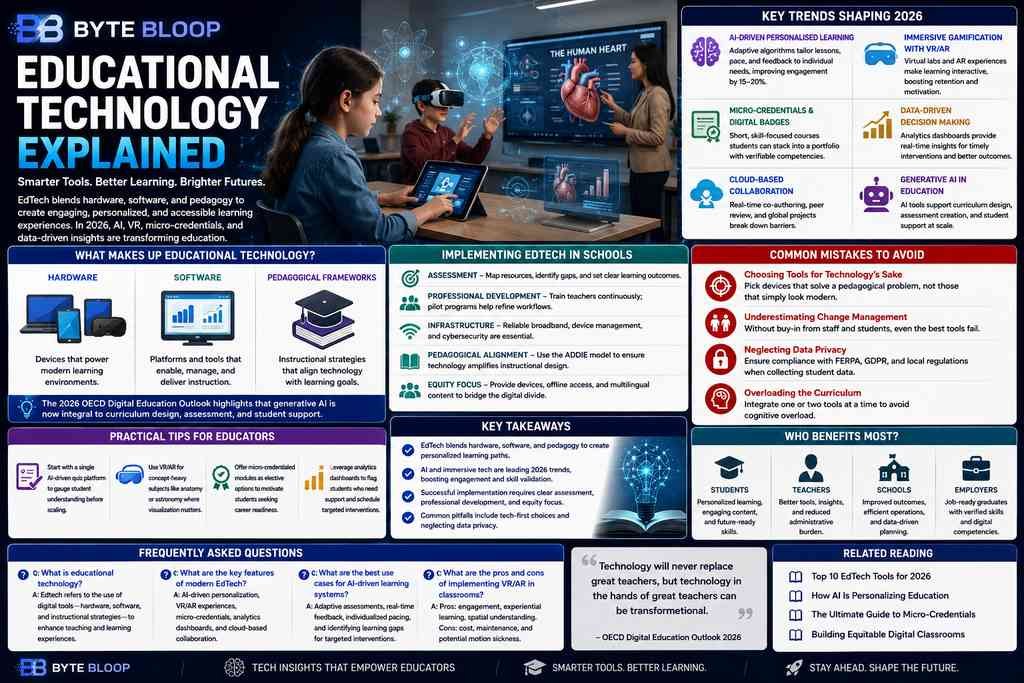
At its heart, educational technology is a convergence of three pillars: hardware (laptops, tablets, VR headsets), software (learning management systems, adaptive platforms, content libraries), and pedagogical frameworks that dictate how technology supports learning objectives. The 2026 OECD Digital Education Outlook underscores that generative AI tools are now integral to curriculum design, assessment, and student support, moving beyond simple content delivery.
Key Trends Shaping 2026
1. AI‑Driven Personalised Learning – Adaptive algorithms analyze student data in real time, tailoring lesson paths, pacing, and feedback to individual needs. Schools report a 15‑20% improvement in engagement when AI tutors are paired with human instruction.
2. Immersive Gamification with VR/AR – Virtual labs, historical reenactments, and augmented overlays transform abstract concepts into tangible experiences, boosting retention and motivation.
3. Micro‑credentials and Digital Badges – Short, skill‑focused courses that students can stack into a portfolio, providing employers with verifiable proof of competencies.
4. Data‑Driven Decision Making – Learning analytics dashboards give educators insights into cohort performance, enabling timely interventions.
5. Cloud‑Based Collaboration – Real‑time co‑authoring, peer review, and global project work are now standard, breaking down geographical barriers.
Implementing EdTech in Schools
Successful adoption hinges on a structured approach:
- Assessment – Map current resources, identify gaps, and set clear learning outcomes.
- Professional Development – Continuous training ensures teachers can integrate tools meaningfully; pilot programs help refine workflows.
- Infrastructure – Reliable broadband, device management, and cybersecurity protocols are prerequisites.
- Pedagogical Alignment – Technology should amplify instructional design, not replace it; use the ADDIE model to guide integration.
- Equity Focus – Address digital divide issues by providing low‑cost devices, offline capabilities, and multilingual content.
Common Mistakes to Avoid
1. Choosing Tools for Technology’s Sake – Pick devices that solve a pedagogical problem, not those that simply look modern.
2. Underestimating Change Management – Without buy‑in from staff and students, even the best tools fail.
3. Neglecting Data Privacy – Ensure compliance with FERPA, GDPR, and local regulations when collecting student data.
4. Overloading the Curriculum – Integrate one or two tools at a time to avoid cognitive overload.
Practical Tips for Educators
• Start with a single AI‑driven quiz platform to gauge student understanding before scaling.
• Use VR/AR for concept‑heavy subjects like anatomy or astronomy where spatial visualization matters.
• Offer micro‑credentialed modules as elective options to motivate students seeking career readiness.
• Leverage analytics dashboards to flag students who need additional support, then schedule targeted interventions.
Key Takeaways
- EdTech blends hardware, software, and pedagogy to create personalized learning paths.
- AI and immersive tech are leading 2026 trends, boosting engagement and skill validation.
- Successful implementation requires clear assessment, professional development, and equity focus.
- Common pitfalls include tech‑first choices and neglecting data privacy.
Frequently Asked Questions
What is educational technology explained?
Educational technology, or edtech, refers to the use of digital tools—hardware, software, and instructional strategies—to enhance teaching and learning experiences.
What are the key features of modern EdTech?
Key features include AI‑driven personalization, immersive VR/AR experiences, micro‑credentials, data analytics dashboards, and cloud‑based collaboration platforms.
What are the best use cases for AI‑driven learning systems?
They excel in adaptive assessments, real‑time feedback, individualized pacing, and identifying learning gaps for targeted interventions.
What are the pros and cons of implementing VR/AR in classrooms?
Pros: heightened engagement, experiential learning, and spatial understanding. Cons: high initial cost, technical maintenance, and potential motion sickness for some students.
Conclusion
Based on the available information and industry analysis, educational technology in 2026 offers a powerful suite of tools that personalize learning, expand access, and prepare students for a digital economy. However, its success depends on thoughtful integration, continuous teacher training, and a steadfast commitment to equity and data privacy. By aligning technology with pedagogical goals, schools can transform traditional classrooms into dynamic, learner‑centered environments that meet the demands of tomorrow’s workforce.
Related Reading
- Top 10 EdTech Tools for 2026