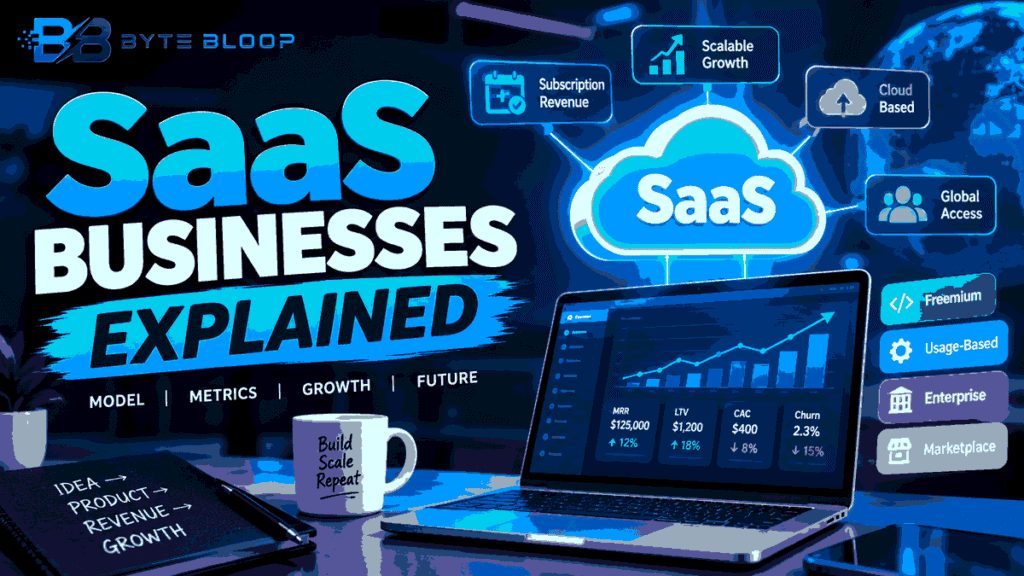
SaaS Businesses: Explained
Introduction
Software as a Service, or SaaS, has reshaped how businesses deliver and monetize applications. Instead of selling perpetual licenses, SaaS companies host their software in the cloud and charge customers on a subscription basis. This model delivers predictable revenue streams, high gross margins, and the ability to scale globally with minimal incremental cost. Over the past decade, SaaS has moved from niche B2B tools to mainstream consumer services, with giants like Salesforce, Adobe, and Microsoft Azure setting industry benchmarks. For entrepreneurs, the promise of recurring revenue and rapid growth makes SaaS an attractive venture, but it also demands rigorous product-market fit, efficient customer acquisition, and relentless focus on retention. Understanding the core mechanics—revenue recognition, customer lifetime value, and churn—can help founders navigate the competitive landscape. As the market matures, new niches such as AI‑driven automation tools and micro‑SaaS products are emerging, offering fresh opportunities for innovation and profitability.
How the SaaS Business Model Works
At its heart, a SaaS business delivers software over the internet, allowing customers to access features via a web browser or mobile app. Revenue is generated through subscription plans—monthly, quarterly, or annual—often tiered by usage or feature set. According to SaaS business model: How do SaaS businesses work?, this recurring model enables companies to forecast cash flow and invest in product development with greater confidence. The model also encourages continuous improvement, as updates are rolled out centrally, ensuring every user benefits from the latest features without manual installations.
Key Metrics Every SaaS Founder Should Track
Success in SaaS hinges on a handful of critical metrics:
- Monthly Recurring Revenue (MRR) – the predictable revenue stream each month.
- Customer Acquisition Cost (CAC) – the total spend to win a new customer.
- Lifetime Value (LTV) – the projected revenue from a customer over their tenure.
- Churn Rate – the percentage of customers who cancel each month.
- Gross Margin – typically 70%–90% for cloud services, reflecting low variable costs.
Balancing these figures—especially keeping LTV/CAC ratio above 3:1—ensures sustainable growth. SaaS Business: The Complete Guide for 2026 highlights that many high‑growth startups hit $1M ARR within 18 months by optimizing these levers.
Common Revenue Models Within SaaS
While subscription is the default, variations exist:
- Freemium – free tier with paid upgrades.
- Usage‑Based – charges tied to API calls or data processed.
- Enterprise Licensing – custom pricing for large organizations.
- Marketplace – platform fees for third‑party integrations.
Choosing the right model depends on target customers and product complexity. For example, AI automation tools often use a hybrid of freemium and usage‑based pricing to attract experimentation while monetizing heavy users.
Scaling Strategies for SaaS Companies
Growth in SaaS is not just about acquiring new customers; it’s about deepening engagement and expanding revenue per user. What Is SaaS Development? Business Guide for 2026 outlines three growth phases:
- Product‑Market Fit – validate that the solution solves a real problem.
- Growth Engine – automate marketing, sales, and onboarding to lower CAC.
- Scale Engine – focus on retention, upsell, and cross‑sell to increase LTV.
Investing in a robust customer success team, data‑driven product roadmaps, and strategic partnerships can accelerate each phase. Micro‑SaaS ventures, as noted in Best SaaS Ideas for 2026, often achieve rapid traction by targeting narrow verticals with high switching costs.
Challenges and Risks in the SaaS Landscape
Despite its allure, SaaS faces distinct hurdles. Don’t Start a SaaS in 2026 Until You Watch This warns that high upfront development costs and fierce competition can erode margins if not managed carefully. Technical debt, data security, and compliance (especially with GDPR and CCPA) add operational complexity. Moreover, customer churn can spike during economic downturns, underscoring the need for diversified revenue streams and flexible pricing.
Future Trends Shaping SaaS
Looking ahead, several trends are redefining the sector:
- AI Integration – embedding machine learning to automate workflows.
- Vertical CRMs – industry‑specific solutions that command higher price points.
- Micro‑SaaS – niche products that solve single pain points with minimal overhead.
- Hybrid Cloud Models – combining public and private clouds for security‑sensitive clients.
Adopting these innovations early can position a SaaS startup as a market leader and attract strategic acquisition offers, as highlighted by the high exit valuations reported in recent industry analyses.
Key Takeaways
- SaaS delivers predictable, recurring revenue through subscription models.
- Key metrics like MRR, CAC, LTV, and churn drive growth decisions.
- Freemium and usage‑based pricing help attract and monetize diverse customer segments.
- Scaling requires a focus on product‑market fit, automation, and retention.
- Future opportunities lie in AI, vertical CRMs, and micro‑SaaS niches.
Frequently Asked Questions
What is a SaaS business?
A SaaS business hosts an application on the cloud and offers it to customers over the internet, charging them through subscription pricing.
What are the key features of a SaaS model?
Recurring revenue, high gross margins, centralized updates, and scalability across geographies.
What are the best use cases for SaaS?
B2B enterprise tools, customer relationship management, AI automation, compliance software, and niche micro‑SaaS products.
What are the pros and cons of SaaS?
Pros include predictable revenue and low marginal costs; cons involve high upfront development, competitive pressure, and the need for robust customer success.
Conclusion
Based on the available information and industry analysis, SaaS businesses provide a scalable, high‑margin platform that transforms traditional software sales into recurring revenue streams. By mastering core metrics, choosing the right pricing model, and staying agile to emerging trends like AI and vertical specialization, founders can build resilient enterprises that attract both users and investors. Continued focus on customer retention and data‑driven product evolution will be essential to sustain growth in an increasingly competitive market.
Related Reading
- Top 10 SaaS Metrics Every Founder Should Know
Sources & References