Cloud Security: Explained
Introduction
Cloud security is the practice of safeguarding data, applications, and infrastructure that reside in cloud environments. It blends technology, policies, and procedures to counter both external and internal threats that can compromise confidentiality, integrity, and availability. As more businesses migrate to public, private, and hybrid clouds, the complexity of protecting assets increases, making cloud security a cornerstone of modern IT strategy. The discipline covers everything from identity and access management (IAM) to encryption, network segmentation, and continuous monitoring. It also incorporates emerging trends such as AI‑powered threat detection and Zero Trust architectures that redefine how access is granted and verified. Understanding cloud security is essential for IT leaders, developers, and security professionals who must ensure that cloud deployments remain resilient against evolving attack vectors. This guide breaks down the core concepts, highlights best practices, and offers real‑world examples to help you build a robust cloud security posture.
What Cloud Security Really Means
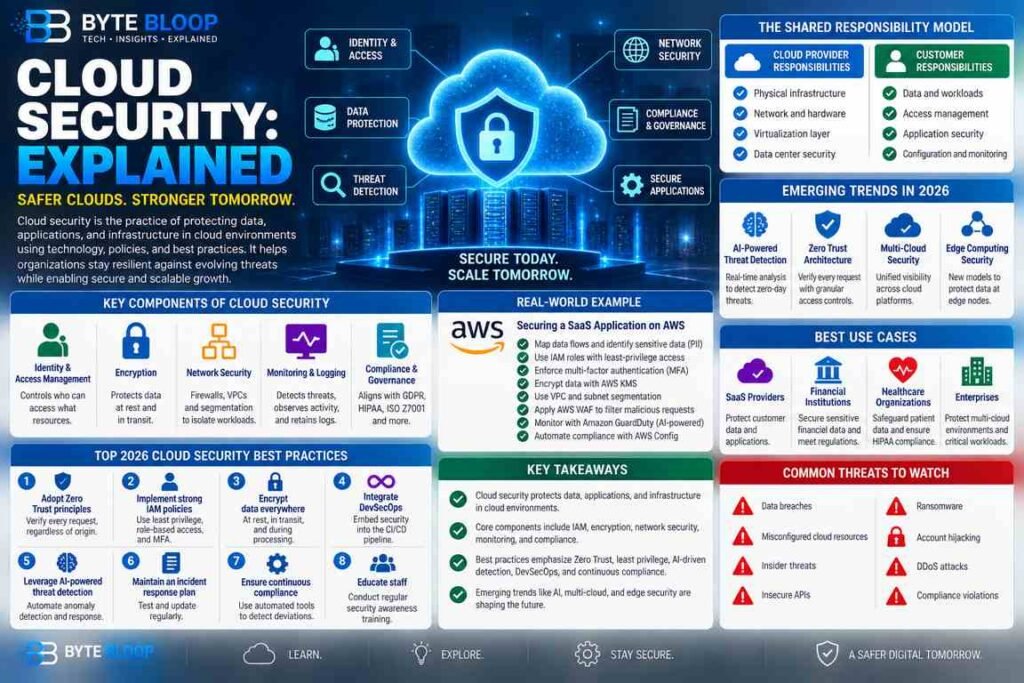
At its core, cloud security is a set of procedures and technologies designed to protect cloud‑based infrastructure, applications, and data from threats. It differs from traditional on‑prem security in that responsibilities are shared between the cloud provider and the customer, a model known as the shared‑responsibility framework. The provider secures the underlying hardware, network, and virtualization layer, while the customer secures their workloads, data, and access controls.
Key Components of a Cloud Security Strategy
- Identity and Access Management (IAM): Controls who can access what resources and under what conditions.
- Encryption: Protects data at rest and in transit using strong cryptographic algorithms.
- Network Security: Implements firewalls, virtual private clouds (VPCs), and segmentation to isolate workloads.
- Security Monitoring & Logging: Continuously observes activity, detects anomalies, and retains logs for compliance.
- Compliance & Governance: Aligns with standards such as GDPR, HIPAA, and ISO 27001.
Practical Example: Securing a SaaS Application
Imagine a company that hosts a customer‑facing SaaS platform on AWS. The security team starts by mapping data flows and identifying sensitive data such as personally identifiable information (PII). They then enable AWS IAM roles with least‑privilege access, enforce multi‑factor authentication, and apply encryption using AWS Key Management Service (KMS). Network traffic is routed through a VPC with subnet segmentation, and a Web Application Firewall (WAF) filters malicious requests. Continuous monitoring is achieved through Amazon GuardDuty, which uses machine learning to flag suspicious behavior. Finally, the team configures automated compliance checks with AWS Config to ensure ongoing adherence to regulatory requirements.
Top 2026 Cloud Security Best Practices
- Adopt Zero Trust principles: Verify every request, regardless of origin.
- Implement strong IAM policies: Use least privilege, role‑based access, and MFA.
- Encrypt data everywhere: At rest, in transit, and during processing.
- Integrate DevSecOps: Embed security into the CI/CD pipeline.
- Leverage AI‑powered threat detection: Automate anomaly detection and response.
- Maintain a robust incident response plan: Test and update regularly.
- Ensure continuous compliance monitoring: Use automated tools to detect deviations.
- Educate staff: Conduct regular security awareness training.
Emerging Trends Shaping Cloud Security in 2026
AI and machine learning are now central to threat detection, enabling real‑time analysis of vast data streams to spot zero‑day exploits. Zero Trust architecture has moved from concept to standard practice, with granular access controls and micro‑segmentation becoming mandatory. Multi‑cloud and hybrid environments demand unified visibility across disparate platforms, pushing vendors to offer cross‑cloud security orchestration. Finally, the rise of edge computing extends cloud services closer to end users, requiring new security models that protect data in transit and at edge nodes.
Key Takeaways
- Cloud security protects data, applications, and infrastructure in cloud environments through technology, policies, and shared responsibility.
- Core components include IAM, encryption, network security, monitoring, and compliance governance.
- Best practices for 2026 emphasize Zero Trust, least privilege, AI‑driven threat detection, DevSecOps, and continuous compliance checks.
- Emerging trends such as AI, Zero Trust, multi‑cloud orchestration, and edge security are redefining how organizations secure their cloud assets.
Frequently Asked Questions
What is cloud security explained?
Cloud security is the set of practices, technologies, and policies that protect cloud‑based infrastructure, applications, and data from external and internal threats, operating under a shared‑responsibility model between provider and customer.
What are the key features of cloud security?
Key features include identity and access management, encryption of data at rest and in transit, network segmentation, continuous monitoring and logging, and compliance governance aligned with industry standards.
What are the best use cases for cloud security?
Any organization that hosts workloads, stores sensitive data, or delivers services via public, private, or hybrid clouds benefits from cloud security, especially SaaS providers, financial institutions, healthcare organizations, and enterprises with regulatory obligations.
What are the pros and cons of adopting a Zero Trust model in the cloud?
Pros: reduces attack surface, enforces least privilege, and provides granular visibility. Cons: requires significant configuration effort, can increase operational overhead, and may impact user experience if not tuned properly.
Conclusion
Based on the available information and industry analysis, cloud security provides a structured framework that protects data, applications, and infrastructure across diverse cloud environments. By combining technology, policy, and continuous monitoring, organizations can mitigate evolving threats while meeting regulatory demands. The shared‑responsibility model ensures that both providers and customers collaborate to maintain a resilient security posture, making cloud security a critical component of modern digital transformation strategies.
Related Reading
- Zero Trust Architecture in the Cloud