Search Technology: Explained
Introduction
Search Technology Explained is a topic worth understanding well. Search technology is the backbone of digital information discovery, enabling users to locate relevant content from vast, unstructured data pools. At its core, it blends indexing, ranking algorithms, and natural language understanding to transform raw data into actionable insights. Over the past decade, the field has evolved from keyword matching to semantic search, incorporating machine learning models that interpret intent and context. This shift has unlocked new possibilities for AI assistants, enterprise knowledge bases, and e‑commerce recommendation engines.
As businesses grapple with data overload, search technology now plays a pivotal role in boosting efficiency, reducing time‑to‑answer, and driving customer satisfaction. Understanding its components, trends, and practical applications is essential for developers, product managers, and data scientists alike. Below we break down the fundamentals, highlight emerging trends, and provide real‑world examples of how search technology is reshaping industries.
How Search Engines Work
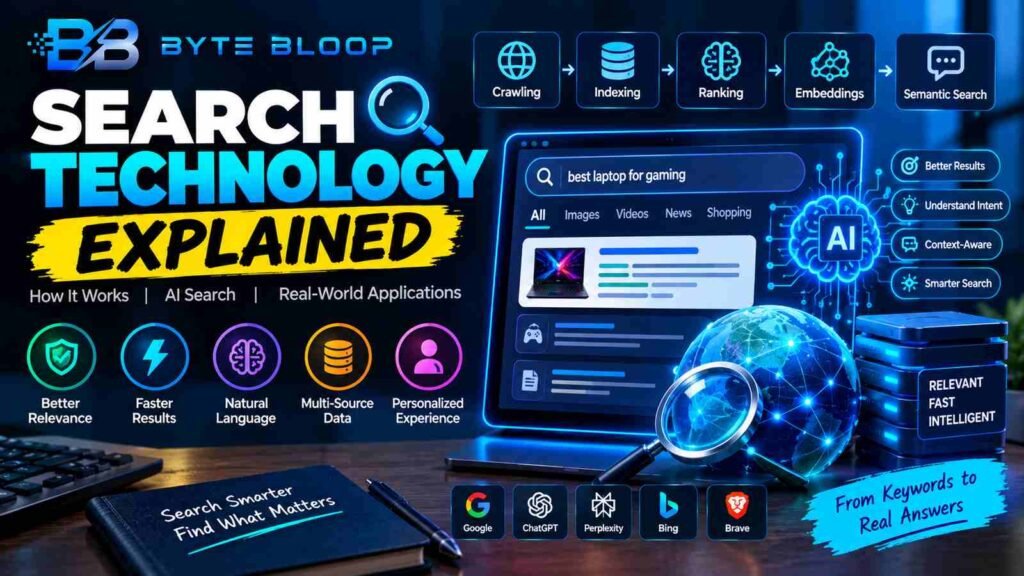
Traditional search engines rely on three primary stages: crawling, indexing, and retrieval. Crawlers scan the web or internal repositories, collecting documents. Indexers parse these documents, extracting terms and metadata, then build inverted indexes that map terms to document IDs. Retrieval engines rank documents based on relevance scores, often using TF‑IDF or BM25 algorithms. Modern AI‑powered search, however, extends this pipeline with embeddings and transformer models that capture semantic meaning, allowing queries like “best laptop for gaming” to surface results beyond exact keyword matches.
Semantic Search and Embedding Models
Semantic search replaces sparse keyword vectors with dense embeddings generated by models such as BERT, GPT, or specialized search embeddings. These embeddings encode contextual nuances, enabling the system to understand synonyms, polysemy, and user intent. For example, a query about “AI-powered document summarization” will retrieve results that discuss summarization tools, even if the exact phrase is absent. This capability is crucial for enterprise search, where documents often use domain‑specific jargon.
This matters directly for anyone exploring search technology explained.
AI Search Engines in 2026
According to the AI Search Engines Guide 2026, tools like ChatGPT, Perplexity, and other AI‑powered search engines are redefining how users interact with information. These platforms combine large language models with real‑time web access, providing concise, contextually relevant answers without the need to sift through multiple pages. The guide notes that the integration of retrieval‑augmented generation (RAG) allows AI search engines to pull up‑to‑date data from external sources, enhancing accuracy and relevance.
Getting search technology explained right can make a real difference.
Enterprise Applications
In corporate settings, search technology fuels knowledge management systems, customer support portals, and compliance monitoring. Intelligent search can surface policy documents, code snippets, or legal precedents within seconds, reducing onboarding time for new hires. Gartner’s 2026 report highlights AI as the digital backbone for enterprises, emphasizing that intelligent apps powered by search will become standard in workflow automation.
That is a core part of understanding search technology explained.
Search in E‑Commerce
E‑commerce platforms leverage search to drive conversions. By employing faceted search, relevance ranking, and personalized recommendations, retailers can guide shoppers to the exact product they need. AI search engines can also interpret natural language queries, allowing users to ask, “Show me eco‑friendly running shoes under $150,” and receive curated results that match both intent and budget.
Many readers look into search technology explained for exactly this reason.
Future Trends
Several emerging trends are set to shape search technology in the next few years:
It is worth revisiting search technology explained as things develop.
- Generative search interfaces that produce summaries, visualizations, or even code snippets directly in response to user queries.
- Multimodal search combining text, images, and audio to provide richer retrieval experiences.
- Privacy‑preserving search models that operate locally or on encrypted data, addressing regulatory concerns.
- Integration with quantum computing for faster indexing and retrieval of massive datasets.
These trends reflect a broader shift toward more conversational, context‑aware, and privacy‑centric search solutions.
Search Technology Explained remains highly relevant here.
Key Takeaways
- Search technology blends indexing, ranking, and semantic understanding to deliver relevant results.
- AI‑powered search engines use embeddings and large language models for context‑aware retrieval.
- Enterprise and e‑commerce sectors are the primary adopters, driving efficiency and conversion gains.
- Future directions include generative interfaces, multimodal search, and privacy‑preserving models.
Frequently Asked Questions
What is search technology explained?
Search technology refers to the set of algorithms, data structures, and models that enable users to locate relevant information from large datasets, ranging from simple keyword matching to advanced semantic and AI‑driven retrieval.
This is a key consideration when it comes to search technology explained.
What are the key features of modern search engines?
Key features include crawling and indexing, relevance ranking, natural language understanding, semantic embeddings, and integration with AI models for conversational interfaces.
This matters directly for anyone exploring search technology explained.
What are the best use cases for AI search engines?
AI search engines excel in knowledge bases, customer support, e‑commerce product discovery, and real‑time data retrieval where context and up‑to‑date information are critical.
What are the pros and cons of AI‑powered search?
Pros: higher relevance, natural language interaction, reduced user effort. Cons: higher computational cost, potential bias in language models, and challenges in ensuring data privacy.
Conclusion
Based on the available information and industry analysis, search technology is evolving from keyword‑centric systems to AI‑driven semantic engines that understand intent and context. This transformation enables enterprises to unlock hidden insights, improves customer experiences, and drives operational efficiencies across sectors. As generative models, multimodal capabilities, and privacy‑preserving techniques mature, search will become an even more integral component of digital ecosystems, shaping how we discover and consume information in 2026 and beyond.
Related Reading
- AI in Enterprise Search: Trends and Best Practices
- The Rise of Multimodal Search in E‑Commerce
Sources & References
- Top Strategic Technology Trends for 2026 — Explore Gartner’s Top Strategic Technology Trends for 2026
- AI Search Engines Guide 2026: Best Tools & How They Work
- Top Tech Trends 2026: AI Backbone, Intelligent …
Related Articles