Blockchain: How It Works
Introduction (Blockchain How It Works)
Blockchain How It Works is a topic worth understanding well. Blockchain has become a buzzword in tech, yet many still wonder what it truly is and how it operates. At its core, blockchain is a decentralized digital ledger that records transactions across a network of computers. Unlike traditional databases that rely on a central authority, a blockchain distributes its data across all participants, ensuring that no single entity can alter the record without consensus. This structure delivers transparency, immutability, and security, making it ideal for finance, supply chain, and beyond.
Understanding the mechanics behind block creation, validation, and chaining reveals why blockchain can disrupt industries that depend on trust and auditability. In this guide, we break down the essential building blocks, explain how transactions move from idea to finality, and highlight practical examples that illustrate the technology’s real‑world impact. By the end, you’ll grasp how blockchain’s design principles translate into tangible benefits and challenges for businesses and consumers alike.
How Transactions Are Formed and Grouped
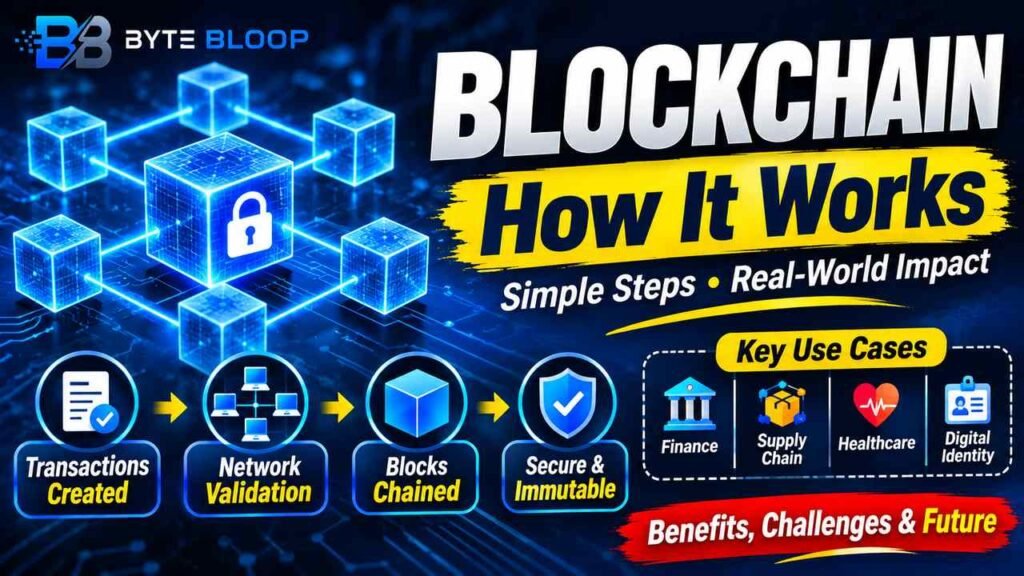
Every interaction on a blockchain begins with a transaction—an instruction that changes the state of the ledger, such as transferring digital currency or recording a contract. These transactions are broadcast to the network, where they are collected into a data structure called a block. A block contains a set of transactions, a reference to the previous block (its hash), and a cryptographic proof that verifies the block’s integrity.
Validation Through Consensus Mechanisms
Before a block can be appended to the chain, network participants must agree on its validity. This agreement is achieved through consensus algorithms. The most common is Proof of Work (PoW), where miners solve complex puzzles to earn the right to add a block. PoW ensures that altering a block would require re‑solving the puzzle for that block and all subsequent ones—an impractical task for a large network. Other mechanisms, such as Proof of Stake (PoS) and Delegated Proof of Stake (DPoS), reduce energy consumption by selecting validators based on stake or reputation, respectively.
This matters directly for anyone exploring blockchain how it works.
The Chain: Linking Blocks in an Immutable Sequence
Each block’s hash is calculated from its contents and the hash of the previous block. This linking creates a chronological chain where tampering with a single block would alter its hash and break the chain, alerting participants to fraud. Because the chain is replicated across thousands of nodes, no single party can rewrite history without controlling a majority of the network—a scenario that is statistically unlikely in well‑established blockchains.
Getting blockchain how it works right can make a real difference.
Smart Contracts and Programmability
Beyond simple value transfer, modern blockchains support programmable scripts called smart contracts. These contracts automatically execute predefined rules when certain conditions are met, enabling decentralized applications (dApps) that run without intermediaries. For example, a supply‑chain dApp can automatically release payments once a shipment’s GPS coordinates match a contract’s destination, reducing paperwork and fraud.
That is a core part of understanding blockchain how it works.
Practical Use Cases in 2026
- Financial Services: Cross‑border payments now settle in minutes, cutting costs and eliminating correspondent banks.
- Supply Chain: Transparent tracking from raw material to retail shelf ensures authenticity and compliance.
- Healthcare: Patient records stored on a permissioned blockchain improve interoperability while safeguarding privacy.
- Identity Management: Decentralized identifiers (DIDs) give users control over personal data, reducing identity theft.
Challenges and Considerations
Despite its promise, blockchain faces hurdles. Scalability remains a concern; high transaction volumes can slow networks and raise fees. Regulatory uncertainty also affects adoption, as governments grapple with how to classify digital assets and enforce compliance. Finally, energy consumption, especially in PoW systems, continues to draw criticism, prompting a shift toward greener consensus models.
Many readers look into blockchain how it works for exactly this reason.
Future Outlook
As standards mature and interoperability improves, blockchains are expected to integrate more tightly with existing IT infrastructures. Layer‑two solutions and sidechains are already extending capacity, while cross‑chain bridges promise seamless asset transfer between ecosystems. The convergence of blockchain with AI and IoT could unlock new automation layers, turning data streams into autonomous, trustless workflows.
It is worth revisiting blockchain how it works as things develop.
Key Takeaways
- Decentralized ledger eliminates single points of failure
- Consensus mechanisms ensure data integrity and security
- Smart contracts enable automated, trustless transactions
- Scalability and regulatory challenges remain key barriers
- Future integrations with AI and IoT promise new use cases
Frequently Asked Questions
What is blockchain technology?
Blockchain is a decentralized digital ledger that records transactions across a network of computers, ensuring transparency and immutability.
Blockchain How It Works remains highly relevant here.
What are the key features of a blockchain?
Key features include decentralization, consensus-based validation, cryptographic linking of blocks, and the ability to host smart contracts.
This is a key consideration when it comes to blockchain how it works.
What are the best use cases for blockchain?
Popular use cases include cross‑border payments, supply‑chain traceability, healthcare record management, and decentralized identity.
This matters directly for anyone exploring blockchain how it works.
What are the pros and cons of blockchain?
Pros: security, transparency, reduced intermediaries. Cons: scalability limits, regulatory uncertainty, and high energy use in some consensus models.
Conclusion
Based on the available information and industry analysis, blockchain technology offers a robust framework for secure, transparent, and tamper‑proof record keeping that can transform a wide range of sectors—from finance to supply chain to identity management—while simultaneously presenting challenges in scalability, regulatory clarity, and energy consumption.
Related Reading
- Blockchain vs. Traditional Databases: A Comparative Overview
Sources & References
- Blockchain Facts: What Is It, How It Works, and How It Can …
- Blockchain payments in 2026: a step by step guide for …
- What Is Blockchain? | IBM
- What is Blockchain Technology? Types and 2026 Guide
- Blockchain Technology: What Is It & How It Works in 2026
Related Articles