Quantum Computing: How It Works
Introduction (Quantum Computing How It Works)
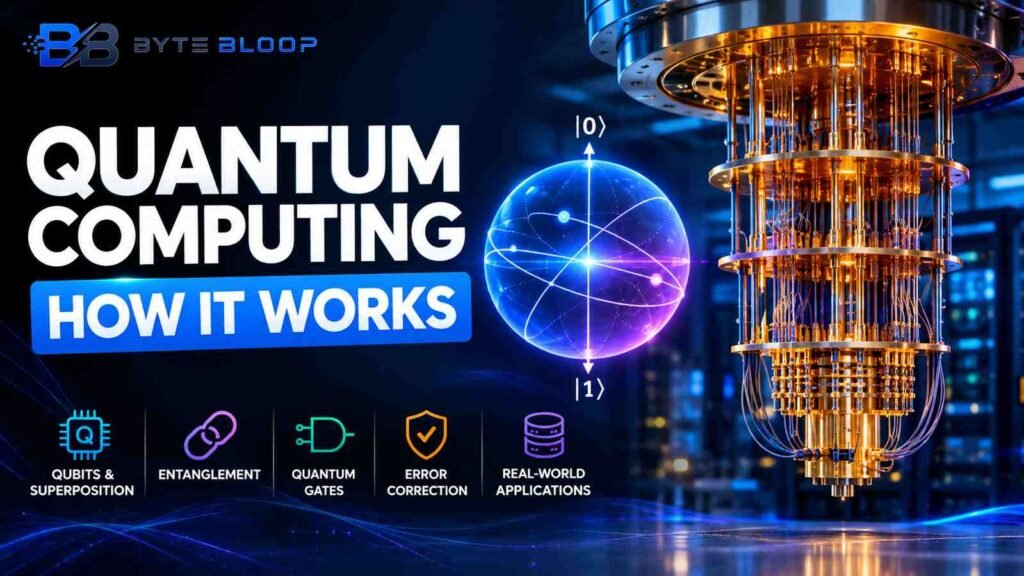
Quantum Computing How It Works is a topic worth understanding well. Quantum computing is often described as the next leap in computational power, but what makes it so different from the silicon‑based machines that dominate today? At its core, a quantum computer leverages the strange rules of quantum mechanics—superposition, entanglement, and interference—to process information in ways that classical bits cannot.
Instead of a binary 0 or 1, a quantum bit, or qubit, can exist in a blend of both states simultaneously, allowing a single device to explore many possible solutions at once. This capability opens the door to solving certain classes of problems—such as factoring large numbers, simulating molecular systems, and optimizing complex networks—orders of magnitude faster than traditional algorithms. The practical implications are vast, from accelerating drug discovery to cracking cryptographic codes, yet the technology remains in its infancy, with challenges in error rates, qubit coherence, and scalable architecture.
Understanding how quantum computing works involves unpacking its physical principles, the logic gates that manipulate qubits, and the error correction schemes that keep calculations reliable. The field is rapidly evolving, with breakthroughs in superconducting circuits, trapped ions, and topological qubits pushing the boundaries of what’s possible. This guide will walk through the fundamental concepts, illustrate real‑world applications, and outline the hurdles that researchers must overcome to bring quantum advantage to everyday use.
Qubits: The Building Blocks of Quantum Power
While classical computers store data in bits that are strictly 0 or 1, qubits can occupy a spectrum of states. According to the book Understanding Quantum Technologies 2026, a qubit’s state is described by a probability amplitude, enabling it to represent multiple values simultaneously. This phenomenon, called superposition, means that a quantum processor with 50 qubits can, in theory, represent over a quadrillion (250) different combinations at once. However, qubits are delicate; interactions with the environment can collapse their state, a problem known as decoherence.
Entanglement: Linking Qubits Across Space
Entanglement is another quantum property that creates a correlation between qubits regardless of distance. When two qubits become entangled, the state of one instantly influences the other. This link is crucial for quantum algorithms like Shor’s factoring or Grover’s search, which rely on coordinated operations across many qubits. The National Institute of Standards and Technology (NIST) notes that entanglement enables error detection protocols that would be impossible with classical bits alone.
This matters directly for anyone exploring quantum computing how it works.
Quantum Gates and Circuits
Just as classical computers use logic gates (AND, OR, NOT) to build circuits, quantum computers use quantum gates—unitary operations that rotate qubit states on the Bloch sphere. Common gates include the Pauli X, Y, Z, Hadamard, and CNOT. The Hadamard gate, for example, creates a perfect superposition from a single qubit, while the CNOT gate entangles two qubits. A sequence of these gates forms a quantum circuit that executes an algorithm. The NIST article on quantum computing explains that these gates are implemented physically through microwave pulses, laser beams, or magnetic fields, depending on the qubit platform.
Getting quantum computing how it works right can make a real difference.
Error Correction and Fault Tolerance
Quantum operations are noisy; a single error can ruin an entire calculation. To mitigate this, researchers employ quantum error correction codes, such as the surface code, which encode logical qubits into many physical qubits. According to the MDPI journal article, a surface code requires a lattice of at least 1,000 physical qubits to protect a single logical qubit, illustrating the resource overhead. Advances in hardware fidelity and error‑correcting algorithms are gradually reducing this overhead, bringing practical quantum advantage closer to reality.
That is a core part of understanding quantum computing how it works.
Hardware Platforms
Several physical systems compete to host qubits. Superconducting circuits, used by companies like IBM and Google, rely on Josephson junctions cooled to millikelvin temperatures. Trapped‑ion systems, employed by IonQ, confine charged atoms with laser fields, offering long coherence times. Topological qubits, explored by research groups worldwide, aim to encode information in non‑local states that are inherently resistant to local noise. Each platform balances trade‑offs between scalability, coherence, and gate speed.
Many readers look into quantum computing how it works for exactly this reason.
Real‑World Applications
Quantum advantage is most evident in niche domains. In cryptography, Shor’s algorithm threatens RSA and ECC schemes by factoring large integers efficiently. In materials science, quantum simulators can model electron interactions in complex molecules, accelerating drug discovery. Optimization problems—such as routing delivery trucks or scheduling airline crews—benefit from quantum annealers that can explore many configurations simultaneously. The AI and Quantum Computing Explained 2026 guide highlights how hybrid quantum‑classical workflows are already enhancing machine‑learning training by providing faster sampling of high‑dimensional spaces.
It is worth revisiting quantum computing how it works as things develop.
Challenges and the Road Ahead
Despite rapid progress, large‑scale quantum computers remain out of reach. The main obstacles are maintaining qubit coherence, scaling up qubit counts while preserving connectivity, and developing robust error‑correcting codes. Funding and interdisciplinary collaboration are accelerating research, but a fully fault‑tolerant system may still be decades away. Nevertheless, the field’s trajectory suggests that even modest quantum processors will find practical uses in the near term, especially when paired with classical infrastructure.
Quantum Computing How It Works remains highly relevant here.
Key Takeaways
- Qubits use superposition to represent multiple states simultaneously.
- Entanglement links qubits, enabling coordinated operations across distances.
- Quantum gates manipulate qubit states via precise physical operations.
- Error correction is essential to counteract noise and decoherence.
- Different hardware platforms offer trade‑offs in scalability and coherence.
- Current applications include cryptography, materials science, and optimization.
- Quantum advantage is still limited to specialized problems, but growth is rapid.
Frequently Asked Questions
What is a qubit?
A qubit is the quantum analogue of a classical bit, capable of existing in a superposition of 0 and 1 states simultaneously, which allows quantum computers to process many possibilities at once.
This is a key consideration when it comes to quantum computing how it works.
What are the key features of quantum computing?
Quantum computing relies on superposition, entanglement, and interference, uses quantum gates to manipulate qubits, and requires error correction to maintain coherence.
This matters directly for anyone exploring quantum computing how it works.
What are the best use cases for quantum computing?
Ideal applications include integer factorization for cryptography, quantum simulation of molecular systems for drug discovery, and optimization problems like routing and scheduling.
Getting quantum computing how it works right can make a real difference.
What are the pros and cons of quantum computing?
Pros: exponential speedup for certain problems, new algorithmic possibilities, and potential breakthroughs in science. Cons: high error rates, demanding cooling and isolation, and current lack of scalable, fault‑tolerant architectures.
That is a core part of understanding quantum computing how it works.
Conclusion
Based on the available information and industry analysis, quantum computing offers unprecedented computational power for specific problem classes, yet its practical deployment hinges on overcoming significant hardware and error‑correction challenges. As research progresses, hybrid quantum‑classical systems are already delivering incremental benefits in cryptography, materials science, and optimization, signaling a gradual shift toward mainstream quantum applications.
Related Reading
- Quantum Algorithms Explained
- The Future of Quantum Hardware
Sources & References
Related Articles