
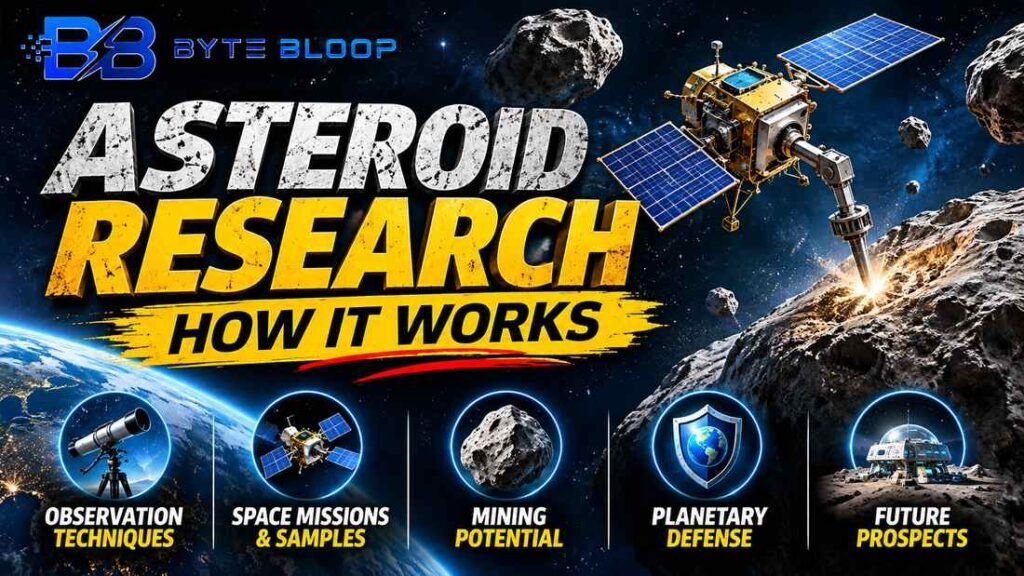
Asteroid Research: How It Works
Introduction
Asteroid Research How It Works is a topic worth understanding well. Asteroids, the rocky relics of the early solar system, hold clues to planetary formation, potential resources, and impact threats. Scientists investigate these bodies using a blend of ground‑based telescopes, space probes, and computer simulations. The goal is to map their composition, orbit, and physical properties, which informs both scientific knowledge and practical applications like mining or planetary defense. Recent missions such as NASA’s OSIRIS‑REx and proposed probes like Nova demonstrate the feasibility of in‑situ sampling and drilling.
By combining remote sensing with laboratory analysis, researchers can determine mineralogy, density, and internal structure, revealing how these objects evolved over billions of years. Understanding asteroid dynamics also supports risk assessment for Earth‑impact events, guiding mitigation strategies. Moreover, the prospect of asteroid mining offers a new frontier for raw materials, potentially reducing the need for Earth‑based mining. This article explains the tools, techniques, and challenges of asteroid research, and why it matters for the future of space and Earth.
Observing Asteroids from Earth
Ground‑based telescopes remain the first line of defense in detecting and tracking near‑Earth objects (NEOs). By measuring an asteroid’s brightness and motion across the sky, astronomers calculate its orbit and size. Photometric surveys like Pan‑STARRS and the Catalina Sky Survey scan large sky areas nightly, flagging moving points of light for follow‑up. Spectroscopy, performed with larger telescopes, identifies surface minerals by analyzing reflected light wavelengths. These observations help classify asteroids into types—C‑type carbonaceous, S‑type silicate, or M‑type metallic—each with distinct composition profiles.
Spacecraft Missions: From Flybys to Sample Return
Space probes provide the most detailed data. The 2018 OSIRIS‑REx mission rendezvoused with the near‑Earth asteroid Bennu, mapping its surface, measuring its mass, and collecting a 2‑kilogram sample for return to Earth. According to the OSIRIS‑REx mission report, the sample contains organics and water‑bearing minerals, offering insights into the early solar system’s chemistry. Future missions, such as the proposed Nova probe, aim to drill into asteroid interiors, extracting core material for analysis. Nova’s design includes a robotic arm and drilling system capable of penetrating several meters, allowing scientists to study layers that have remained untouched since the solar system’s birth.
This matters directly for anyone exploring asteroid research how it works.
Remote Sensing and Radar Imaging
Radar observations from facilities like Arecibo (before its collapse) and Goldstone transmit radio waves that bounce off an asteroid’s surface, revealing shape, rotation, and surface roughness. By measuring time delays and frequency shifts, researchers deduce an asteroid’s spin state and even detect binary companions. Infrared telescopes, both ground‑based and space‑based like the NEOWISE mission, measure thermal emission, which informs size and albedo estimates. Combining optical, infrared, and radar data yields a comprehensive 3‑D model of an asteroid’s shape and surface features.
Getting asteroid research how it works right can make a real difference.
Computational Modeling and Simulations
Computer models simulate asteroid formation, collisional evolution, and dynamical behavior. Researchers use N‑body simulations to track how asteroid orbits change over time due to gravitational interactions with planets and the Yarkovsky effect—a subtle force from uneven heat radiation. These models predict future trajectories, helping assess impact risk. Additionally, finite element analysis models the structural integrity of asteroids, informing both mining feasibility and deflection strategies.
That is a core part of understanding asteroid research how it works.
Asteroid Mining Feasibility
Studies such as the 2025 Phys.org feasibility analysis show that many near‑Earth asteroids contain water, metals, and rare earth elements. Mining would involve landing a robotic platform, drilling, and processing material in microgravity. The extracted water could be split into hydrogen and oxygen for rocket propellant, creating a sustainable fuel supply in space. However, the economic viability depends on launch costs, processing efficiency, and market demand for extracted materials.
Many readers look into asteroid research how it works for exactly this reason.
Planetary Defense and Policy Integration
The Asteroid Science Tool for Planetary Defense and Law project, led by Duke University, seeks to integrate scientific risk assessment with policy decision‑making. By providing real‑time impact probability calculations, the tool supports international agreements on mitigation measures. The project emphasizes the need for coordinated global monitoring, rapid response protocols, and public communication strategies to reduce the risk of catastrophic impacts.
It is worth revisiting asteroid research how it works as things develop.
Future Directions and Emerging Technologies
Advances in autonomous navigation, AI‑driven data analysis, and miniature sensor packages are lowering the cost and increasing the capability of asteroid missions. CubeSats and small satellites can perform targeted reconnaissance, reducing the need for large launch vehicles. Machine learning algorithms process vast imaging datasets, identifying surface features and composition signatures more efficiently than traditional methods. These innovations will accelerate the pace of discovery and bring asteroid research closer to commercial and defense applications.
Asteroid Research How It Works remains highly relevant here.
Key Takeaways
- Asteroids are key to understanding solar system history and potential resources.
- Ground‑based telescopes and radar provide initial detection and orbit determination.
- Space missions like OSIRIS‑REx deliver detailed surface and compositional data.
- Computational models predict orbital evolution and impact risk.
- Asteroid mining could supply water, metals, and propellant for deep‑space missions.
- Planetary defense tools integrate science with policy for timely response.
Frequently Asked Questions
What is asteroid research how it works?
Asteroid research combines telescopic observations, radar imaging, spacecraft missions, and computational modeling to determine an asteroid’s orbit, composition, and physical properties.
This is a key consideration when it comes to asteroid research how it works.
What are the key techniques used in asteroid studies?
Key techniques include optical photometry, spectroscopy, radar imaging, infrared thermal measurements, sample‑return missions, drilling probes, and computer simulations.
This matters directly for anyone exploring asteroid research how it works.
What are the main applications of asteroid research?
Applications range from understanding planetary formation and sourcing raw materials for space mining to assessing and mitigating Earth‑impact threats.
Getting asteroid research how it works right can make a real difference.
What are the pros and cons of asteroid mining?
Pros include access to abundant water and metals for space use; cons involve high launch costs, technical challenges of mining in microgravity, and uncertain market demand.
Conclusion
Based on the available information and industry analysis, asteroid research provides a dual benefit: unlocking a wealth of scientific knowledge about the early solar system and opening pathways to sustainable space resource utilization. By integrating ground‑based observations, robotic missions, and advanced simulations, scientists can map asteroid properties, assess impact risks, and evaluate mining feasibility, thereby supporting both planetary defense and the emerging space economy.
Related Reading
- The Future of Space Mining: Opportunities and Challenges
Sources & References
- Asteroid and lunar space resources for future space industry
- Nova: Unlocking Asteroid Wealth! Are asteroids just rocks, or …
- Asteroid Science: A Tool for Planetary Defense, Law and …
- Asteroids — Asteroids, sometimes called minor planets, are rocky, airless remnants left over from the early formation of our solar system about 4.6 billion years ago.
Related Articles


