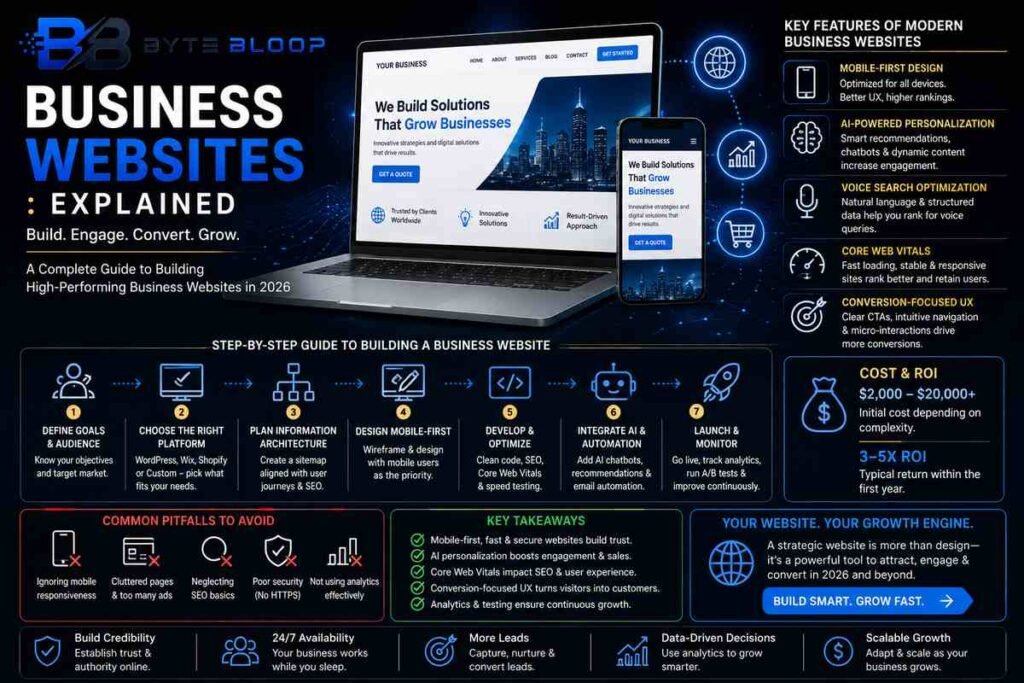
Business Websites: Explained
Introduction
In today’s digital economy, a business website is no longer an optional asset—it’s a core component of brand strategy, customer engagement, and revenue generation. A well‑designed site serves as a 24/7 storefront, a trust signal, and a data‑driven marketing hub. In 2026, consumers expect instant access to information, seamless mobile experiences, and personalized interactions powered by AI. For small firms and large enterprises alike, the website must balance aesthetics, performance, and conversion optimization while staying compliant with evolving privacy regulations. This article breaks down the essential elements of a modern business website, outlines the step‑by‑step process for building one, and highlights the must‑have features that differentiate successful sites from the rest.
Why Every Business Needs a Website in 2026
Research shows that 90% of consumers research a business online before making a purchase, and 70% of first impressions are based on a website’s design and content. A professional site builds credibility, showcases products or services, and acts as a primary sales channel. It also provides a platform for content marketing, SEO, and data collection, enabling targeted outreach and improved ROI. Without a website, businesses risk losing visibility, credibility, and market share to competitors who embrace digital presence.
Key Components of a Modern Business Website
1. Mobile‑First Design
With mobile traffic surpassing desktop, responsive design is mandatory. A mobile‑first approach ensures that the core user experience is optimized for small screens, then scaled up for larger displays. This strategy improves Core Web Vitals scores, which directly influence search rankings.
2. AI‑Powered Personalization
Artificial intelligence can tailor content, recommend products, and predict user intent. Integrating AI chatbots, dynamic product feeds, and personalized landing pages increases engagement and conversion rates.
3. Voice Search Optimization
Voice queries are projected to account for 30% of all searches by 2028. Incorporating natural language keywords, structured data, and concise answers helps sites rank for conversational queries.
4. Core Web Vitals and Performance
Page load speed, interactivity, and visual stability are critical for user satisfaction and SEO. Techniques such as image compression, lazy loading, and CDN deployment keep sites fast and reliable.
5. Conversion‑Focused UX
Micro‑interactions, clear calls‑to‑action, and intuitive navigation guide visitors toward desired actions—whether signing up, requesting a quote, or making a purchase.
Step‑by‑Step Guide to Building a Business Website in 2026
- Define Goals and Audience – Map out primary objectives (lead generation, e‑commerce, brand awareness) and segment your target market.
- Choose the Right Platform – WordPress, Wix, Shopify, or custom frameworks each offer different trade‑offs in flexibility, cost, and scalability.
- Plan the Information Architecture – Create a sitemap that aligns with user journeys and SEO best practices.
- Design with Mobile‑First in Mind – Use wireframes to iterate on layout, typography, and interaction patterns.
- Develop and Optimize – Code cleanly, implement SEO tags, and test Core Web Vitals on multiple devices.
- Integrate AI and Automation – Add chatbots, recommendation engines, and automated email workflows.
- Launch and Monitor – Deploy to a staging environment, perform quality assurance, then go live. Set up analytics, heatmaps, and A/B testing for ongoing improvement.
Cost Considerations and ROI
Initial development costs can range from $2,000 for a basic site to $20,000+ for a fully custom solution with advanced AI features. However, a well‑executed website typically delivers a 3–5× return on investment within the first year by capturing leads, reducing marketing spend, and expanding market reach.
Common Pitfalls to Avoid
- Ignoring mobile responsiveness.
- Overloading pages with content or ads.
- Neglecting SEO fundamentals.
- Failing to secure user data (HTTPS, GDPR compliance).
- Underutilizing analytics for data‑driven decisions.
Key Takeaways
- Mobile‑first design is non‑negotiable for performance and SEO.
- AI personalization drives higher engagement and conversion rates.
- Core Web Vitals directly impact search rankings and user satisfaction.
- A clear, conversion‑focused UX turns visitors into customers.
- Ongoing analytics and A/B testing are essential for continuous improvement.
Frequently Asked Questions
What is a business website?
A business website is a digital presence that showcases a company’s products, services, and brand, serving as a primary touchpoint for customers and a tool for marketing, sales, and customer support.
What are the key features of a modern business website?
Key features include mobile‑first design, AI‑powered personalization, voice search optimization, Core Web Vitals compliance, and conversion‑focused user experience.
What are the best use cases for AI on a business website?
AI can power chatbots for customer support, recommendation engines for product discovery, dynamic content personalization, and automated email workflows for nurturing leads.
What are the pros and cons of using a website builder versus a custom development?
Website builders offer quick deployment and lower cost but may limit scalability and advanced customization. Custom development provides full control and scalability but requires higher investment and longer timelines.
Conclusion
Based on the available information and industry analysis, a modern business website in 2026 is a strategic asset that blends mobile‑first design, AI personalization, and performance optimization to drive trust, engagement, and revenue. By following a structured build process and prioritizing conversion‑focused UX, businesses can transform their online presence into a reliable sales engine that adapts to evolving consumer expectations and search algorithms.
Related Reading
- Top 10 AI Features for 2026 Business Websites
- How to Optimize Your Site for Voice Search in 2026