Functional Programming: Explained
Introduction (Functional Programming Explained)
Functional Programming Explained is a topic worth understanding well. Functional programming is a paradigm that treats computation as the evaluation of mathematical functions and avoids mutable state and side effects. Unlike imperative or object‑oriented styles, it encourages building software by composing small, pure functions that can be combined, reused, and reasoned about independently. This approach leads to code that is often shorter, easier to test, and less prone to bugs caused by hidden state changes.
Functional concepts such as first‑class functions, higher‑order functions, and lazy evaluation have influenced mainstream languages, from JavaScript’s arrow functions to Java’s streams. Understanding functional programming can unlock new ways to write cleaner, more maintainable code, especially in concurrent or data‑intensive applications. By embracing immutability and declarative expressions, developers can focus on what the program should do rather than how it should do it. This article walks through the core ideas, common patterns, and practical examples that illustrate why functional programming remains a powerful tool in modern software development.
Core Concepts of Functional Programming
Pure Functions produce the same output for a given input and have no observable side effects. This predictability makes reasoning and testing straightforward. For example, a function that adds two numbers is pure because it never changes external state.
First‑Class and Higher‑Order Functions treat functions as values that can be passed, returned, or stored. This allows building flexible abstractions like map, filter, and reduce, which operate on collections by applying a supplied function.
This matters directly for anyone exploring functional programming explained.
Immutability means data structures are not altered after creation. Instead, new versions are returned, preserving the original state. This eliminates bugs related to shared mutable state, especially in concurrent environments.
Getting functional programming explained right can make a real difference.
Declarative Style focuses on describing the desired outcome rather than the steps to achieve it. Languages like Haskell or modern JavaScript let developers express intent with concise syntax, letting the runtime handle execution details.
That is a core part of understanding functional programming explained.
Why Functional Programming Matters Today
Modern applications often require high concurrency, fault tolerance, and maintainability. Functional programming’s avoidance of shared mutable state aligns naturally with parallel execution models, reducing race conditions. Additionally, the composability of pure functions supports microservices and serverless architectures, where isolated units of logic are preferred.
Many readers look into functional programming explained for exactly this reason.
Practical Example: Data Transformation Pipeline
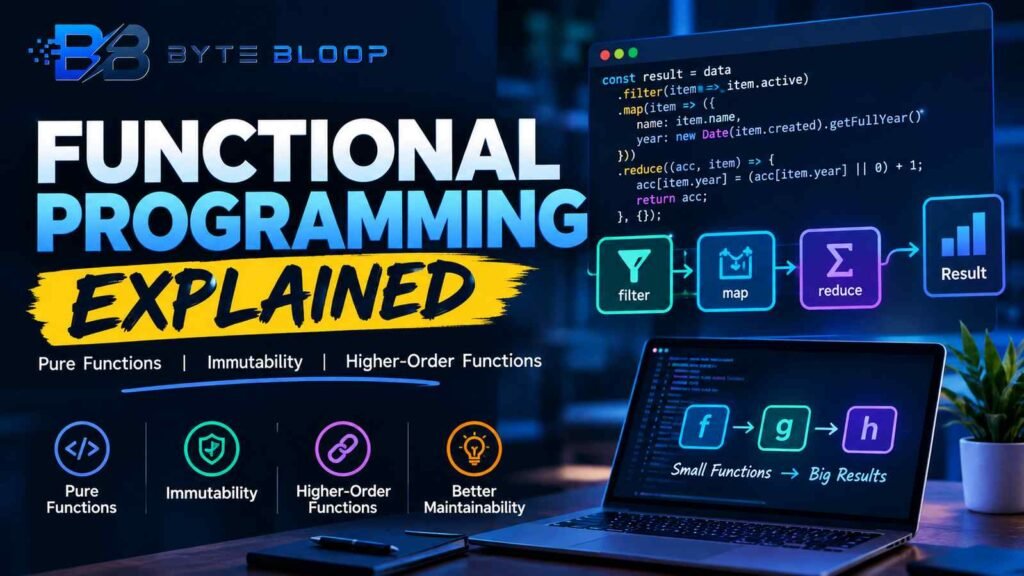
Consider a dataset of user records that need filtering, transformation, and aggregation. In a functional style, the pipeline might look like this in JavaScript:
It is worth revisiting functional programming explained as things develop.
const users = [...];
const activeUsers = users
  .filter(user => user.isActive)
  .map(user => ({
    name: user.name,
    signupYear: new Date(user.signup).getFullYear()
  }))
  .reduce((acc, user) => {
    acc[user.signupYear] = (acc[user.signupYear] || 0) + 1;
    return acc;
  }, {});
Each step is a pure function: filter returns a new array, map creates new objects, and reduce aggregates without mutating the original data. This chain is readable, testable, and easily parallelizable.
Functional Programming Explained remains highly relevant here.
Common Pitfalls and How to Avoid Them
- Over‑Abstraction: Excessive use of higher‑order functions can obscure intent. Keep abstractions clear and document their purpose.
- Performance Overheads: Immutable data structures may incur copying costs. Use persistent data libraries or optimize with structural sharing where needed.
- Learning Curve: Transitioning from imperative to functional thinking requires practice. Start by refactoring small modules and gradually adopt functional patterns.
Best Practices for Adopting Functional Programming
- Start with pure functions: isolate logic that can be expressed without side effects.
- Introduce immutability incrementally: use immutable libraries or language features.
- Leverage existing functional utilities: libraries like Lodash/fp or Ramda provide composable helpers.
- Write tests for pure functions: they are deterministic, making unit tests trivial.
- Use type systems where available: TypeScript, Flow, or Haskell’s type inference catch many errors early.
Key Takeaways
- Functional programming treats computation as pure function evaluation.
- Immutability and pure functions reduce bugs in concurrent code.
- Higher‑order functions enable powerful data pipelines.
- Adopting functional patterns improves testability and maintainability.
- Incremental refactoring helps integrate FP into existing codebases.
Frequently Asked Questions
What is functional programming?
Functional programming is a paradigm where programs are built by composing pure functions, avoiding mutable state and side effects.
This is a key consideration when it comes to functional programming explained.
What are the key features of functional programming?
Key features include pure functions, first‑class functions, higher‑order functions, immutability, and a declarative style.
What are the best use cases for functional programming?
Functional programming excels in data transformation pipelines, concurrent systems, and applications where predictability and testability are critical.
What are the pros and cons of functional programming?
Pros: easier reasoning, fewer bugs, better concurrency support. Cons: learning curve, potential performance overhead, and sometimes verbose syntax.
Conclusion
Based on the available information and industry analysis, functional programming provides a robust framework for building reliable, maintainable, and concurrent software by emphasizing pure functions, immutability, and declarative expression. Its influence across modern languages demonstrates its enduring value for developers seeking clarity and correctness in complex systems.
Related Reading
- Top Functional Programming Languages in 2026
Sources & References
- Functional programming — In computer science, functional programming is a programming paradigm where programs are constructed by applying and composing functions.
- An introductory guide to functional programming concepts
- Learn Functional Programming from Scratch | Michael Sperber
- The Functional Programming Paradigm: Concepts, …
- Fundamentals of functional programming
- Top 4 Functional Programming Languages in 2026
- Functional Programming for Beginners
Related Articles