Multiplayer Games: Explained
Introduction
Multiplayer games have evolved from simple split‑screen coop to sprawling online universes that connect millions of players worldwide. At their core, these titles allow multiple users to interact in a shared virtual space, whether competing, cooperating, or simply exploring together. The rise of high‑speed broadband, low‑latency servers, and advanced networking engines has made real‑time interaction smoother than ever, turning casual mobile titles into competitive esports spectacles. Developers now leverage engines like Unreal and Unity, along with cloud services, to build persistent worlds that can scale from a handful of friends to global tournaments. For players, multiplayer games offer social engagement, replayability, and a chance to test skills against human opponents rather than scripted AI. In 2026, the genre remains a driving force behind console, PC, and mobile markets, with titles such as Splatoon 3, Street Fighter 6, and Super Smash Bros. Ultimate topping critical lists. Understanding the mechanics behind these games can help you choose the right title, improve your play, or even inspire your own development projects.
What Makes a Game Multiplayer?
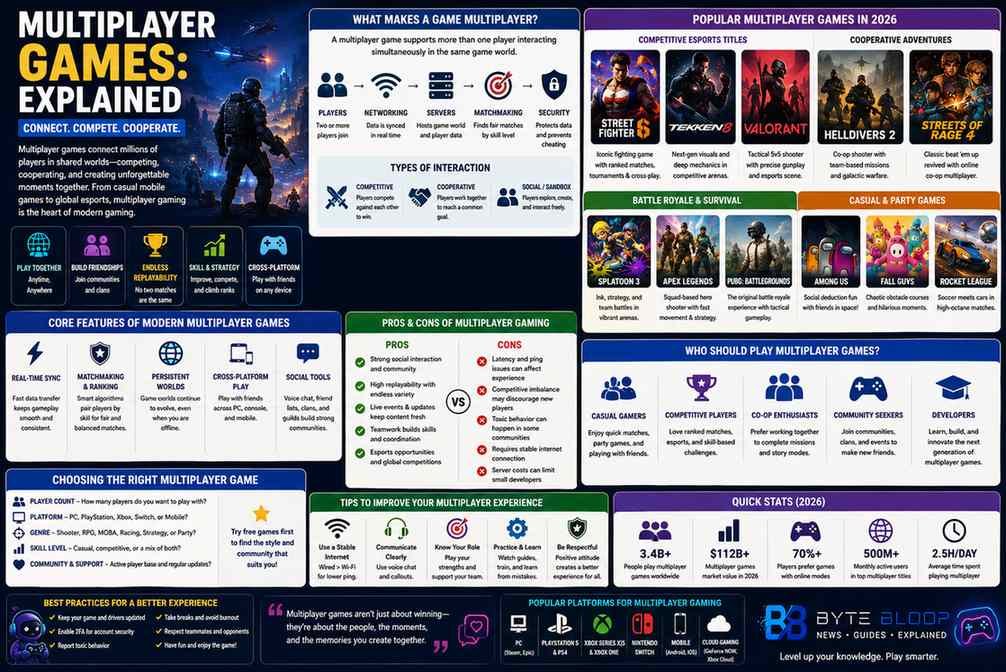
At its simplest, a multiplayer game is any game that supports more than one player interacting simultaneously. The interaction can be local—on the same console or device—or online, spanning continents. Key elements include a networking layer that synchronizes state, a matchmaking system that pairs players, and a server architecture that handles persistence and security.
Core Features of Modern Multiplayer Games
- Real‑time Sync: Fast packet transmission keeps all players’ views consistent.
- Matchmaking & Ranking: Algorithms group players by skill, ensuring fair competition.
- Persistent Worlds: Servers maintain game state even when players log off.
- Cross‑Platform Play: Players on different hardware can join the same match.
- Social Tools: Voice chat, friend lists, and guild systems foster community.
Popular Multiplayer Game Types in 2026
Competitive Esports Titles
Games like Street Fighter 6 and Tekken 8 offer ranked ladders, seasonal tournaments, and spectator modes that have turned them into professional sports.
Cooperative Adventures
Co‑op shooters and RPGs such as Streets of Rage 4 let players tackle missions together, sharing loot and strategy.
Battle Royale & Survival
Fast‑paced titles like Splatoon 3 pit squads against each other in time‑limited matches, emphasizing teamwork and map control.
Casual & Party Games
Mobile-friendly options, including free competitive titles highlighted by YouTube creators, provide quick, accessible fun for groups of friends.
Pros and Cons of Multiplayer Gaming
Pros
- Social interaction and community building.
- High replayability driven by player variability.
- Continuous updates and live events keep content fresh.
Cons
- Latency and network issues can frustrate players.
- Competitive imbalance may discourage newcomers.
- Server costs and maintenance can limit indie developers.
Who Should Play Multiplayer Games?
Anyone looking for social engagement, skill development, or competitive challenge can benefit. Casual gamers enjoy party titles, while hardcore players gravitate toward esports and large‑scale co‑op experiences. Developers interested in building games should study networking patterns and community tools to create engaging multiplayer systems.
Key Takeaways
- Multiplayer games connect millions through real‑time interaction
- Core tech: networking, matchmaking, persistence, cross‑play
- 2026’s top titles span competitive, co‑op, battle royale, and casual genres
- Pros include social play and replayability; cons involve latency and balance
- Developers must balance server costs with player experience
Frequently Asked Questions
What is a multiplayer game?
A multiplayer game allows two or more players to interact within the same game world, either locally or over the internet.
What are the key features of modern multiplayer games?
Fast real‑time synchronization, matchmaking algorithms, persistent servers, cross‑platform play, and built‑in social tools like voice chat.
What are the best use cases for multiplayer games?
Social bonding, competitive esports, cooperative storytelling, and skill development across all age groups.
What are the pros and cons of multiplayer games?
Pros: community, replayability, live events. Cons: latency, balance issues, high server costs.
Conclusion
Based on the available information and industry analysis, multiplayer games continue to be a cornerstone of the gaming ecosystem, offering dynamic social interaction and endless replayability. Their evolution—from split‑screen local play to global online arenas—has been driven by advances in networking, matchmaking, and cross‑platform capabilities. For players, this means more immersive experiences and competitive opportunities than ever before. For developers, mastering the technical and community aspects of multiplayer design is essential to create titles that resonate with a worldwide audience. Ultimately, multiplayer games remain a vibrant, ever‑expanding segment that shapes how we play, connect, and compete in 2026 and beyond.
Related Reading
- Top 10 Free Competitive Multiplayer Games of 2026