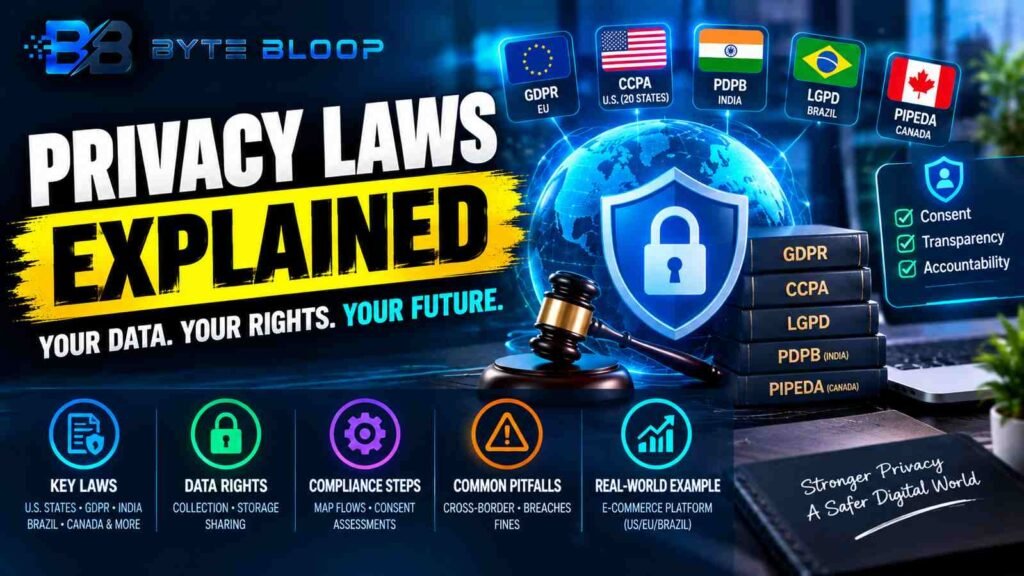
Privacy Laws: Explained
Introduction (Privacy Laws Explained)
Privacy Laws Explained is a topic worth understanding well. Privacy laws shape how personal data is collected, stored, and shared across the globe. In 2026, the regulatory landscape has expanded dramatically: twenty U.S. states now enforce comprehensive consumer privacy statutes, while the European Union’s General Data Protection Regulation (GDPR) remains the gold standard for data protection. Emerging markets such as India and Brazil have also introduced sweeping legislation—India’s Data Protection Bill and Brazil’s LGPD—forcing companies to rethink their data strategies.
These laws aim to protect individuals from misuse, fraud, and surveillance, but they also impose significant compliance burdens on businesses of all sizes. Understanding the core principles, key provisions, and practical implications of these regulations is essential for anyone handling personal data, whether you’re a startup founder, a compliance officer, or a developer building consumer apps. This guide breaks down the most influential privacy laws, highlights common pitfalls, and offers actionable steps to stay compliant in 2026 and beyond.
Core Concepts of Modern Privacy Laws
At their heart, privacy laws center on three pillars: consent, transparency, and accountability. Consent requires that individuals knowingly agree to data collection, often through clear opt‑in mechanisms. Transparency mandates that organizations disclose what data they collect, why, and how long it will be retained. Accountability forces companies to implement technical and administrative safeguards, conduct privacy impact assessments, and report breaches within strict timelines.
Key U.S. State Laws in 2026
According to Data Privacy Laws: What You Need to Know in 2026, twenty states have enacted comprehensive consumer privacy laws effective January 1, 2026. Indiana, Kentucky, and Rhode Island are the most stringent, imposing strict data minimization and breach notification requirements. These statutes mirror federal frameworks like the California Consumer Privacy Act (CCPA) but add state‑specific provisions such as mandatory data escrow and enhanced consumer rights to data deletion.
This matters directly for anyone exploring privacy laws explained.
European Union – GDPR and UK GDPR
The GDPR, effective since 2018, remains the benchmark for privacy regulation. It requires explicit consent, the right to be forgotten, and data portability. The UK’s post‑Brexit GDPR adaptation retains most core GDPR principles but introduces a national supervisory authority and a separate Data Protection Act to address UK‑specific concerns. Companies operating in both jurisdictions must navigate overlapping mandates, especially regarding cross‑border data transfers.
Getting privacy laws explained right can make a real difference.
Global Expansion: India, Brazil, Canada, and Beyond
India’s Data Protection Bill, still in the legislative process, is poised to establish a comprehensive framework that aligns with global best practices. Brazil’s LGPD, already in force, imposes similar obligations to the GDPR, including data breach notification and the appointment of a Data Protection Officer. Canada’s PIPEDA, while less prescriptive, requires organizations to obtain consent and protect personal data with reasonable security measures. These laws collectively illustrate a trend toward harmonization, with many jurisdictions adopting GDPR‑style principles.
That is a core part of understanding privacy laws explained.
Practical Compliance Steps for 2026
1. Map Your Data Flows: Identify where personal data enters, exits, and resides. Use data flow diagrams to pinpoint jurisdictional overlaps.
Many readers look into privacy laws explained for exactly this reason.
2. Implement Consent Management Platforms: Deploy tools that capture, store, and audit consent records in a tamper‑proof manner.
It is worth revisiting privacy laws explained as things develop.
3. Conduct Privacy Impact Assessments for high‑risk processing activities, especially those involving AI or predictive analytics.
Privacy Laws Explained remains highly relevant here.
4. Establish Breach Response Protocols: Draft incident response plans that meet the 72‑hour notification requirement of the GDPR and similar timelines in U.S. states.
This is a key consideration when it comes to privacy laws explained.
5. Appoint a Data Protection Officer where required, ensuring they have the authority to oversee compliance and liaise with supervisory authorities.
This matters directly for anyone exploring privacy laws explained.
Common Pitfalls and How to Avoid Them
Many organizations underestimate the cross‑border implications of data transfers. The GDPR’s “adequacy” framework and U.S. state laws’ “data escrow” provisions can create conflicting obligations. Regular audits and legal counsel are essential to reconcile these differences. Another frequent mistake is relying solely on technical safeguards; privacy laws demand administrative controls, employee training, and clear policies. Finally, failure to keep consent records up to date can lead to hefty fines—up to 4% of global turnover under the GDPR.
Getting privacy laws explained right can make a real difference.
Real‑World Example: E‑Commerce Platform
Consider an e‑commerce company that operates in the U.S., EU, and Brazil. It must maintain separate consent mechanisms for each region, enforce data minimization for EU customers, and provide data deletion requests within 30 days for Brazilian users. By implementing a unified privacy platform that supports multilingual consent forms and automated data subject request workflows, the company can achieve compliance while reducing operational overhead.
Key Takeaways
- GDPR remains the global benchmark for data protection.
- Twenty U.S. states have enacted comprehensive privacy laws by 2026.
- Cross‑border data transfers require careful mapping and legal review.
- Regular audits and a dedicated Data Protection Officer are essential for compliance.
- Consent management and breach response plans must be tailored to each jurisdiction.
Frequently Asked Questions
What is the difference between GDPR and CCPA?
GDPR focuses on data protection rights such as the right to be forgotten, while CCPA emphasizes consumer control over personal data sales.
Which U.S. states have the strictest privacy laws as of 2026?
Indiana, Kentucky, and Rhode Island have the most stringent statutes, adding requirements like data escrow and enhanced deletion rights.
How do global privacy laws affect cross‑border data transfers?
Organizations must map data flows, ensure adequacy decisions or standard contractual clauses, and reconcile overlapping state and federal mandates.
What are the key compliance steps for a startup in 2026?
Map data flows, implement consent management, conduct privacy impact assessments, establish breach protocols, and appoint a Data Protection Officer if required.
Conclusion
Based on the available information and industry analysis, privacy laws in 2026 provide a robust framework that balances individual rights with business innovation. By aligning data practices with GDPR, U.S. state statutes, and emerging global regulations, companies can mitigate legal risk while fostering consumer trust. The evolving landscape underscores the need for proactive compliance, continuous monitoring, and a holistic approach that blends legal, administrative, and technical safeguards. Ultimately, embracing privacy as a competitive advantage will position organizations for sustainable growth in an increasingly data‑centric world.
Related Reading
- Navigating Data Breach Notifications in 2026
- AI and Privacy: Regulatory Challenges Ahead
Sources & References
Related Articles