Subscription Businesses: Explained
Introduction
Subscription businesses have reshaped the way companies generate revenue, turning one‑time purchases into recurring streams that power growth and stability. The model, which charges customers a recurring fee—weekly, monthly, or annually—in exchange for ongoing access to a product or service, has become the backbone of many high‑growth startups and mature enterprises alike. According to Subscribe & Conquer, this structure delivers predictable cash flow, reduces acquisition costs, and fosters deeper customer relationships. The shift from transactional to subscription is not merely a pricing tweak; it requires a holistic change in product design, customer support, and data analytics to manage churn and lifetime value. Businesses that master this model can see valuations 5–8× higher than their one‑time‑revenue counterparts, as highlighted by IdeaProof. With the digital economy expanding, understanding the nuances of subscription business models is essential for entrepreneurs, investors, and marketers looking to stay competitive. This guide breaks down the core concepts, common types, pricing strategies, and practical steps to launch and scale a subscription venture in 2026.
What Is a Subscription Business?
A subscription business charges customers a recurring fee to access a product or service. The revenue model is built on repeat transactions, creating a predictable cash flow that can be forecasted and scaled. This recurring nature allows companies to invest confidently in product development, marketing, and infrastructure. The model also encourages continuous engagement, as customers expect ongoing value to justify the recurring cost.
Three Core Types of Subscription Models
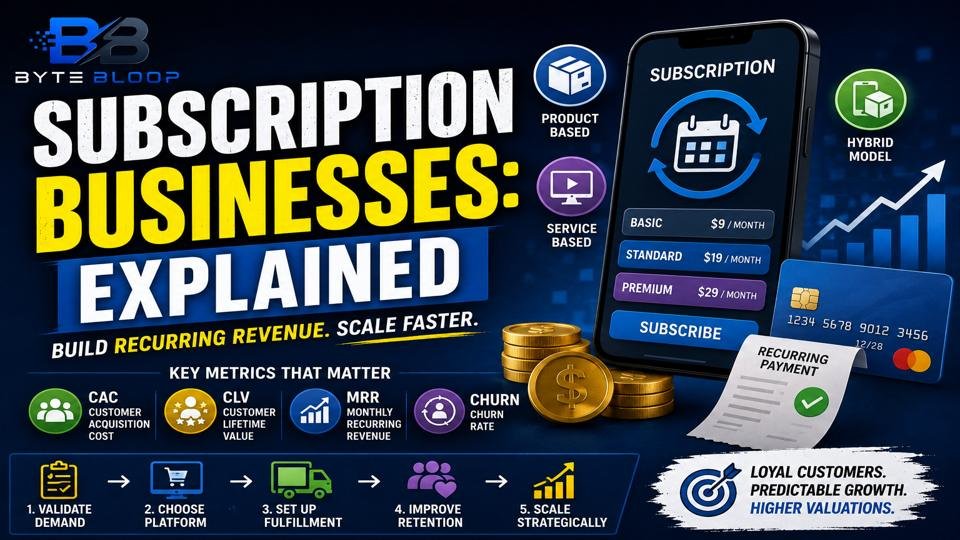
1. Product‑Based: Physical goods delivered on a schedule, such as meal kits or curated boxes. 2. Service‑Based: Access to digital or professional services, like streaming platforms or SaaS tools. 3. Hybrid: Combines physical and digital components, for example, a subscription box that includes a digital companion app.
Pricing Strategies That Drive Growth
Successful subscription businesses balance price, value, and churn. Common tactics include tiered pricing, where customers choose plans that fit their usage, and freemium models that attract users with free access before upselling. Chargebee notes that offering annual plans with a discount can reduce churn by encouraging long‑term commitment. Dynamic pricing, where rates adjust based on usage or engagement, also helps align revenue with customer value.
Key Metrics to Monitor
To ensure profitability, track metrics such as Customer Acquisition Cost (CAC), Customer Lifetime Value (CLV), Monthly Recurring Revenue (MRR), and Churn Rate. A healthy subscription business typically aims for a CLV that is at least three times its CAC. Monitoring churn is critical; even a 1% monthly churn can erode growth if not addressed. Tools like Shopify and Cleeng provide dashboards that simplify these calculations.
Launching a Subscription Business in 2026
1. Validate Demand: Use surveys, landing pages, and pre‑sales to confirm interest. Cleeng recommends a minimum viable product (MVP) that focuses on core features. 2. Choose a Platform: Shopify, WooCommerce, and custom solutions all support recurring billing. EasySubscription outlines best practices for setting up automated billing and customer portals. 3. Set Up Fulfillment: For physical products, partner with logistics providers that support subscription workflows. For digital services, ensure robust hosting and security. 4. Implement Retention Tactics: Offer loyalty rewards, personalized recommendations, and proactive support to reduce churn. 5. Scale Strategically: Use data to identify high‑value segments and expand pricing tiers or add complementary products.
Common Challenges and How to Overcome Them
Subscription businesses often struggle with high churn, complex billing, and customer acquisition costs. Regularly analyzing churn drivers—such as unmet expectations or pricing mismatches—helps refine the offering. Implementing clear cancellation policies and providing self‑service options can also improve customer satisfaction. Additionally, leveraging automation for billing, onboarding, and support reduces operational overhead and frees teams to focus on growth initiatives.
Key Takeaways
- Subscription models turn one‑time sales into predictable revenue streams.
- Tiered and freemium pricing can attract and retain diverse customer segments.
- Monitoring MRR, churn, and CLV is essential for long‑term profitability.
- Automation and data analytics reduce churn and improve customer experience.
- Hybrid models combine physical and digital assets for unique value propositions.
Frequently Asked Questions
What is a subscription business model?
A subscription business model charges customers a recurring fee—weekly, monthly, or annually—to access a product or service, creating predictable, repeat revenue.
What are the key features of subscription businesses?
Key features include recurring billing, customer lifecycle management, churn monitoring, tiered pricing, and a focus on continuous value delivery.
What are the best use cases for subscription businesses?
Subscription models thrive for products or services that benefit from regular use, such as software (SaaS), media streaming, meal kits, curated boxes, and professional services.
What are the pros and cons of subscription businesses?
Pros: predictable cash flow, higher valuation, deeper customer relationships. Cons: higher churn risk, complex billing, need for ongoing engagement.
Conclusion
Based on the available information and industry analysis, subscription businesses provide a resilient revenue foundation that fuels growth, enhances customer loyalty, and boosts valuations. By mastering pricing strategies, monitoring key metrics, and leveraging automation, entrepreneurs can transform a simple product or service into a scalable, recurring‑income engine that delivers long‑term value to both customers and investors.
Related Reading
- How to Reduce Churn in Subscription Businesses
- Top 10 SaaS Subscription Models of 2026
Sources & References
- Guide to Subscription Businesses – Subscribe & Conquer
- Subscription Business Models: Types, Pricing, And The …
- Subscription Business Model Guide: Types & Profitability (2026)
- How to Start a Digital Subscription Business in 2026
- 50 Subscription Business Ideas (2026 Revenue Data)
- How to Start a Subscription Business on Shopify (2026 …