Mixed Reality: Explained
Introduction
Mixed reality (MR) stands at the intersection of augmented reality (AR) and virtual reality (VR), creating a seamless blend where digital objects coexist and interact with the physical environment in real time. Unlike AR, which overlays graphics onto the real world, or VR, which immerses users in a completely virtual space, MR allows users to manipulate holographic elements as if they were tangible. This technology relies on sophisticated sensors, depth cameras, and spatial mapping to anchor digital content to real-world coordinates, enabling intuitive hand gestures and eye tracking for interaction. The result is an experience that feels both immersive and grounded, opening doors to new forms of communication, education, and entertainment. As hardware becomes more affordable and software frameworks mature, MR is poised to transform industries from architecture to remote collaboration. The ability to blend the tangible and virtual in a single environment offers unprecedented opportunities for designers, educators, and businesses alike. In this article, we unpack the core concepts, practical examples, and future directions of mixed reality, providing a clear roadmap for anyone curious about this evolving technology.
How Mixed Reality Works
At its core, MR depends on a pipeline of sensors that capture the physical world and translate it into a digital map. Depth cameras and LiDAR scanners map surfaces and obstacles, while inertial measurement units track head and hand positions. The MR headset or device then renders 3D models that align precisely with real-world objects, maintaining occlusion and shadows to enhance realism. Developers use platforms such as Microsoft’s Mixed Reality Toolkit or Unity’s XR Interaction Toolkit to build experiences that respond to user gestures, voice commands, and environmental changes.
Key Features Distinguishing MR
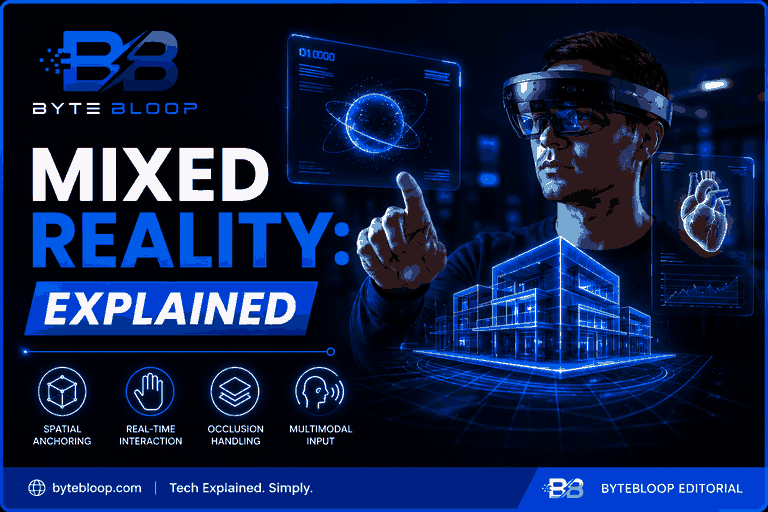
- Spatial Anchoring – Digital content remains fixed in a real-world location, even as the user moves.
- Real-Time Interaction – Users can pick up, rotate, or combine holograms with physical items.
- Occlusion Handling – Virtual objects are hidden behind real objects, preserving depth cues.
- Multimodal Input – Hands, voice, and gaze are used simultaneously for natural control.
Practical Applications Today
In architecture and design, MR lets clients walk through a building before construction, manipulating furniture and lighting in situ. Healthcare professionals use MR for surgical planning, overlaying patient scans onto the operative field to guide precision. Education benefits from interactive labs where students can assemble virtual molecules or conduct physics experiments in a classroom setting. The gaming industry is experimenting with hybrid titles that blend real-world obstacles with digital challenges, creating immersive scavenger hunts. In remote collaboration, MR enables distributed teams to share 3D models in real time, reducing the need for travel and accelerating decision-making.
Challenges and Limitations
Despite its promise, MR faces hurdles. High-resolution displays and precise tracking require expensive hardware, limiting consumer adoption. Latency between sensor input and visual output can break immersion, especially in fast-paced scenarios. Power consumption remains a concern for mobile MR devices, and software ecosystems are still fragmented, making cross-platform development complex. Additionally, privacy concerns arise when devices continuously capture detailed environmental data.
Future Outlook
Research indicates that MR will increasingly integrate artificial intelligence for predictive interaction and context-aware content. Edge computing will reduce latency, while advances in lightweight optics will bring true mobile MR to mainstream consumers. As standards converge, developers can create richer, more interoperable experiences, accelerating MR’s penetration across industries. The convergence of MR with other emerging technologies—such as 5G, AI, and advanced haptics—promises a future where digital and physical realities are indistinguishable.
Key Takeaways
- MR fuses AR and VR to create interactive, real‑world digital overlays
- Spatial anchoring keeps holograms fixed in place, enhancing realism
- Industries like architecture, healthcare, and education already benefit from MR tools
- Latency, cost, and power consumption remain key barriers to widespread adoption
- AI and edge computing will drive the next wave of immersive MR experiences
Frequently Asked Questions
What is mixed reality explained?
Mixed reality is a technology that blends digital content with the physical world, allowing virtual objects to interact with real environments in real time.
What are the key features of mixed reality?
Key features include spatial anchoring, real-time interaction, occlusion handling, and multimodal input such as hand gestures, voice, and gaze.
What are the best use cases for mixed reality?
Top use cases span architecture (walkthroughs), healthcare (surgical overlays), education (interactive labs), gaming (hybrid play), and remote collaboration (shared 3D models).
What are the pros and cons of mixed reality?
Pros: immersive interaction, real-world integration, cross-industry applications. Cons: high hardware cost, latency issues, power consumption, and fragmented software ecosystems.
Conclusion
Based on the available information and industry analysis, mixed reality provides a transformative bridge between digital and physical worlds, enabling unprecedented levels of interaction and collaboration across multiple sectors. As sensor accuracy improves and AI integration deepens, MR is set to become a mainstream tool for design, education, and entertainment, while ongoing challenges around cost and latency will shape its adoption trajectory.
Related Reading
- Virtual Reality vs. Augmented Reality: Key Differences