LangGraph: Explained
Introduction
LangGraph has emerged as a pivotal framework for building complex, stateful AI agents. Unlike traditional linear pipelines, LangGraph introduces a graph-based orchestration model that maps out decision points, data flow, and agent interactions in a deterministic way. This structure allows developers to design multi-step reasoning workflows that can pause, resume, and adapt based on real-time context. By integrating seamlessly with LangChain’s core, LangGraph extends the library’s capabilities from simple chains to fully-fledged, multi-agent systems. The framework’s emphasis on state persistence and checkpointing ensures that long-running tasks remain reliable, even across failures or restarts. As AI workloads grow in complexity, LangGraph offers a scalable solution that balances flexibility with control, making it a favorite among researchers and enterprise teams alike.
In this guide, we’ll unpack what LangGraph is, explore its core features, illustrate practical use cases, and compare it to related tools. Whether you’re a seasoned AI engineer or just starting out, understanding LangGraph will equip you to build smarter, more resilient agents.
What Is LangGraph?
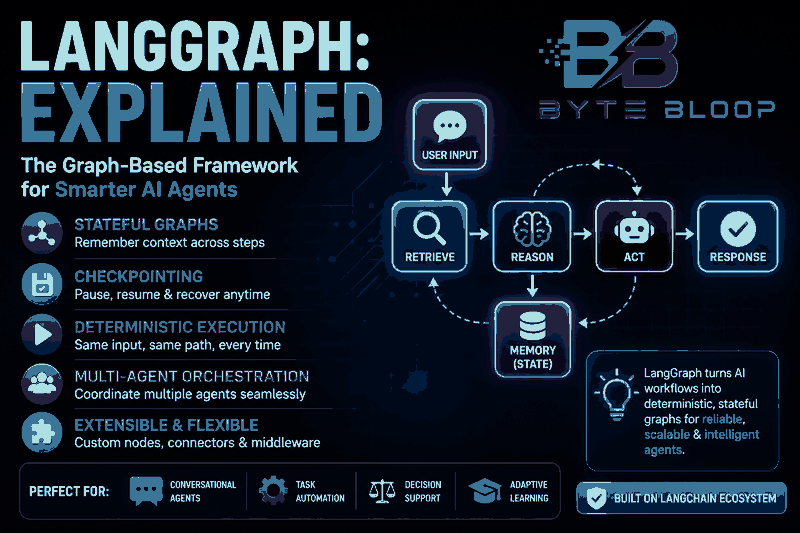
LangGraph is a deterministic execution engine built on top of LangChain’s ecosystem. It treats an AI workflow as a directed graph where each node represents an LLM call, a function, or a decision point. Edges dictate the flow of data and control between nodes. This model supports branching, looping, and parallel execution, enabling sophisticated reasoning patterns that were difficult to express in linear chains.
Core Features
- Stateful Graphs – Each node can read and write to a shared state, allowing agents to remember context across steps.
- Checkpointing & Persistence – Built-in checkpointers let you save and restore graph execution, which is critical for long-running or costly tasks.
- Deterministic Execution – The framework guarantees that the same input will follow the same path, aiding reproducibility and debugging.
- Agent Orchestration – Multiple agents can operate concurrently, each with its own policy, while the graph manages coordination.
- Extensibility – Custom nodes, connectors, and middleware can be added without touching the core engine.
Practical Use Cases
1. Conversational Agents: Build a chatbot that can switch between retrieval, reasoning, and generation steps based on user intent.
2. Complex Task Automation: Orchestrate a multi-step data extraction pipeline that queries databases, calls APIs, and validates results.
3. Decision Support Systems: Create a workflow that evaluates options, performs cost-benefit analysis, and recommends actions.
4. Educational Tutoring: Design adaptive learning paths where the system chooses the next lesson based on student performance.
How to Build a Simple LangGraph
Start by installing the latest LangChain and LangGraph packages:
pip install langchain langgraph==1.2.6Define nodes as Python functions or LLM calls. For example, a node that fetches data:
def fetch_data(state):
    response = api_call(state['query'])
    state['data'] = response
    return state
Then connect nodes in a graph:
graph = Graph()
graph.add_node('fetch', fetch_data)
graph.add_node('analyze', analyze_data)
graph.set_start('fetch')
graph.add_edge('fetch', 'analyze')
Run the graph with a state dictionary and let LangGraph handle the rest.
Pros and Cons
- Pros – Deterministic flow, state persistence, easy scaling, rich community support.
- Cons – Steeper learning curve than simple chains, requires careful design to avoid state bloat.
Alternatives
While LangGraph excels in orchestrating complex agents, other frameworks like CrewAI focus on multi-agent coordination without a graph model. LangChain Core remains the foundation for simpler linear pipelines. Choosing between them depends on workflow complexity and the need for deterministic execution.
Key Takeaways
- LangGraph turns AI workflows into deterministic, stateful graphs.
- Checkpointing ensures reliable long‑running tasks.
- It extends LangChain, offering advanced agent orchestration.
- Ideal for conversational agents, automation, and decision support.
- Learning curve is steeper than simple chains but rewards with flexibility.
Frequently Asked Questions
What is LangGraph?
LangGraph is a deterministic, graph-based orchestration engine built on LangChain that manages stateful AI workflows.
What are the key features of LangGraph?
Stateful nodes, checkpointing, deterministic execution, multi‑agent orchestration, and extensibility.
What are the best use cases for LangGraph?
Conversational agents, complex automation pipelines, decision support systems, and adaptive learning platforms.
What are the pros and cons of LangGraph?
Pros: deterministic flow, persistence, scalability. Cons: steeper learning curve, potential state management complexity.
Conclusion
Based on the available information and industry analysis, LangGraph provides a robust, deterministic framework for orchestrating complex AI agents, enabling developers to build scalable, stateful workflows that can pause, resume, and adapt with precision. Its integration with LangChain and built‑in checkpointing make it a compelling choice for enterprises seeking reliable, long‑running AI solutions.
Related Reading
- Building AI Agents with LangGraph: A Step-by-Step Guide