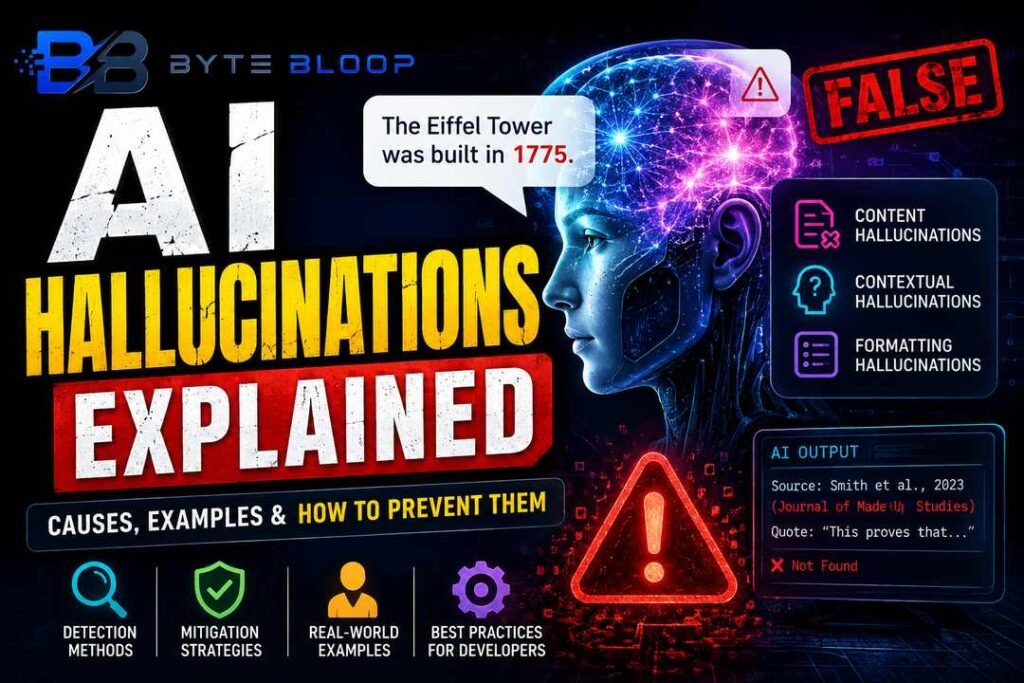
AI Hallucinations Explained
Introduction
Artificial intelligence has surged into everyday life, from chatbots that draft emails to generative models that paint images. Yet a growing concern shadows these advances: the phenomenon of AI hallucinations. In this context, a hallucination is not a dream but a false or misleading output that a model presents as fact. When a language model generates a plausible-sounding paragraph that contains fabricated dates, names, or statistics, it is hallucinating. This issue matters because users increasingly trust AI for research, decision‑making, and creative work, and hallucinations can spread misinformation or lead to costly mistakes. Understanding the mechanics, causes, and mitigation strategies of AI hallucinations is essential for developers, data scientists, and everyday users alike. The following sections break down the definition, types, root causes, detection methods, and practical steps to reduce hallucinations in AI systems. By the end, you will know how to recognize a hallucination and what tools can help you keep your AI outputs reliable.
What Exactly Are AI Hallucinations?
According to What Are AI Hallucinations?, AI hallucinations occur when an AI system produces outputs that sound plausible but are factually incorrect or irrelevant. They are common in large language models (LLMs) and generative AI because the models learn patterns from massive datasets rather than verifying facts. The hallucination is not a random glitch; it is a systematic bias in the model’s training and inference process.
Types of Hallucinations
Hallucinations can be classified into three main types:
- Content hallucinations – The model fabricates facts, such as inventing a company name or a scientific study.
- Contextual hallucinations – The model misinterprets user intent, providing information that is unrelated to the query.
- Formatting hallucinations – The model follows a template but fills it with incorrect data, like citing a nonexistent source.
Root Causes
Multiple factors contribute to hallucinations:
- Training data quality – Models trained on noisy or biased data inherit those inaccuracies.
- Prompt ambiguity – Vague or open‑ended prompts give the model room to speculate.
- Inference temperature – Higher temperature settings increase randomness, raising hallucination risk.
- Model architecture limits – Some models lack built‑in fact‑checking mechanisms.
Detection and Mitigation
Industry research suggests a layered approach:
- Fact‑checking APIs – Integrate services that cross‑reference model output with trusted databases.
- Human‑in‑the‑loop review – For high‑stakes applications, require manual verification before publication.
- Prompt engineering – Use explicit instructions like “Verify before responding” or “Cite sources.”
- Fine‑tuning on curated data – Retrain the model on a dataset that emphasizes factual correctness.
Practical Examples
1. A medical chatbot that recommends a medication it never encountered in its training data. The user follows the advice, risking health.
2. A news summarizer that invents a quote from a public figure, leading to defamation concerns.
3. An academic research assistant that cites a nonexistent journal article, undermining scholarly integrity.
When to Worry About Hallucinations
Hallucinations are most problematic in:
- Regulated sectors like finance, healthcare, and law.
- Public‑facing content where misinformation can spread rapidly.
- Automated decision systems that influence hiring, lending, or criminal justice.
Best Practices for Developers
• Start with a clear, specific prompt.
• Set a lower temperature (e.g., 0.2–0.4) for factual queries.
• Implement post‑generation validation checks.
• Keep users informed that the model may hallucinate and encourage verification.
Key Takeaways
- Hallucinations are plausible but factually wrong AI outputs.
- They stem from data quality, prompt ambiguity, and model design.
- Detection requires fact‑checking, human review, and prompt engineering.
- Mitigation includes fine‑tuning, lower temperature, and post‑processing checks.
Frequently Asked Questions
What is an AI hallucination?
An AI hallucination is a response generated by a model that appears credible but contains false or misleading information.
What are the main types of AI hallucinations?
Content, contextual, and formatting hallucinations are the primary categories.
How can developers reduce hallucinations in their models?
Use precise prompts, lower temperature settings, fine‑tune on curated data, and integrate fact‑checking APIs.
When should users be wary of AI hallucinations?
In regulated industries, public content, and automated decision systems where misinformation can have serious consequences.
What role does human oversight play in preventing hallucinations?
Human review serves as a final safety net, especially for high‑stakes outputs.
Conclusion
Based on the available information and industry analysis, AI hallucinations represent a persistent challenge that stems from the very architecture of large language models. While they cannot be eliminated entirely, a combination of prompt engineering, lower temperature settings, fine‑tuning on high‑quality data, and post‑generation fact‑checking can significantly reduce their frequency and impact. By adopting these practices, developers and users alike can harness the power of AI while maintaining trust and accuracy.
Related Reading
- Mitigating AI Misinformation in Generative Models
Sources & References