AI Privacy: Explained
Introduction
Artificial intelligence has moved from niche research labs to everyday products, from chatbots that answer customer queries to autonomous vehicles that navigate city streets. As AI systems ingest, analyze, and generate personal data, the question of privacy has become central to both users and regulators. In 2026, the EU AI Act and India’s Digital Personal Data Protection Act set strict guidelines for data handling, consent, and accountability, while corporate shadow AI usage remains largely invisible. Understanding AI privacy means grasping the technical safeguards, governance frameworks, and legal obligations that intersect to protect individual rights. It also involves recognizing how data flows through AI pipelines, from raw input to model outputs, and where vulnerabilities can arise. This guide breaks down the core concepts, regulatory landscape, and best practices so that developers, businesses, and consumers can navigate AI privacy confidently. By the end, you’ll know what it takes to build privacy‑first AI systems and how to stay compliant across jurisdictions. AI privacy explained is not just a legal checkbox; it’s a foundational principle that shapes trust and innovation.
What Is AI Privacy?
AI privacy refers to the protection of personal data throughout the lifecycle of an AI system—collection, storage, processing, and dissemination. It encompasses both the data that feeds models and the outputs that may reveal sensitive information. Privacy concerns arise when AI systems infer or generate content that could identify individuals or disclose confidential insights.
Key Regulatory Pillars
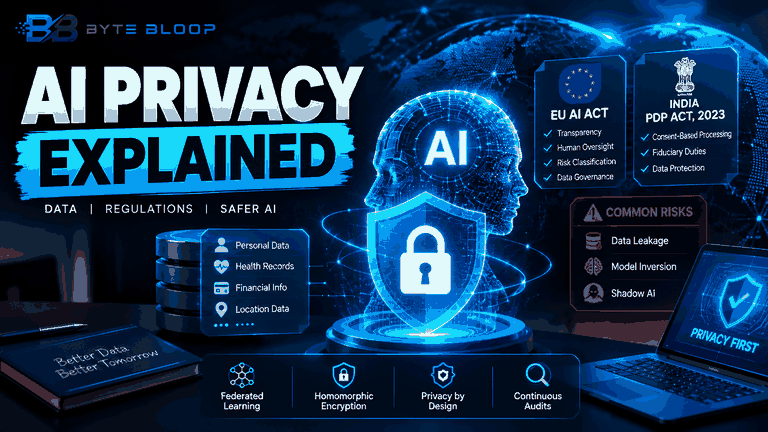
Two major frameworks dominate the 2026 landscape. The EU AI Act classifies AI systems by risk level and mandates transparency, human oversight, and data governance for high‑risk applications. According to the EU AI Act guide, high‑risk AI must undergo conformity assessments and maintain logs of data usage. India’s Digital Personal Data Protection Act, 2023 introduces consent‑based processing and fiduciary duties for AI operators, ensuring that personal data is handled responsibly.
Common Privacy Risks in AI
- Data Leakage: Training on unencrypted data can expose private records.
- Model Inversion: Attackers can reconstruct training data from model outputs.
- Shadow AI: 80% of organizations use unmonitored AI tools, creating blind spots in data handling (Optro 2026).
Building a Privacy‑First AI Pipeline
Effective privacy starts with governance. The AI Security and Governance Guide 2026 recommends a layered approach: data minimization, encryption, role‑based access, and continuous monitoring. Implementing a privacy impact assessment before model deployment helps identify potential breaches. Regular audits, as advised by TrustArc’s 2026 roadmap, ensure compliance with evolving standards.
Practical Examples
Consider a healthcare chatbot that recommends treatments. By anonymizing patient records and using differential privacy techniques, the system can generate useful responses without exposing identifiers. In finance, a credit‑scoring AI must log all data sources and provide explainability to meet EU transparency requirements. For marketing, generative AI should restrict output that could reveal proprietary customer lists.
Tools and Techniques
- Federated Learning: Trains models across devices without central data aggregation.
- Homomorphic Encryption: Enables computation on encrypted data.
- Privacy‑by‑Design frameworks that integrate policy checks into the development lifecycle.
Common Misconceptions
Many believe that anonymization alone guarantees privacy, yet re‑identification attacks can reverse engineered data. Another myth is that compliance is a one‑time effort; continuous monitoring is essential due to evolving regulations.
Key Takeaways
- AI privacy protects data from collection to output
- EU AI Act and India’s PDP Act set stringent compliance standards
- Shadow AI usage remains largely invisible, risking breaches
- Privacy‑by‑Design and continuous audits are essential
- Techniques like federated learning and homomorphic encryption mitigate risks
Frequently Asked Questions
What is AI privacy explained?
AI privacy refers to safeguarding personal data throughout an AI system’s lifecycle, from collection to output.
What are the key features of AI privacy frameworks?
They include data minimization, encryption, transparency, human oversight, and continuous monitoring as outlined in the EU AI Act and India PDP Act.
What are the best use cases for privacy‑first AI?
Healthcare chatbots, credit‑scoring systems, and marketing tools benefit from privacy‑first design to protect sensitive data.
What are the pros and cons of implementing privacy‑by‑design?
Pros: reduces breach risk, builds trust, ensures compliance. Cons: increases development time, may limit data richness.
Conclusion
Based on the available information and industry analysis, AI privacy explained is a critical component of responsible AI deployment, ensuring that personal data is protected through rigorous governance, compliance with evolving regulations, and the adoption of privacy‑enhancing technologies.
Related Reading
- Navigating the EU AI Act: Compliance Checklist
Sources & References
- AI Security And Governance Guide 2026: Protect Models, …
- EU AI Act 2026: Key Compliance Requirements for …
- AI Act | Shaping Europe’s digital future – European Union
- Mastering Privacy in 2026: AI & Governance Roadmap
- India AI Governance Guidelines — Digital Personal Data Protection Act, 2023
- AI Privacy: The Ultimate Guide for 2026 & Beyond – Learn
- Your Privacy Policies Cannot See What Shadow AI Touches
- AI Governance: Data Best Practice and Solutions in 2026