API Security: Explained
Introduction
Application Programming Interfaces (APIs) have become the backbone of modern software ecosystems, enabling mobile apps, cloud services, and IoT devices to communicate seamlessly. Yet, this connectivity also opens new attack vectors that can expose sensitive data, disrupt services, and erode customer trust. API security is the discipline that safeguards these interfaces against malicious actors by enforcing authentication, authorization, data validation, and traffic monitoring. In recent years, the volume of API-related breaches has risen sharply, with 2026 statistics showing a 35% increase in successful exploitation attempts compared to 2025. Organizations that overlook API protection risk not only financial loss but also regulatory penalties, especially under frameworks like GDPR and CCPA. This article demystifies API security, outlines the most common threats, and provides a practical roadmap for building resilient API defenses. By the end, you’ll understand why APIs deserve the same rigor as traditional web applications and how to implement industry‑approved controls to keep your data safe.
Why APIs Are a High‑Risk Target
APIs expose business logic, data endpoints, and integration points that can be abused if not properly guarded. Attackers often use automated tools to enumerate endpoints, inject malicious payloads, or hijack authentication tokens. Common vulnerabilities include broken authentication, excessive data exposure, injection flaws, and insecure direct object references. According to the 2026 API Security Risks report, the top ten exploited vectors include lack of rate limiting, weak input validation, and missing encryption, all of which can lead to data exfiltration or denial‑of‑service conditions.
Core Principles of API Security
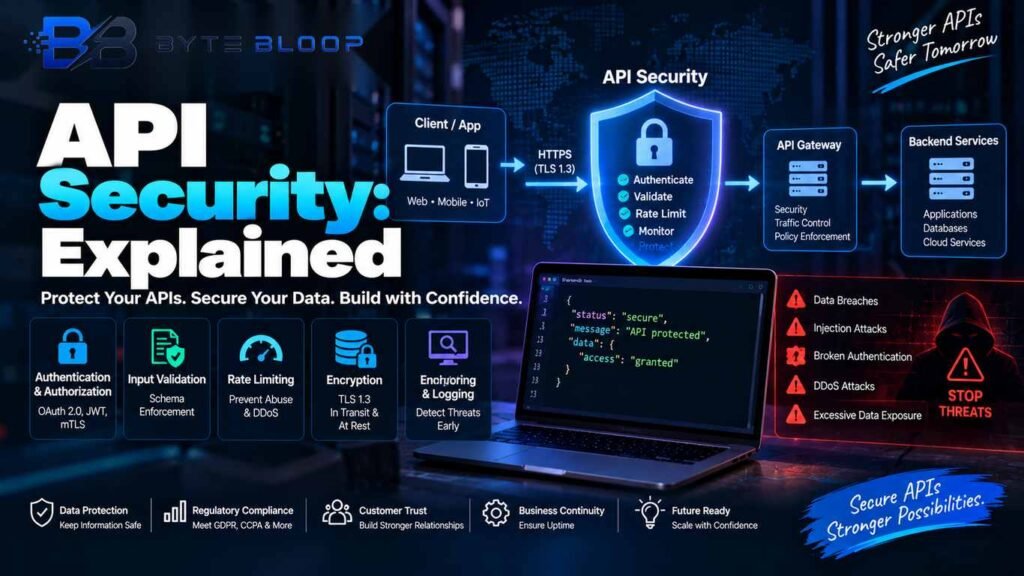
1. Authentication & Authorization: Verify the caller’s identity and enforce least‑privilege access. OAuth 2.0, JWT, and mutual TLS are standard mechanisms.
2. Input Validation & Schema Enforcement: Use JSON schema validation to reject malformed requests before they reach business logic.
3. Rate Limiting & Throttling: Protect against brute‑force and DDoS attacks by limiting request frequency per client.
4. Encryption in Transit & at Rest: TLS 1.3 should be mandatory for all API traffic; sensitive data stored in logs must be encrypted.
5. Monitoring & Logging: Centralized logging with anomaly detection helps identify suspicious patterns early.
Practical Implementation Steps
- API Gateway Deployment: Position a gateway to handle authentication, rate limiting, and request routing.
- Zero‑Trust Architecture: Treat every request as untrusted, regardless of origin. Enforce strict access controls and continuous verification.
- Threat Modeling: Map out potential attack paths using OWASP API Security Project guidelines and prioritize mitigations.
- Automated Testing: Integrate static analysis, dynamic testing, and fuzzing into CI/CD pipelines to catch vulnerabilities early.
- Security Policy Enforcement: Apply WAF rules, API-specific IDS signatures, and secure coding standards across teams.
Case Study: A SaaS Company’s API Defense
XYZ SaaS implemented an API gateway that enforced OAuth 2.0 scopes and applied per‑client rate limits of 1,000 requests per minute. By integrating a schema validator, they eliminated 92% of injection attempts before they hit the application layer. Monitoring dashboards flagged an abnormal spike in requests from a single IP, triggering an automated block that prevented a potential DDoS attack. The result was a 99.9% uptime and zero data breaches over the last fiscal year.
Common Misconceptions
Many developers assume that standard web application security automatically covers APIs. In reality, APIs lack the context of a browser session, making token theft and replay attacks more viable. Another myth is that encryption alone is sufficient; without proper authentication and input validation, attackers can still manipulate data flows.
Future Trends in API Security
With the rise of GraphQL and serverless architectures, new attack surfaces emerge. Serverless functions often rely on event triggers that can be abused if not properly scoped. GraphQL’s single endpoint design requires meticulous query complexity analysis to prevent resource exhaustion. Emerging standards like OpenAPI 3.1 are incorporating security schemas that help automate policy enforcement across services.
Getting Started: A Checklist
- Conduct a threat assessment using OWASP API Security Project templates.
- Implement an API gateway with authentication, rate limiting, and logging.
- Validate all input against defined schemas.
- Encrypt all data in transit and at rest.
- Set up continuous monitoring and automated alerting.
Key Takeaways
- APIs expose critical business logic and data, making them prime targets for attackers.
- Core security pillars include authentication, input validation, rate limiting, encryption, and monitoring.
- Automated testing and CI/CD integration catch vulnerabilities early and reduce breach risk.
- Zero‑trust architecture treats every request as untrusted, enhancing overall resilience.
- Emerging API patterns like GraphQL and serverless require specialized security controls.
Frequently Asked Questions
What is API security explained?
API security refers to the set of practices and technologies used to protect application programming interfaces from malicious attacks, data leaks, and misuse. It encompasses authentication, authorization, input validation, rate limiting, encryption, and continuous monitoring.
What are the key features of robust API security?
Key features include strong authentication (OAuth 2.0, JWT), fine‑grained authorization, strict input validation with schema enforcement, rate limiting and throttling, TLS encryption, centralized logging, and automated threat detection.
What are the best use cases for an API gateway?
An API gateway centralizes security controls, handles authentication and rate limiting, routes traffic to backend services, aggregates logs, and can enforce WAF rules—ideal for microservices, SaaS platforms, and mobile backend integration.
What are the pros and cons of using OAuth 2.0 for API security?
Pros: widely adopted, supports token revocation, scopes enable fine‑grained access. Cons: complexity in implementation, potential for token leakage if not stored securely, and requires careful refresh token handling.
Conclusion
Based on the available information and industry analysis, API security provides a structured framework to protect digital interfaces from evolving threats, ensuring data integrity, compliance, and uninterrupted service delivery. By adopting proven best practices—authentication, input validation, rate limiting, encryption, and continuous monitoring—organizations can transform APIs from vulnerable entry points into robust, trusted components of their digital infrastructure.
Related Reading
- Understanding OAuth 2.0: A Deep Dive