Smart Home Security: Explained
Introduction
Smart home security has moved beyond simple door locks and motion sensors. Today, it’s a network of interconnected devices that can detect, alert, and even respond to threats in real time. By integrating cameras, doorbell cams, smart locks, environmental sensors, and AI‑powered analytics, homeowners can monitor every corner of their property from a smartphone or tablet. The convenience of remote access, coupled with automated alerts, has made these systems a staple for modern households. However, the same connectivity that offers peace of mind also introduces new cybersecurity risks that must be managed carefully. Understanding how these systems work, their key components, and best practices for securing them is essential for anyone looking to protect their home in 2026. This guide breaks down the core elements of smart home security, explains how they interact, and offers practical tips to keep your network safe and your family protected.
Core Components of a Smart Home Security System
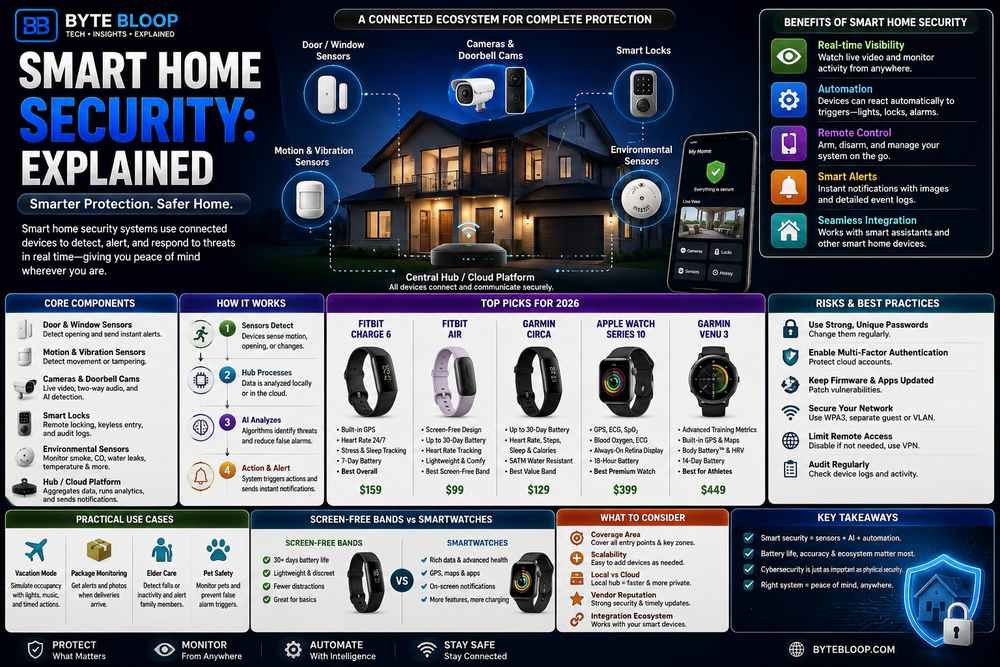
At its heart, a smart home security system is a mesh of devices that communicate through a central hub or cloud service. The main elements include:
- Door and window sensors – Detect opening and trigger alerts.
- Motion and vibration sensors – Spot movement or tampering inside rooms.
- Cameras and doorbell cams – Provide live video, two‑way audio, and facial recognition.
- Smart locks – Allow remote locking, keyless entry, and audit logs.
- Environmental sensors – Monitor smoke, carbon monoxide, water leaks, and temperature.
- Central hub or cloud platform – Aggregates data, runs analytics, and sends notifications.
Many vendors bundle these components into all‑in‑one kits, while others let you mix and match. The choice depends on budget, desired coverage, and integration preferences.
How the Technology Works
Smart security systems rely on a combination of wireless protocols—Wi‑Fi, Zigbee, Z‑Wave, and Bluetooth Low Energy—to transmit data. Sensors report status changes to the hub, which processes events locally or in the cloud. AI algorithms analyze video feeds to distinguish between a pet, a person, or a package, reducing false alarms. When an anomaly is detected, the system can:
- Send instant push notifications to your phone.
- Trigger an audible alarm.
- Activate cameras to record a 30‑second loop.
- Notify local authorities if you’ve subscribed to a monitored service.
Integration with smart assistants (Alexa, Google Assistant, Siri) adds voice control, allowing you to arm or disarm the system with a simple command.
Benefits of Smart Home Security
1. Real‑time visibility – View live footage from anywhere.
2. Automation – Lights, locks, and cameras can react to sensor triggers.
3. Remote control – Arm, disarm, and monitor without being home.
4. Enhanced alerts – Receive detailed notifications with images and timestamps.
5. Integration with other smart devices – Create scenes that combine security with climate control or entertainment.
Risks and Security Best Practices
While the convenience is undeniable, the connectivity also opens doors to cyberattacks. Common vulnerabilities include weak passwords, outdated firmware, and unsecured Wi‑Fi networks. To mitigate these risks, follow these steps:
- Use strong, unique passwords for every device and change them regularly.
- Enable multi‑factor authentication on cloud accounts.
- Keep firmware and apps up‑to‑date to patch known exploits.
- Separate your security network from the main Wi‑Fi using a guest or dedicated VLAN.
- Disable remote access if you don’t need it, and use VPNs for remote management.
- Regularly audit device logs for unusual activity.
Adhering to these practices aligns with the cybersecurity guidelines recommended by the CISA and industry experts.
Choosing the Right System for Your Home
When evaluating options, consider the following:
- Coverage area – Ensure sensors and cameras can reach all entry points and high‑risk zones.
- Scalability – Look for systems that allow adding devices without costly upgrades.
- Local vs. cloud processing – Local hubs reduce latency and protect data if the cloud service is compromised.
- Vendor reputation – Choose brands with transparent security practices and a history of timely firmware releases.
- Integration ecosystem – Compatibility with existing smart home devices can save money and simplify setup.
Testing and reviews, such as those compiled in the 2026 Guide to Home Security Systems, can help you compare features, ease of use, and cost effectiveness.
Practical Use Cases
1. Vacation mode – Simulate occupancy by cycling lights and playing music.
2. Package monitoring – Doorbell cams can notify you when a delivery arrives and even capture photos for evidence.
3. Elder care – Sensors detect falls or unusual inactivity and alert family members.
4. Pet safety – Cameras can monitor pets, while motion sensors prevent pets from triggering false alarms.
These scenarios illustrate how smart security extends beyond simple intrusion detection to enhance everyday life.
Key Takeaways
- Smart systems use sensors, cameras, and AI to provide real‑time alerts and automation.
- Connectivity introduces cyber risks; strong passwords, MFA, and firmware updates are essential.
- Separate networks and local hubs improve privacy and reduce latency.
- Choosing a system depends on coverage, scalability, and vendor reliability.
- Integration with smart assistants offers convenient voice control and scene creation.
Frequently Asked Questions
What is smart home security explained?
Smart home security refers to a network of connected devices—such as sensors, cameras, smart locks, and environmental monitors—that communicate through a central hub or cloud platform to detect, alert, and sometimes respond to security threats in real time.
What are the key features of a typical smart home security system?
Key features include door/window sensors, motion detectors, cameras with two‑way audio, smart locks, environmental sensors, AI video analytics, remote notifications, and integration with voice assistants.
What are the best use cases for smart home security?
Common use cases are vacation mode to simulate occupancy, package monitoring via doorbell cams, elder care monitoring, pet safety, and automated lighting or alarm responses to sensor triggers.
What are the pros and cons of smart home security?
Pros: real‑time visibility, automation, remote control, detailed alerts, and integration with other smart devices. Cons: potential cyber vulnerabilities, reliance on internet connectivity, initial setup complexity, and ongoing firmware maintenance.
Conclusion
Based on the available information and industry analysis, smart home security systems provide a sophisticated blend of physical protection and digital convenience, enabling homeowners to monitor and control their environment remotely while mitigating cyber risks through best‑practice measures. The convergence of IoT, AI, and cloud services continues to expand the capabilities of these systems, making them an indispensable component of modern home safety strategies.
Related Reading
- How to Secure Your Smart Home Network