Web Application Security Explained: 10 Powerful Practices, Risks & Tools in 2026
Introduction
Web application security explained in simple terms, it is the practice of protecting websites, web applications, APIs, users, servers, and the data they process from unauthorized access, manipulation, disruption, and other security threats.
Modern web applications are rarely isolated systems. A typical application may connect a browser or mobile client to APIs, databases, cloud services, third-party providers, authentication systems, payment platforms, analytics services, and internal business systems.
That connectivity creates useful functionality, but it also creates more places where security problems can occur.
Web application security therefore involves more than installing a firewall. It includes secure software design, authentication, authorization, input handling, encryption, dependency management, logging, testing, monitoring, patching, and incident response.
OWASP’s current Top 10:2025 remains an important awareness resource for developers and security teams. The latest list includes Broken Access Control, Security Misconfiguration, Software Supply Chain Failures, Cryptographic Failures, Injection, Insecure Design, Authentication Failures, Software or Data Integrity Failures, Security Logging and Alerting Failures, and Mishandling of Exceptional Conditions.
NIST’s Secure Software Development Framework also recommends integrating security practices into the software development lifecycle instead of treating security as a separate activity performed only after development.
This guide explains web application security, common risks, practical defenses, authentication, APIs, encryption, WAFs, security testing, monitoring, secure development, and security tools that developers can use in 2026.
What Is Web Application Security?
Web application security is the combination of technologies, processes, architecture, coding practices, and operational controls used to protect web-based software.
It covers applications such as:
- Websites
- E-commerce platforms
- SaaS applications
- Banking applications
- Admin dashboards
- APIs
- Customer portals
- Cloud applications
- Web-based business systems
The objective is not simply to prevent one specific attack.
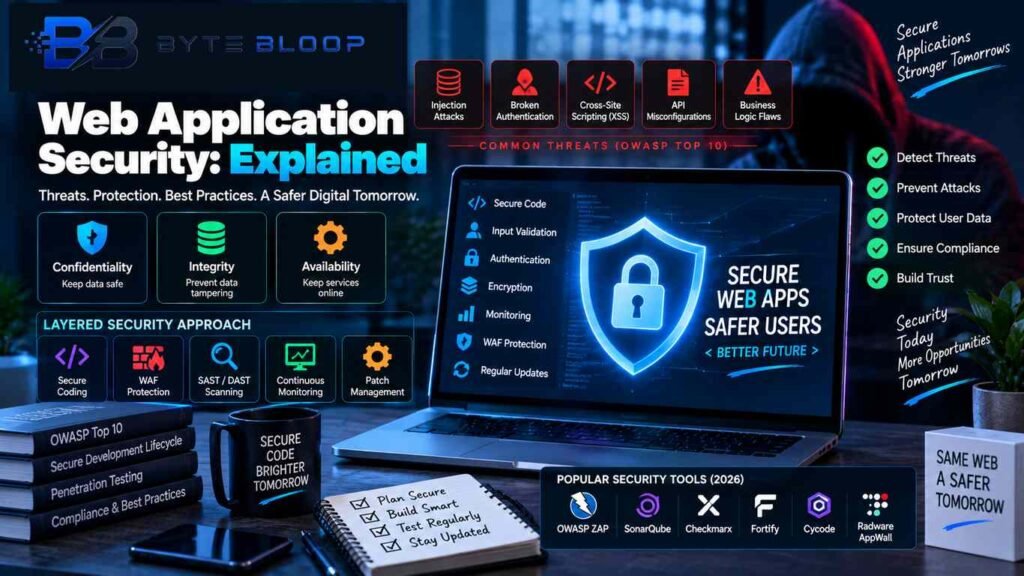
A secure application should protect:
- Confidentiality
- Integrity
- Availability
- Authentication
- Authorization
- Privacy
- Accountability
The CIA Triad in Web Security
Three traditional security goals provide a useful foundation.
Confidentiality
Confidentiality means that information is accessible only to authorized users or systems.
Examples include:
- Passwords
- Customer information
- Payment data
- Business documents
- API credentials
Integrity
Integrity means that information and application behavior are not improperly changed.
For example, a user should not be able to modify another customer’s order or change an account balance without authorization.
Availability
Availability means the application remains accessible and functional when legitimate users need it.
Security controls therefore also need to consider outages, resource exhaustion, infrastructure failure, and denial-of-service conditions.
OWASP Top 10:2025
OWASP’s current web-application awareness list is Top 10:2025, not a 2026 edition.
The 2025 categories are:
- Broken Access Control
- Security Misconfiguration
- Software Supply Chain Failures
- Cryptographic Failures
- Injection
- Insecure Design
- Authentication Failures
- Software or Data Integrity Failures
- Security Logging & Alerting Failures
- Mishandling of Exceptional Conditions
OWASP says the project is intended as a standard awareness document for developers and web application security.
Broken Access Control
Access-control failures happen when users can perform actions or access resources they are not authorized to use.
Examples include:
- Viewing another user’s account
- Editing another customer’s record
- Accessing administrative functions
- Changing an identifier in a URL to access someone else’s data
Authorization must be enforced on the server, not merely hidden in the user interface.
Security Misconfiguration
Misconfiguration can occur when systems use:
- Unnecessary services
- Insecure defaults
- Exposed administrative interfaces
- Incorrect permissions
- Debugging settings in production
- Improper security headers
Security configuration should be reviewed during development and deployment.
Software Supply Chain Failures
Modern applications depend on frameworks, libraries, packages, containers, plugins, CI/CD systems, and third-party services.
A weakness in one dependency can affect the larger application.
This makes dependency inventory, update management, provenance, and secure build pipelines important security practices.
Cryptographic Failures
Cryptographic failures can occur when sensitive information is:
- Transmitted without adequate protection
- Stored without suitable encryption
- Protected using weak algorithms
- Handled with poor key management
Encryption should be selected according to the security requirements and threat model.
Injection
Injection occurs when untrusted input is interpreted as part of a command or query.
Common examples include:
- SQL injection
- Command injection
- LDAP injection
- Template injection
OWASP recommends handling untrusted input carefully and using appropriate controls such as parameterized queries and contextual output encoding.
OWASP’s Input Validation Cheat Sheet also emphasizes validating untrusted input early while noting that input validation alone is not the primary defense against every injection or XSS vulnerability.
Insecure Design
Some security problems originate in the architecture or business logic rather than a single coding mistake.
Examples include:
- Missing abuse controls
- Unsafe business workflows
- Weak authorization architecture
- No protection for sensitive actions
- Poor threat modeling
Secure design should therefore happen before implementation is complete.
Authentication Failures
Authentication verifies who a user or system claims to be.
Problems can include:
- Weak password policies
- Poor account recovery
- Credential stuffing exposure
- Session weaknesses
- Inadequate multi-factor authentication
OWASP recommends strong authentication controls and secure session management.
Software or Data Integrity Failures
Applications can be affected when software updates, dependencies, plugins, or critical data are accepted without sufficient trust or validation.
Secure build pipelines, dependency controls, signatures, and integrity checks can reduce these risks.
Security Logging and Alerting Failures
An application may be compromised without anyone noticing quickly when important events are not logged or monitored.
Useful security events can include:
- Failed authentication attempts
- Privilege changes
- Suspicious API access
- Administrative activity
- Sensitive-data access
- Security-policy violations
Logs should also avoid exposing secrets such as session identifiers. OWASP’s session guidance specifically warns against placing sensitive session IDs in logs.
Mishandling of Exceptional Conditions
Unexpected errors and abnormal states can create security problems.
Applications should handle:
- Invalid input
- Missing data
- Timeouts
- Failed dependencies
- Authentication errors
- Resource exhaustion
- Unexpected application states
Error messages should also avoid exposing sensitive implementation details.
Common Web Application Attack Types
SQL Injection
An attacker attempts to manipulate database queries through untrusted input.
Parameterized queries and suitable database APIs are important defenses.
Cross-Site Scripting
XSS can occur when untrusted content is interpreted as executable browser-side code.
Defenses include contextual output encoding, safe templating, input handling, and appropriate browser security controls.
Cross-Site Request Forgery
CSRF attacks attempt to make a user’s browser perform an unwanted action while authenticated.
Modern frameworks and application designs can use anti-CSRF tokens, SameSite cookies, origin checks, and other appropriate defenses.
Broken Access Control
A user may exploit missing server-side authorization checks to reach resources or operations they should not control.
Session Hijacking
If session identifiers are exposed, stolen, predictable, or improperly managed, an attacker may be able to impersonate a user.
OWASP notes that compromise of a session ID can effectively allow an attacker to impersonate the associated user.
Server-Side Request Forgery
SSRF can occur when an application fetches attacker-controlled URLs or network resources without adequate restrictions.
API gateways and internal services can be especially important to protect.
File Upload Abuse
Unrestricted uploads can allow attackers to submit dangerous files or overload storage and processing systems.
File upload security can include:
- Allowed file types
- File-size limits
- Content validation
- Safe storage
- Renaming uploaded files
- Execution restrictions
Denial of Service
An attacker may attempt to exhaust:
- CPU
- Memory
- Network bandwidth
- Database connections
- API quotas
- Application workers
Rate limiting and resource controls can help reduce abuse.
Authentication and Authorization
Authentication and authorization are related but different.
Authentication
Authentication answers:
“Who are you?”
Examples include:
- Passwords
- Passkeys
- One-time codes
- Security keys
- Certificates
- Biometrics
Authorization
Authorization answers:
“What are you allowed to do?”
A successfully authenticated user may still have no permission to perform a particular operation.
Secure applications therefore need both.
OWASP’s authentication guidance recommends strong authentication controls, context-aware reauthentication, and secure session management.
Session Security
After login, applications typically need a way to maintain user state.
Sessions may use cookies or other secure mechanisms.
A session identifier should be:
- Hard to predict
- Properly protected
- Expired when appropriate
- Invalidated on logout where required
- Regenerated after important authentication events
OWASP recommends secure session management and specifically notes that session IDs should not be unnecessarily exposed in URLs or logs.
For high-risk actions, applications can require reauthentication or another verification step.
Input Validation
Applications receive information from users, browsers, APIs, files, partners, and other external systems.
This data should be considered untrusted.
OWASP recommends syntactic and semantic input validation so that data has the expected structure, type, format, and values.
Examples include validating:
- Email format
- Date ranges
- Numeric limits
- File types
- Request sizes
- Enumerated values
- JSON structures
Input validation should happen on the server, not only in browser JavaScript.
Output Encoding
Input validation and output encoding solve different problems.
Output encoding transforms data appropriately for the context in which it will be displayed or interpreted.
Different contexts may require different controls:
- HTML
- JavaScript
- CSS
- URLs
- SQL
OWASP’s secure code review guidance emphasizes context-appropriate output encoding and server-side input validation.
Encryption and HTTPS
HTTPS protects data while it travels between the browser and server.
Applications handling sensitive data should configure TLS correctly and avoid insecure transport.
Sensitive information stored on servers may also require encryption at rest depending on the threat model and regulatory requirements.
Encryption should be combined with secure key management.
Simply enabling encryption does not solve authentication, authorization, application-logic, or access-control problems.
Security Headers
HTTP security headers can provide additional browser-side protections.
Common headers include:
- Content-Security-Policy
- Strict-Transport-Security
- X-Content-Type-Options
- Referrer-Policy
- Permissions-Policy
The correct set depends on the application.
A strong Content-Security-Policy, for example, can reduce the impact of some classes of browser-side attacks when correctly configured.
Web Application Firewalls
A Web Application Firewall (WAF) sits between clients and the application and can inspect HTTP traffic.
A WAF may help detect or block patterns associated with:
- Injection
- Malicious requests
- Automated abuse
- Exploit attempts
- Suspicious traffic
However, a WAF should not replace secure application code.
A vulnerable application can remain vulnerable even when a WAF is installed.
WAF rules can also generate false positives, so they need appropriate tuning and monitoring.
SAST, DAST and IAST
Security testing can happen at different stages.
SAST
Static Application Security Testing analyzes source code, bytecode, or related artifacts without executing the application in the same way as a live attack.
It can identify potential security patterns early in development.
DAST
Dynamic Application Security Testing tests a running application.
It can identify problems visible through the application’s externally reachable interfaces.
IAST
Interactive Application Security Testing combines aspects of application instrumentation and runtime testing.
The appropriate mix depends on the application and development process.
Penetration Testing
Penetration testing involves authorized security testing designed to identify vulnerabilities and demonstrate potential impact.
Testing may cover:
- Authentication
- Authorization
- APIs
- Input handling
- Business logic
- Session management
- Configuration
- File uploads
- Error handling
OWASP’s Web Security Testing Guide is a major resource for structured web-application security testing. OWASP says the latest development release is being prepared as WSTG 5.0, while version 4.2 is the currently available versioned release.
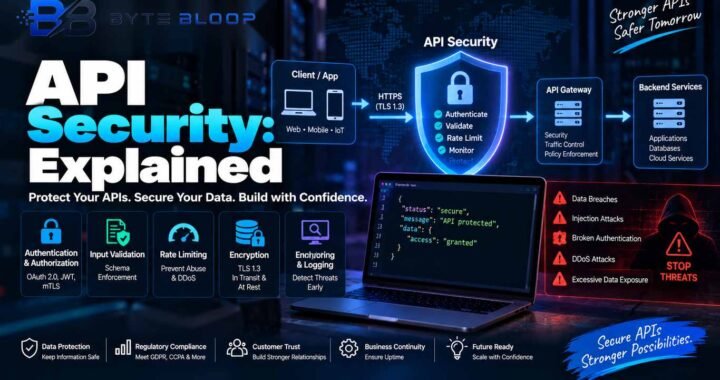
API Security
Modern web applications frequently depend on APIs.
An API can expose:
- User data
- Account operations
- Business logic
- Administrative functions
- Internal services
That creates a separate security surface.
OWASP’s current API Security Top 10 edition is 2023. It includes risks such as Broken Object Level Authorization, Broken Authentication, Broken Object Property Level Authorization, Unrestricted Resource Consumption, Broken Function Level Authorization, Server-Side Request Forgery, Security Misconfiguration, Improper Inventory Management, and Unsafe Consumption of APIs.
For a deeper guide, read:
Secure Software Development Lifecycle
Security should be integrated into the development process.
A typical secure workflow can include:
Requirements → Threat Modeling → Secure Design → Secure Coding → Testing → Deployment → Monitoring → Updates
NIST’s Secure Software Development Framework provides a set of practices intended to integrate security into existing software development processes and reduce vulnerabilities in released software.
Threat Modeling
Threat modeling helps teams think about security before vulnerabilities reach production.
Developers can ask:
- What assets need protection?
- Who can access them?
- What could an attacker control?
- What trust boundaries exist?
- What happens if a component fails?
- What actions have high impact?
Threat modeling can be performed during design and updated when major architectural changes occur.
Dependency and Supply Chain Security
Modern web applications depend heavily on external components.
Examples include:
- npm packages
- Python packages
- PHP libraries
- WordPress plugins
- Frameworks
- Containers
- Cloud services
- CI/CD actions
A secure process should maintain visibility into dependencies and update vulnerable components when appropriate.
Teams should also review:
- Package provenance
- Maintainer trust
- Dependency licenses
- Vulnerability advisories
- Build processes
- Deployment artifacts
OWASP added Software Supply Chain Failures to its Top 10:2025 list, reflecting the importance of this area.
Logging and Monitoring
Security controls are incomplete if suspicious activity cannot be detected.
Useful monitoring can include:
- Failed login attempts
- Privilege changes
- Unusual API activity
- Large data downloads
- Administrative actions
- Configuration changes
- Application errors
- Security alerts
Logs should be centralized where appropriate and protected against unauthorized modification.
Sensitive secrets should not be recorded unnecessarily. OWASP’s session guidance specifically cautions against logging session IDs.
Security Monitoring and Incident Response
No security system is perfect.
Organizations should prepare for the possibility of an incident.
A basic incident-response process can include:
Detection
Identify suspicious behavior.
Containment
Limit the ability of the attacker to continue.
Investigation
Determine what happened and what systems were affected.
Recovery
Restore normal operation and address compromised components.
Lessons Learned
Improve controls based on the incident.
Security Testing Tools
OWASP ZAP
OWASP ZAP is commonly used for dynamic web application security testing.
It can help security teams and developers examine running web applications for potential vulnerabilities.
OWASP also provides its broader Web Security Testing Guide as a structured reference for testing methodology.
SonarQube
SonarQube can analyze source code for software-quality and security issues.
CodeQL
GitHub CodeQL treats code as data and can be used to find security vulnerabilities through queries.
Burp Suite
Burp Suite is widely used for web-security testing and penetration-testing workflows.
Dependency Scanners
Dependency-scanning tools can identify known vulnerabilities in libraries and packages used by applications.
Common Security Mistakes
Trusting Client-Side Validation
Browser-side validation improves usability but does not replace server-side security checks.
Hiding Admin Buttons
Removing an admin button does not constitute authorization.
The server must enforce permissions.
Storing Secrets in Source Code
API keys, passwords, private credentials, and certificates should not be hard-coded into public repositories or application source files unnecessarily.
Using Outdated Dependencies
Old libraries can contain known vulnerabilities.
Ignoring Error Handling
Detailed errors can accidentally expose:
- File paths
- Database details
- Internal service names
- Stack traces
- Credentials or tokens
Relying Only on a WAF
A WAF is another layer of protection, not a substitute for secure application architecture and code.
Logging Too Much Sensitive Data
Security logs should provide useful evidence without unnecessarily storing credentials, session IDs, or other secrets.
Web Application Security Checklist
Before deploying an application, teams can review:
- Authentication
- Authorization
- Session management
- Input validation
- Output encoding
- HTTPS
- Security headers
- Dependency versions
- Secret management
- API security
- File upload controls
- Logging
- Monitoring
- Backup and recovery
- Security testing
The exact requirements vary by application and risk profile.
Web Application Security in 2026
Web application security in 2026 is increasingly connected to software supply chains, APIs, cloud services, automated deployment, and modern development workflows.
OWASP’s 2025 Top 10 reflects this broader view by adding Software Supply Chain Failures and Mishandling of Exceptional Conditions, while also consolidating some categories and updating the ranking based on newer data and trends.
At the same time, APIs remain a significant security surface. OWASP maintains a dedicated API Security Top 10 because APIs directly expose application logic and sensitive data.
NIST continues to promote secure-development practices that integrate security across the software lifecycle rather than treating it as a final-stage activity.
This makes modern web security a combination of secure design, secure code, secure infrastructure, secure dependencies, testing, monitoring, and continuous maintenance.
Future of Web Application Security
Several areas are likely to remain important.
Automated Security Testing
Security checks are increasingly being integrated into development pipelines.
Software Supply Chain Protection
Dependency provenance, package integrity, build security, and artifact verification will remain important.
API Security
As applications expose more services through APIs, authorization, inventory management, input validation, and abuse prevention become increasingly important.
Identity-Centered Security
Modern applications increasingly depend on strong authentication, authorization, session controls, and identity-aware architectures.
AI-Assisted Security
AI can help analyze logs, explain vulnerabilities, review code, and prioritize findings, but AI-generated security recommendations still require validation.
Continuous Monitoring
Security increasingly becomes an ongoing operational process rather than a one-time pre-launch test.
Key Takeaways
- Web application security protects applications, APIs, users, and data.
- Security involves confidentiality, integrity, availability, authentication, authorization, and privacy.
- OWASP’s current web-application awareness list is Top 10:2025, not an unchanged 2026 list.
- Broken access control and authentication failures can expose sensitive resources.
- Input validation, output encoding, secure sessions, and authorization are essential.
- HTTPS and suitable cryptographic controls protect data, but encryption alone does not secure an application.
- WAFs can provide an additional defensive layer but do not replace secure coding.
- SAST, DAST, IAST, penetration testing, and code review can complement each other.
- APIs require dedicated security controls; OWASP maintains a separate API Security Top 10.
- Software dependencies are part of the application’s security boundary.
- Logging and alerting help teams detect suspicious behavior.
- NIST recommends integrating security practices into the software development lifecycle.
- Security requires continuous updates, testing, monitoring, and improvement.
Frequently Asked Questions
What is web application security?
Web application security is the practice of protecting websites, web applications, APIs, users, servers, and application data from unauthorized access, attacks, misuse, and disruption.
Why is web application security important?
Web applications can process sensitive information and provide access to important business functions. Security controls help reduce the risk of unauthorized access, data exposure, service disruption, and other security incidents.
What are the main areas of web application security?
Important areas include authentication, authorization, session management, input validation, output encoding, encryption, dependency security, API security, testing, logging, monitoring, and secure development.
What is the OWASP Top 10?
The OWASP Top 10 is an awareness document covering major web-application security risks. The current official release is Top 10:2025.
What are the OWASP Top 10:2025 risks?
They are Broken Access Control, Security Misconfiguration, Software Supply Chain Failures, Cryptographic Failures, Injection, Insecure Design, Authentication Failures, Software or Data Integrity Failures, Security Logging & Alerting Failures, and Mishandling of Exceptional Conditions.
What is broken access control?
Broken access control occurs when an application fails to properly enforce what authenticated or unauthenticated users are allowed to access or modify.
What is SQL injection?
SQL injection occurs when attacker-controlled input is interpreted as part of a database query.
How can SQL injection be prevented?
Developers should use parameterized queries or safe database APIs and should not construct SQL queries by directly concatenating untrusted user input.
What is XSS?
Cross-site scripting, or XSS, occurs when untrusted content is interpreted as executable browser-side code.
What is authentication?
Authentication verifies the identity of a user, device, or system.
What is authorization?
Authorization determines which resources and actions an authenticated identity is permitted to use.
What is session management?
Session management maintains the state of a user’s interaction with a web application after authentication. OWASP provides detailed guidance on secure session handling.
What is input validation?
Input validation checks that incoming data conforms to expected syntax, type, format, size, and semantic requirements.
Is client-side validation enough?
No. Security validation must be enforced on the server because browser-side controls can be bypassed.
What is a WAF?
A Web Application Firewall is a security control that analyzes web traffic and can block or challenge certain suspicious requests.
Can a WAF stop every attack?
No. A WAF is an additional defensive layer and does not replace secure code, secure design, authentication, authorization, patching, or testing.
What are SAST and DAST?
SAST analyzes application code or related artifacts, while DAST tests a running application.
What is penetration testing?
Penetration testing is authorized security testing designed to identify and validate vulnerabilities in an application or system.
What is API security?
API security protects application programming interfaces from unauthorized access, misuse, manipulation, and attacks.
Does API security need separate controls?
Often yes. APIs can expose specific authorization, resource-management, authentication, and business-logic risks. OWASP maintains a dedicated API Security Top 10.
Why are dependencies a security concern?
Applications depend on external libraries and services. A vulnerable or compromised dependency can introduce risk into the application or build process.
What is secure software development?
Secure software development integrates security practices throughout planning, design, coding, testing, release, and maintenance.
What is the NIST SSDF?
The NIST Secure Software Development Framework is a set of secure-development practices designed to integrate security into software development processes and reduce software vulnerabilities.
What should security logs contain?
Useful security logs can include authentication failures, administrative activity, privilege changes, suspicious requests, and other security-relevant events. Logs should avoid unnecessary exposure of secrets such as session identifiers.
How often should a web application be security tested?
Testing frequency depends on the application’s risk, development pace, architecture, and regulatory environment. Testing should also occur after significant changes.
Is HTTPS enough to secure a website?
No. HTTPS protects data in transit but does not prevent application-level flaws such as broken authorization, injection, insecure business logic, or vulnerable dependencies.
What security headers should a website use?
Common examples include Content-Security-Policy, Strict-Transport-Security, X-Content-Type-Options, Referrer-Policy, and Permissions-Policy. The appropriate configuration depends on the application.
Can AI help with web application security?
AI can assist with code analysis, log analysis, vulnerability explanation, testing ideas, and security review. Important findings should still be validated by qualified developers or security professionals.
What is the most important web security practice?
There is no single control that secures every application. Effective security normally comes from multiple layers working together: secure design, authentication, authorization, input handling, dependency management, testing, monitoring, and maintenance.
Does web application security apply to WordPress?
Yes. WordPress sites should consider secure plugins and themes, updates, authentication, administrator permissions, backups, HTTPS, monitoring, and protection of forms and APIs.
Does web application security apply to APIs?
Yes. APIs are part of modern application security and require controls for authentication, authorization, validation, resource limits, inventory, logging, and business logic.
Conclusion
Web application security explained simply is the continuous process of designing, developing, testing, deploying, and maintaining applications so that attackers have fewer opportunities to access data, misuse functionality, or disrupt services.
Modern security is not based on one product.
A WAF cannot compensate for broken authorization. HTTPS cannot compensate for insecure business logic. Security scanning cannot replace good architecture. Strong passwords cannot compensate for unsafe session management.
A practical security strategy combines secure design, authentication, authorization, input validation, output encoding, appropriate cryptography, dependency management, API security, security testing, logging, monitoring, and timely updates.
OWASP’s current Top 10:2025 provides an important awareness framework, while OWASP’s API Security project addresses risks specific to APIs.
NIST’s Secure Software Development Framework reinforces the idea that security should be integrated throughout the software-development lifecycle instead of being added only at the end.
For developers and businesses, the most useful approach is to identify the application’s important assets, understand realistic threats, implement layered controls, test those controls, monitor the system in production, and improve security as the application changes.
As web applications become more connected to APIs, cloud infrastructure, third-party dependencies, automated pipelines, and AI-enabled services, security will continue to be an ongoing engineering responsibility rather than a one-time task.
Related Reading
ByteBloop Cybersecurity Guides
Sources & References
OWASP Top 10:2025 Introduction
OWASP API Security Risks — 2023
OWASP Web Security Testing Guide
OWASP Input Validation Cheat Sheet
OWASP Authentication Cheat Sheet
OWASP Session Management Cheat Sheet