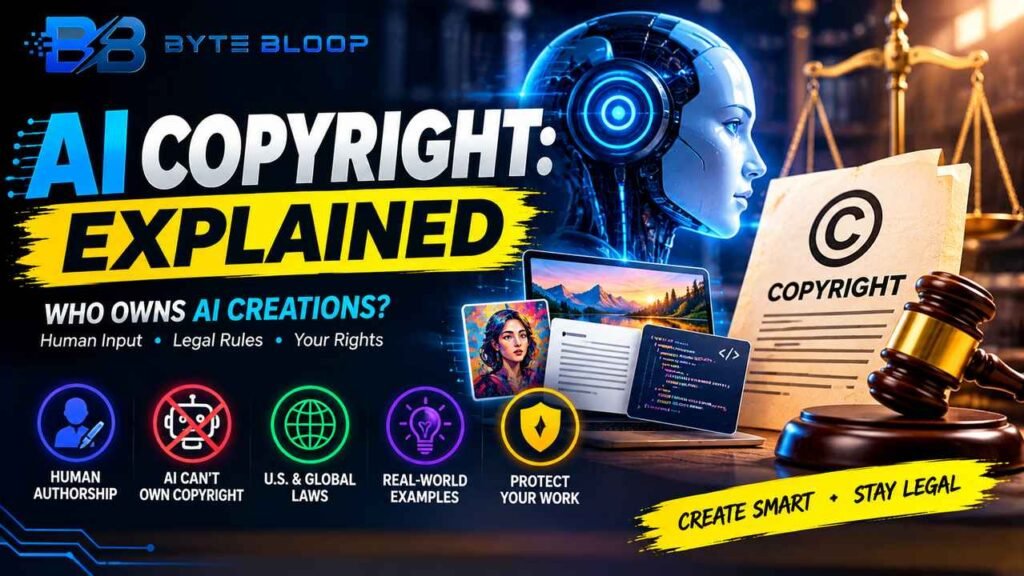
AI Copyright Explained: 10 Rules, Human Authorship, AI Art & Laws in 2026
Introduction
AI copyright explained in simple terms is the study of how copyright law applies when artificial intelligence is used to create, modify, analyze, or distribute creative content.
Generative AI can produce text, images, music, video, software code, and other material from prompts or other inputs. This creates several separate legal questions. Who can claim copyright in an AI-assisted work? Does an AI-generated image receive copyright protection? What happens when an existing copyrighted work is used as an input? What rights does a user receive under an AI platform’s terms?
These questions do not have one universal answer. Copyright law differs between countries, and even within one country different issues can be treated separately.
In the United States, the U.S. Copyright Office’s January 2025 report concluded that copyright can protect human-authored expression in works that also contain AI-generated material, but purely AI-generated material is not protected when the expressive elements are determined by the machine. The Office also concluded that prompts alone, based on currently available technology, generally do not provide sufficient human control for authorship.
India has its own legal framework. The official Indian Copyright Office states that copyright protects original literary, dramatic, musical, and artistic works, films, and sound recordings, and its explanation of “computer-generated work” identifies the person who causes the work to be created as the author for that category.
This means creators should avoid assuming that the same AI-copyright rule applies everywhere.
This guide explains human authorship, AI-generated content, AI-assisted creation, AI art, software generated with AI, licensing, training data, registration, practical risks, and what creators should consider in 2026.
What Is AI Copyright?
AI copyright refers to the copyright questions that arise when artificial intelligence is involved in creating or processing creative works.
It can involve several different situations:
- A person creates a work without AI.
- A person uses AI as a creative tool.
- AI generates part of a larger human-created work.
- AI generates most or all of the expressive content.
- Existing copyrighted material is supplied to an AI system.
- Copyrighted works are used to train AI models.
- An AI platform grants specific contractual rights to users.
These situations should not be treated as identical.
Copyright normally protects qualifying original expression rather than ideas, facts, systems, or methods. The U.S. Copyright Office describes copyright as protection for original works of authorship and says copyright does not protect ideas, facts, systems, or methods of operation.
Human Authorship and AI-Generated Content
Human authorship is a central issue in U.S. copyright analysis.
The U.S. Copyright Office’s Part 2 report states that AI-assisted works can be protected when a human author determines sufficient expressive elements. The Office also says that human-authored material can remain protected when it appears in an AI-assisted output, and creative selection, coordination, arrangement, or modification can contribute protectable authorship.
AI-Assisted Creation
Imagine a designer who:
- Develops a creative concept.
- Uses AI to generate several variations.
- Selects specific elements.
- Reworks the composition.
- Adds original artwork.
- Performs substantial manual editing.
- Produces a final design.
The resulting work can contain both AI-generated and human-created material.
The U.S. Copyright Office says the use of AI as an assistive tool does not automatically prevent copyright protection for the human-authored portions of a work.
AI-Only Generation
A different situation occurs when a user provides a prompt and the AI system determines the expressive content with little or no meaningful human creative control.
According to the U.S. Copyright Office’s 2025 report, purely AI-generated material is not protected by U.S. copyright, and prompts alone generally are not sufficient to establish authorship under current technology.
This is a U.S.-specific legal conclusion and should not automatically be applied to every country.
AI Copyright Rules in the United States
The U.S. Copyright Office has published several important materials relating to AI.
Copyrightability of AI Outputs
The January 2025 Part 2 report concludes that existing copyright principles can be applied to generative-AI outputs.
Its key points include:
- Human-created expression can be protected.
- AI-generated material can appear inside a copyrightable human-authored work.
- Creative selection or arrangement may be protected.
- Human modifications may contribute protected expression.
- Purely AI-generated material is not protected under the Office’s current analysis.
- Prompts alone generally do not provide sufficient control.
- Whether human contributions are sufficient should be evaluated case by case.
The U.S. Copyright Office also continues to maintain an AI initiative covering copyrightability, training, digital replicas, and other policy questions.
AI Copyright Rules in India
India’s framework has important differences from the U.S. approach.
The official Indian Copyright Office states that copyright protects original literary, dramatic, musical, and artistic works, as well as cinematograph films and sound recordings. It also explains that, for a computer-generated work, the author is the person who causes the work to be created.
This statutory language means that a simple statement such as “AI-generated content can never have copyright in India” would be too broad.
AI-assisted and computer-generated works can raise fact-specific questions about authorship, ownership, originality, contracts, and the way the work was created.
Creators in India should therefore examine the actual circumstances of creation rather than relying on a blanket rule.
AI Copyright vs AI Ownership
Copyright and ownership are related but not identical concepts.
A person may have contractual rights to use content without necessarily owning copyright in every aspect of that content.
Similarly, an AI service may give users certain commercial-use permissions under its terms without guaranteeing copyright protection in every jurisdiction.
This distinction is especially important for AI-generated images, music, videos, and other creative material.
Before commercial use, creators should check both:
Copyright law and the AI platform’s contract or license terms.
AI Tools and Licensing
AI platforms often publish terms describing how users can use generated material.
These terms can address issues such as:
- Commercial use
- User ownership
- Platform licenses
- Uploaded material
- Third-party models
- Content moderation
- Prohibited uses
- Data handling
A subscription does not automatically mean that every generated asset has identical legal treatment everywhere.
The platform’s current terms should therefore be checked before using AI-generated material in major commercial projects.
AI Art and Copyright
AI art is one of the most visible areas of the copyright debate.
A creator may use a text prompt to produce an image, modify the result in Photoshop, combine it with original artwork, or create a larger composition.
The legal analysis can change depending on how much human creative expression is present.
In the United States, the Copyright Office has stated that AI-generated material can be included within a copyrightable work when sufficient human-authored expression is present, while purely machine-generated expressive material is not protected.
Example: AI Image With Human Editing
Suppose an artist generates a rough background with an AI system and then:
- Paints original characters.
- Creates a custom composition.
- Adds original textures.
- Reworks lighting.
- Draws additional elements.
- Performs extensive manual editing.
The final work may contain both AI-generated and human-authored components.
The exact copyright protection should be assessed based on the particular contribution and jurisdiction.
AI-Generated Writing and Copyright
The same issue applies to AI-generated text.
A person may:
- Ask an AI system for ideas.
- Generate a draft.
- Rewrite paragraphs.
- Add original analysis.
- Change structure.
- Add research.
- Fact-check information.
- Add original examples.
- Produce a final edited article.
The more meaningful human contribution involved, the more important that contribution becomes when evaluating copyrightability.
In the United States, the Copyright Office’s current analysis focuses on whether sufficient expressive elements were determined by a human author.
For ByteBloop content, human editorial review, original structure, fact-checking, source selection, and meaningful rewriting are therefore useful parts of the publishing workflow.
AI-Generated Software and Code
AI coding tools can generate:
- Functions
- Scripts
- Classes
- Documentation
- Test code
- Configuration
- Boilerplate
Copyright questions can arise when generated code is incorporated into a larger software project.
The U.S. Copyright Office recognizes computer software as a category of copyrightable authorship when legal requirements are met.
However, developers should also consider:
- Open-source licenses
- Third-party code
- Existing copyrighted code
- Platform terms
- Human modifications
- Security
- Ownership contracts
Generated code should not automatically be assumed to be free of third-party rights.
AI and Derivative Works
A derivative work is generally based on one or more pre-existing works.
This can create problems when someone uses copyrighted material as part of an AI-generated result.
For example, a creator might upload:
- A copyrighted photograph
- A movie frame
- A commercial illustration
- A proprietary character
- A copyrighted music track
and ask an AI tool to transform it.
The creator still needs to consider whether they have the necessary rights to use the original material.
Creating a new output does not automatically erase the rights associated with the underlying work.
AI Training and Copyright
AI training is a separate issue from whether a generated output is copyrightable.
AI systems may be developed using very large collections of text, images, audio, video, software, and other material.
Some of that material may be copyrighted.
The U.S. Copyright Office released Part 3 of its AI report as a pre-publication version in May 2025. It examines the use of copyrighted works in generative-AI training and discusses issues including fair use, licensing, and potential liability. The Copyright Office says the final version will be published separately.
This area remains legally complex because training practices, licensing models, court decisions, and legislation can differ across jurisdictions.
Fair Use and AI Training
Fair use is a U.S. legal doctrine and should not be treated as a worldwide copyright rule.
AI training disputes in the United States have raised questions about whether and when copying copyrighted works for training can qualify as fair use.
The U.S. Copyright Office’s Part 3 report examines these issues and notes that numerous lawsuits have focused on how copyright law applies to AI training.
The existence of a fair-use argument does not mean that every AI training use is automatically fair.
The analysis can depend on factors such as:
- The purpose of the use
- The nature of the copyrighted work
- The amount used
- The effect on the market
- Technical details of the copying and use
Specific disputes should be evaluated with appropriate legal advice.
Copyright Registration for AI-Assisted Works
Copyright registration can be important when creators want an official public record of a work.
The U.S. Copyright Office provides registration guidance for works containing AI-generated material.
The Office expects applicants to identify AI-generated material when required and claim only the human-authored portions that qualify for protection.
The Copyright Office has also published registration decisions involving works containing AI-generated material, including cases involving mixed human and AI-created content.
Documenting Your Human Contribution
Creators who use AI should keep records of their creative process.
Useful documentation can include:
- Original prompts
- Draft versions
- Source files
- Editing history
- Layer files
- Original sketches
- Human-written text
- Research notes
- Design decisions
- Final modifications
Documentation does not automatically create copyright protection.
However, it can help demonstrate how a final work was produced.
AI Copyright Best Practices for Creators
Understand the Tool’s Terms
Read the current terms for commercial use, ownership, uploads, and generated content.
Keep Source Files
Save editable project files and earlier versions.
Document Human Contributions
Record substantial creative decisions and modifications.
Avoid Unauthorized Inputs
Do not upload copyrighted material unless you have the necessary rights or a valid legal basis.
Review Outputs
AI systems can reproduce unwanted similarities, errors, or copyrighted material.
Check Important Assets
For major commercial projects, consider professional legal review where necessary.
Monitor Changes
AI platforms can update their models, policies, pricing, and terms.
AI Copyright for Businesses
Businesses using AI-generated content should establish clear internal policies.
Content Policy
Define which AI tools employees can use.
Approval Policy
Require human review before publishing important material.
Data Policy
Specify what confidential information employees may upload to AI services.
Licensing Policy
Track which AI platforms are approved for commercial projects.
Record Keeping
Maintain records of important AI-assisted creative work.
Vendor Review
Review:
- Terms of service
- Commercial-use rules
- Privacy documentation
- Data retention
- Third-party models
- Enterprise protections
AI Copyright and Content Credentials
Some AI ecosystems also provide provenance or content-credential technologies.
These systems can record information about how a piece of content was created or modified.
Content credentials do not themselves determine copyright ownership.
Instead, they can provide useful information about an asset’s creation history and transformations.
Creators should therefore treat provenance information as a transparency tool rather than as automatic proof of copyright.
AI Copyright Risks
Unclear Human Authorship
A creator may assume that using an AI tool automatically creates a copyrightable work.
That is not necessarily true in every jurisdiction.
Third-Party Material
AI output may resemble or incorporate protected material.
Contractual Restrictions
An AI platform may impose usage conditions even when copyright law does not.
Training Data Disputes
Questions about how AI models use copyrighted works remain an evolving legal area.
Registration Problems
A creator may incorrectly claim AI-generated material as entirely human-authored.
Cross-Border Differences
A work may receive different treatment under different national laws.
AI Copyright for Social Media Creators
Social-media creators often use AI for:
- Captions
- Thumbnails
- Images
- Video editing
- Voice generation
- Music
- Scripts
Creators should distinguish between content they created themselves, AI-generated content, and third-party content.
For commercial campaigns, keeping project files and documenting the creation process can make rights management easier.
AI Copyright for Publishers and Websites
Websites using AI-assisted publishing should establish an editorial workflow.
A practical workflow can be:
- Use AI for research assistance or drafting.
- Verify information using reliable sources.
- Add original analysis.
- Rewrite and edit the draft.
- Add original examples or explanations.
- Check third-party material.
- Review images and other assets.
- Publish after human editorial approval.
This creates a clearer distinction between AI assistance and the site’s own editorial contribution.
AI Copyright vs Copyright Infringement
These are two different questions.
Copyrightability
Asks whether a work or portion of a work is protected by copyright.
Infringement
Asks whether someone used protected material in a way that violates the copyright owner’s rights.
A work may contain original human-authored material and still raise infringement issues because of another component.
Likewise, material may lack copyright protection while its use still creates contractual, trademark, privacy, or other legal concerns.
International AI Copyright Rules
There is currently no single worldwide AI-copyright law.
Different countries can apply different approaches to:
- Human authorship
- Computer-generated works
- AI-assisted creation
- Copyright registration
- AI training
- Fair use or related exceptions
- Licensing
- Moral rights
The WIPO AI and IP initiative also tracks international developments around artificial intelligence and intellectual-property policy. (wipo.int)
Creators publishing internationally should therefore avoid assuming that a rule from the United States, India, or another country automatically applies everywhere.
AI Copyright in 2026
In 2026, AI copyright remains an evolving area of law and policy.
In the United States, the Copyright Office’s current AI initiative includes its Part 2 analysis of copyrightability and Part 3 work on generative-AI training. The Office’s public AI page currently identifies Part 3 as a pre-publication version released in May 2025.
In India, the Copyright Office continues to apply the Copyright Act’s existing framework, including its definition of computer-generated works and the related authorship provision.
The practical lesson is that creators should separate three questions:
Who created the expression?
What rights does the source material have?
What does the AI platform’s contract allow?
Those questions can lead to different answers.
How to Build a Safer AI Content Workflow
A responsible AI content workflow can follow these steps.
Step 1: Choose an Appropriate AI Tool
Check the platform’s current terms and commercial-use rules.
Step 2: Avoid Unauthorized Inputs
Use material you created, licensed, or are legally permitted to process.
Step 3: Keep Human Creative Control
Add meaningful original contributions where copyright protection is important.
Step 4: Save Your Work
Keep source files, drafts, and project history.
Step 5: Check the Output
Review the result for errors, unwanted similarities, or third-party material.
Step 6: Record AI Usage
For important projects, record which AI tool and model were used.
Step 7: Get Legal Review When Necessary
High-value or high-risk commercial projects may require professional advice.
AI Copyright and Creators: Practical Examples
Example 1: AI Draft + Human Rewrite
A writer asks AI to create an outline, then independently researches the topic and writes the final article.
The final article can contain substantial human-authored expression.
Example 2: AI Image + Human Design
A designer generates several concepts and then creates an original final composition using human illustration and editing.
The copyright analysis can focus on the human-authored elements.
Example 3: AI-Generated Music
A user generates an entire music track with minimal creative control.
Copyright treatment may differ depending on the country and circumstances.
The platform’s license should also be reviewed.
Example 4: AI Code
A developer asks an AI coding assistant to generate a function and then integrates, modifies, tests, and documents it as part of a larger software project.
The developer should still review the code for third-party licensing and technical problems.
Key Takeaways
- AI copyright is not one universal legal rule.
- Copyrightability and licensing are separate questions.
- In the United States, the Copyright Office’s current analysis centers on human authorship and sufficient human expressive control.
- Prompts alone generally do not provide sufficient human control under the U.S. Copyright Office’s current analysis.
- AI-generated material can be included in a larger human-authored work in the United States.
- India’s official copyright framework contains a specific provision for computer-generated works and identifies the person who causes the work to be created as the author for that category.
- AI training and AI output copyright are separate legal questions.
- AI-platform contracts can impose additional conditions.
- Copyrighted source material should not be used casually as an AI input.
- Keeping records of human contributions can help document how a work was created.
- International copyright rules differ.
- AI copyright issues should be reviewed when laws, cases, or platform terms change.
Frequently Asked Questions
What is AI copyright?
AI copyright refers to copyright questions involving artificial intelligence, including AI-generated content, AI-assisted works, training data, licensing, and human authorship.
Can AI own copyright?
AI systems are not generally treated as human authors. In the United States, the Copyright Office’s current analysis focuses on human authorship and states that purely AI-generated material is not protected by copyright.
Can AI-generated content be copyrighted?
It depends on the jurisdiction and how the content was created. In the United States, human-authored expression in an AI-assisted work can be protected, while purely AI-generated material is not protected under the Copyright Office’s current analysis.
Can prompts create copyright?
In the United States, the Copyright Office says prompts alone generally do not provide sufficient control over expressive elements under currently available technology.
Is AI art copyrighted?
AI art can contain human-authored and AI-generated elements. The copyright treatment depends on the jurisdiction and the amount and nature of human creative contribution.
Is AI-generated writing copyrighted?
The answer depends on the jurisdiction and creative process. Human-authored writing can be protected, while fully machine-generated content may receive different treatment.
Can I commercially use AI-generated images?
Commercial use depends on both applicable copyright law and the AI platform’s terms. Users should check the current license and commercial-use conditions before using an image in a business project.
Can AI-generated content infringe copyright?
Potentially. An AI output can raise copyright concerns if it reproduces or improperly uses protected material.
Does AI training use copyrighted content?
AI training can involve copyrighted works, depending on how datasets are collected and used. The legal treatment of training is an active area of copyright policy and litigation, particularly in the United States.
What is AI-assisted creation?
AI-assisted creation is a workflow where a human uses an AI system as a tool while contributing creative decisions, editing, arrangement, or other original expression.
What is the difference between AI-generated and AI-assisted content?
AI-generated content may have most of its expressive elements determined by the system, while AI-assisted content includes meaningful human creative input.
Can I copyright a human-edited AI image?
Possibly. In the United States, the Copyright Office says creative human modifications, selection, coordination, or arrangement can contribute to copyright protection.
Can I copyright a blog written with AI?
It depends on the jurisdiction and the human contribution. Substantial human-authored expression can matter significantly, especially under the U.S. Copyright Office’s current approach.
Can AI-generated code be copyrighted?
Software can be protected by copyright when it meets the applicable legal requirements. AI-generated code also raises questions about human authorship, third-party code, and licenses.
Does India have AI copyright rules?
India applies its existing copyright framework to works involving computers and AI-related creation. The official Copyright Office states that a computer-generated work is authored by the person who causes it to be created.
Is AI copyright the same in every country?
No. Copyright is territorial, and countries can differ in their definitions of authorship, exceptions, registration rules, and treatment of AI-generated material.
Should I save my AI prompts?
For important projects, keeping prompts, drafts, source files, and editing history can help document the creative process.
Do AI platforms give ownership of generated content?
Some platforms grant users specific rights through their terms, but contractual rights and copyright protection are not the same thing.
Can I use copyrighted images as AI inputs?
You should only do so when you have the necessary rights or a valid legal basis for using the material.
What is a derivative work in AI copyright?
A derivative work is based on a pre-existing work. An AI transformation of copyrighted material can therefore raise questions about the rights in the underlying work.
Do I need copyright registration for AI-assisted work?
Registration requirements vary by country. In the United States, the Copyright Office provides registration procedures and guidance for works containing AI-generated material.
Is fair use applicable to AI?
Fair use is a U.S. doctrine. It may be relevant to certain AI-related uses, including some training disputes, but it is not a universal international rule.
Can AI-generated content be protected in India?
Indian law contains specific language concerning computer-generated works, including an authorship provision identifying the person who causes the work to be created. The exact copyright position depends on the facts and applicable law.
Can businesses safely use AI-generated content?
Businesses can use AI-generated or AI-assisted content, but they should review platform terms, copyright issues, source material, privacy, licensing, and human review requirements before commercial publication.
What should creators do before publishing AI-generated content?
Check the AI tool’s terms, review source material, keep records of the creative process, review the output, add meaningful human contributions where appropriate, and obtain professional legal advice for high-risk projects.
Conclusion
AI copyright explained simply is not a single rule saying that AI-generated content is either always protected or never protected.
The result can depend on the jurisdiction, the amount of human creative contribution, the source material, the AI platform’s terms, and the specific way the work was created.
In the United States, the Copyright Office’s current position emphasizes human authorship. Human-created expression can remain protected in AI-assisted works, while purely AI-generated material is not protected under the Office’s current analysis. Prompts alone generally do not provide sufficient human control under currently available technology.
India has a different statutory framework. The official Indian Copyright Office identifies the person who causes a computer-generated work to be created as the author for that category.
For creators, the practical approach is to keep meaningful human involvement, review the AI tool’s current terms, avoid unauthorized source material, document the creation process, and understand the law that applies to the specific project.
AI copyright is also a changing area. The U.S. Copyright Office continues to examine AI-generated outputs and AI training, while countries around the world continue developing their own approaches.
That makes ongoing review important for anyone using AI in publishing, design, software development, marketing, music, video, or other creative work.
Related Reading
AI Bias Explained: 10 Types, Causes, Examples & Solutions in 2026
https://bytebloop.com/ai-bias-explained/
AI Agents Explained: 10 Key Components, Use Cases & Safety in 2026
https://bytebloop.com/ai-agents-explained-7/
AI Automation Software Explained
https://bytebloop.com/ai-automation-software-explained/
Adobe Firefly Explained: Features, Pricing, Uses & AI Tools in 2026
https://bytebloop.com/adobe-firefly-explained/
ByteBloop AI Guides
https://bytebloop.com/category/ai/
Sources & References
U.S. Copyright Office — Copyright and Artificial Intelligence
https://www.copyright.gov/ai/
U.S. Copyright Office — Part 2: Copyrightability
https://www.copyright.gov/ai/Copyright-and-Artificial-Intelligence-Part-2-Copyrightability-Report.pdf
U.S. Copyright Office — Part 3: Generative AI Training
https://www.copyright.gov/ai/Copyright-and-Artificial-Intelligence-Part-3-Generative-AI-Training-Report-Pre-Publication-Version.pdf
U.S. Copyright Office — Registration Guidance for Works Containing AI-Generated Material
https://www.copyright.gov/ai/ai_policy_guidance.pdf
Indian Copyright Office — Basic of Copyright
https://ipindia.gov.in/basics-of-copyright
Indian Copyright Act — Chapter III
https://copyright.gov.in/Copyright_Act_1957/chapter_iii.html
WIPO — Artificial Intelligence and Intellectual Property
https://www.wipo.int/about-ip/en/frontier_technologies/ai_and_ip.html