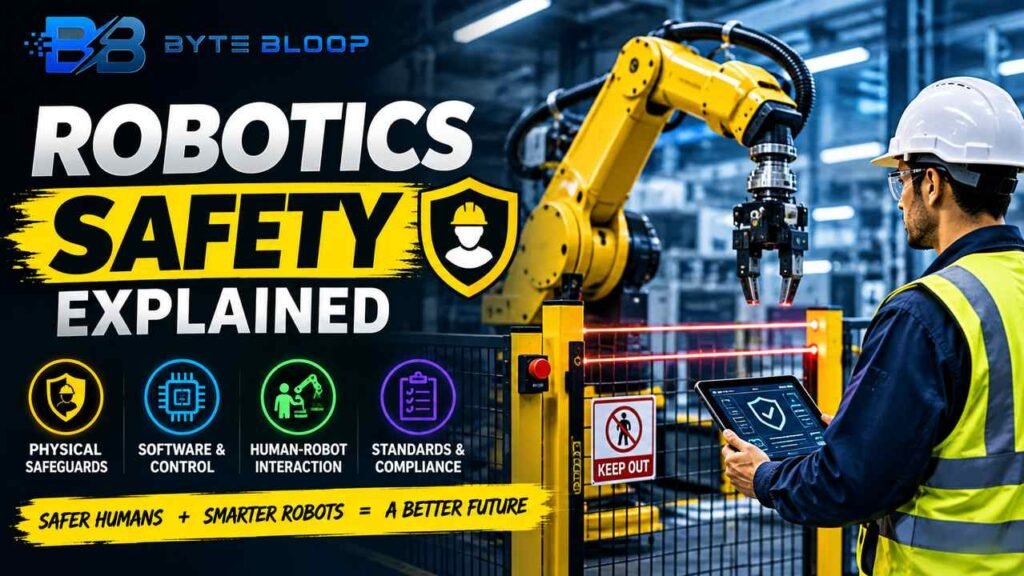
Robotics Safety: Explained
Introduction
What Is Robotics Safety?
Robotics safety refers to the systematic design, implementation, and monitoring of measures that prevent harm to humans when robots operate in shared spaces. In manufacturing, healthcare, and logistics, robots can perform repetitive, heavy, or hazardous tasks, but their power and speed also introduce new risks. Safety engineers therefore embed physical barriers, force limits, and intelligent control systems to keep humans out of danger zones. The goal is to create environments where humans and robots collaborate without injury, while maintaining productivity and reliability. Standards such as ISO 10218 and ISO 13849 provide a framework for risk assessment, design controls, and verification. Recent updates in 2026 emphasize hand‑guided control, speed and separation monitoring, and power and force limiting as key safety approaches. These measures are not optional; they are mandatory for any facility that integrates industrial robots into daily operations. Understanding the layers of safety—from mechanical safeguards to software algorithms—helps organizations choose the right mix for their specific applications.
Core Safety Strategies
Physical Safeguards
Robotic cells often use cages, guards, and light curtains to create invisible boundaries. According to the 2026 Robot Safety Standards Update, hand‑guided control allows a human operator to move the robot safely within a defined workspace, while speed and separation monitoring ensures the robot slows or stops when a person encroaches. Power and force limiting reduces the energy the robot can deliver, making accidental contacts less damaging.
Software and Control Algorithms
Modern robots incorporate collision detection, predictive path planning, and adaptive speed control. Safety‑critical software is verified against ISO 13849, ensuring that fault detection and isolation occur within strict timeframes. Simulation‑based testing, as discussed in “Safety by simulation,” allows designers to model human–robot interactions before physical deployment, reducing costly redesigns.
Human‑Robot Interaction (HRI) Design
HRI focuses on ergonomics and user experience. By minimizing physical hazards and optimizing control mechanisms, designers can reduce the likelihood of accidents. The webinar “The Role of Robotics in the Future of Work” highlighted that clear visual cues and intuitive interfaces improve operator trust and compliance with safety protocols.
Implementing Safety in Your Facility
- Conduct a risk assessment that identifies potential contact points and hazardous energy sources.
- Select appropriate safety measures—barriers, speed limits, force limits—based on the assessment.
- Integrate safety-rated sensors and control systems that meet ISO standards.
- Validate the system through simulation and live testing, documenting all results.
- Train staff on safety procedures, emergency stop use, and routine inspections.
- Maintain a continuous improvement loop, updating protocols as robots evolve.
Future Trends
As AI and machine learning mature, robots will gain better context awareness, enabling dynamic safety responses. Next‑generation robotics guides point to modular safety components that can be swapped as tasks change, reducing downtime. Regulatory bodies are also exploring simulation‑based certification, which could streamline approval processes while maintaining rigorous safety standards.
Key Takeaways
- Robots use layered safeguards—physical barriers, speed limits, force limits—to protect humans.
- Software algorithms and simulation testing are essential for verifying safety compliance.
- Human‑robot interaction design improves trust and reduces accidental contact.
- Regular risk assessments and staff training keep safety measures effective.
- Future regulations may rely more on simulation‑based certification to accelerate deployment.
Frequently Asked Questions
What is robotics safety explained?
Robotics safety explains the methods and standards used to prevent injury when robots operate alongside humans.
What are the key features of robotics safety?
Key features include physical barriers, speed and separation monitoring, power and force limiting, safety‑rated sensors, and validated control software.
What are the best use cases for robotics safety?
Industries such as manufacturing, healthcare, and logistics benefit most, where robots perform repetitive, heavy, or hazardous tasks in shared spaces.
What are the pros and cons of robotics safety measures?
Pros: reduced injury risk, increased productivity, regulatory compliance. Cons: higher upfront cost, complexity in integration, and potential operational downtime during updates.
Conclusion
Based on the available information and industry analysis, robotics safety provides a structured framework that blends mechanical safeguards, intelligent control, and human‑centric design to protect workers while enabling advanced automation. By adhering to evolving standards, leveraging simulation for testing, and maintaining rigorous training, organizations can confidently deploy robots that enhance efficiency without compromising safety.
Related Reading
- AI in Industrial Robotics: Enhancing Precision
Sources & References
- 2026 Robot Safety Standards Update: What Manufacturers and Integrators Need to Know
- Safety Considerations in Deployment of Robotic Systems
- The Role of Robotics in the Future of Work
- The Future of Robotics: Exploring the Exciting Outlook
- Safety by simulation: theorizing the future of robot regulation