Online Communities Explained: 10 Essential Features, Types & Growth Tips in 2026
Introduction
Online communities are virtual spaces where people connect, communicate, share knowledge and participate around a common interest, goal or identity. Unlike traditional communities that depend on physical locations, online communities use websites, apps, forums, chat platforms and social networks to bring people together regardless of geographic boundaries.
Today, people use online communities for everything from solving technical problems and learning new skills to discussing hobbies, building professional networks, getting customer support and sharing personal experiences. Communities can be open to everyone or limited to specific members, customers, employees or organizations.
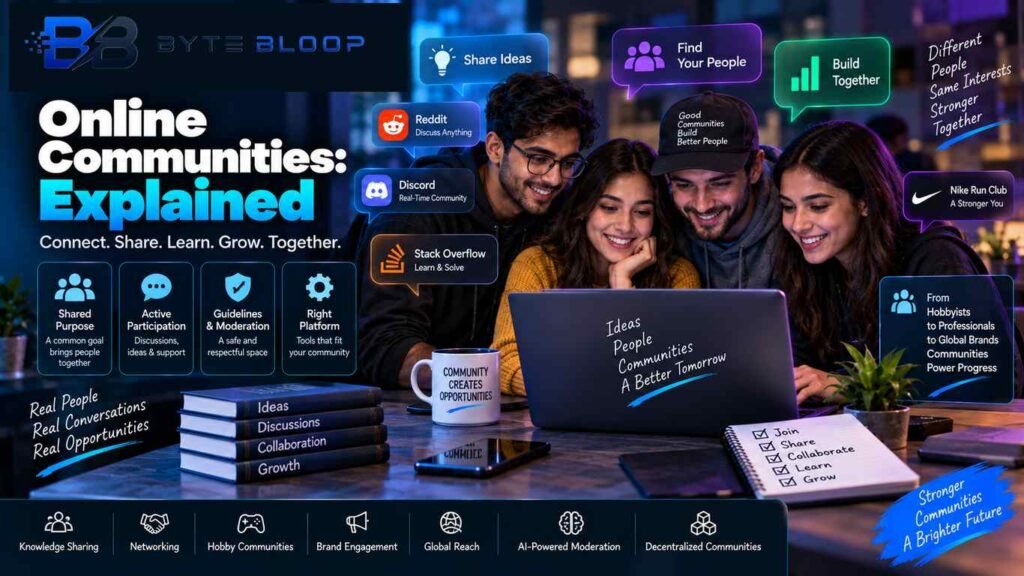
Platforms such as Reddit, Stack Overflow and Discord demonstrate different approaches to community interaction. Reddit organizes discussions into individual communities, commonly called subreddits, while Stack Overflow focuses heavily on structured questions and answers with reputation and voting mechanisms.
A successful online community is not created simply by putting people on a platform. It needs a clear purpose, useful participation, sensible rules, effective moderation and a reason for members to keep returning.
In this guide, we will explain what online communities are, how they work, the different types, real-world examples, how to build one, common challenges, important metrics and future trends.
What Is an Online Community?
An online community is a group of people who interact through digital platforms because they share a common interest, goal, profession, experience or purpose.
Communication can happen through:
- Discussion posts
- Comments
- Private messages
- Live chat
- Voice channels
- Video meetings
- Questions and answers
- Shared files
- Reviews and feedback
- Events and activities
For example, developers may join a technical community to troubleshoot programming problems. Gamers may participate in a Discord server to discuss games and organize multiplayer sessions. Customers may join a brand community to ask questions, provide feedback and learn how to use products.
The technology is only one part of the equation. The community itself is built through repeated interaction between its members.
How Online Communities Work
Most online communities combine several basic elements that work together to create an environment for interaction.
1. Shared Purpose
Every strong community needs a reason to exist.
The purpose could be:
- Learning
- Technical support
- Gaming
- Professional networking
- Entertainment
- Fitness
- Hobbies
- Product discussions
- Local activities
- Customer support
A community without a clear purpose can become difficult to understand and difficult to moderate.
For example, a programming community might focus specifically on solving development problems rather than becoming a general discussion space.
2. Members and Participation
Members are the foundation of an online community.
Participation can take different forms. Some members create posts, others answer questions, while many simply read discussions and occasionally react or contribute.
Not every member needs to be highly active.
A healthy community can include:
- New members
- Regular contributors
- Experts
- Moderators
- Community leaders
- Passive readers
The important factor is that members understand how they can contribute and what value they can receive.
3. Communication
Online communities need a way for members to communicate.
Different platforms support different communication models.
A discussion forum may focus on long-form posts and replies, while a chat-based community may prioritize real-time conversations.
Common communication formats include:
Asynchronous communication:
Members post and reply whenever they are available.
Real-time communication:
Members communicate through live text, voice or video.
Structured Q&A:
Members ask specific questions and receive answers.
Content-driven communication:
Members interact through articles, videos, images or other media.
Choosing the communication model that matches the community’s purpose is important.
4. Rules and Governance
Rules help define acceptable behavior.
Community guidelines may cover:
- Respectful communication
- Spam
- Advertising
- Harassment
- Off-topic content
- Misinformation
- Self-promotion
- Privacy
- Copyright
- Moderator decisions
Rules should be easy to understand and consistently applied.
A community does not necessarily need a huge rulebook. Clear expectations are usually easier for new members to understand and for moderators to enforce.
5. Technology Platform
The platform provides the technical foundation of the community.
Depending on the goal, a community might use:
- A dedicated website
- Forum software
- Discord
- Facebook Groups
- Slack
- Community platforms
- Messaging applications
- Customer support portals
The right platform depends on how members are expected to interact.
A community focused on detailed technical answers may need strong search and organization features, while a gaming group may benefit more from real-time voice and chat.
Types of Online Communities
Online communities can be divided into several categories based on their purpose and interaction style.
1. Discussion Forums
Forums are designed for organized discussions around specific subjects.
Members create topics and other users reply to them. Older discussions can often remain searchable, making forums useful as long-term knowledge repositories.
They are commonly used for:
- Technology
- Cars
- Hobbies
- Technical support
- Hardware
- Travel
- Specialized interests
2. Social Communities
Social communities are generally centered around conversations, relationships and content sharing.
Members may share:
- Photos
- Videos
- Opinions
- Experiences
- News
- Questions
- Personal updates
The structure can range from highly organized groups to relatively open-ended conversations.
3. Professional Communities
Professional communities bring together people working in the same industry or profession.
They can support:
- Networking
- Career advice
- Knowledge sharing
- Job opportunities
- Mentorship
- Industry discussions
- Professional development
For example, software developers may participate in communities focused on programming languages, development tools or specific technologies.
For readers interested in technology careers, our AI for Developers guide also covers how AI tools are changing software development workflows.
4. Gaming Communities
Gaming communities are built around games, genres, platforms or gaming interests.
Members may use them to:
- Find teammates
- Discuss updates
- Share strategies
- Exchange tips
- Organize tournaments
- Share clips
- Discuss game releases
Real-time communication is particularly important for many gaming communities, making chat and voice platforms common choices.
5. Brand Communities
Brand communities are groups centered around a particular company, product or brand.
Customers may use these communities to:
- Ask product questions
- Share experiences
- Suggest improvements
- Receive support
- Discover features
- Connect with other customers
For a company, a community can create a direct feedback channel, although it requires consistent participation and moderation.
6. Learning Communities
Learning communities connect people who want to study or develop particular skills.
Examples include communities focused on:
- Programming
- Languages
- Digital marketing
- Photography
- Business
- Design
- Academic subjects
Members can share resources, ask questions and learn from other participants.
7. Support Communities
Support communities exist primarily to help users solve problems.
Technology companies frequently use community-based support because customers can sometimes find solutions from other customers who experienced similar problems.
This can complement traditional customer service rather than completely replacing it.
8. Local Communities
Local online communities focus on a specific geographic area.
Members may discuss:
- Local businesses
- Events
- Traffic
- Neighborhood updates
- Services
- Recommendations
- Community activities
These communities can be especially useful because they connect digital communication with real-world local needs.
Real-World Examples of Online Communities
Reddit is a large collection of topic-specific communities. Reddit’s official documentation describes its Communities feature as a way to discover communities based on interests, local trends, related communities and other discovery signals.
Its community structure allows conversations to be separated by topic rather than placing every discussion into one general feed.
Reddit communities can therefore range from broad subjects to highly specialized interests.
Learn more: Reddit Communities
Stack Overflow
Stack Overflow is a strong example of a structured technical community.
Its model revolves around asking questions, providing answers and improving content. Stack Overflow’s reputation system is described as a rough measure of how much the community trusts a user’s contributions, and reputation can unlock additional privileges.
Voting also plays an important role in helping useful content become more visible within the platform.
Learn more: Stack Overflow Help Center
Discord Communities
Discord is commonly used for communities that need real-time communication.
A server can contain different text and voice spaces for separate conversations. This makes the format useful for gaming groups, hobby communities, creator audiences and other groups where members want ongoing interaction.
Brand Communities
A brand community can exist around a product or customer base.
For example, customers may share product tips, provide feedback and help each other solve common problems.
The most useful brand communities generally provide value beyond simply advertising products.
What Makes an Online Community Successful?
Creating an account or opening a forum does not automatically create an engaged community.
Several factors influence whether members continue participating.
Clear Purpose
Members should understand why the community exists.
A simple statement such as:
“A community for developers to discuss practical AI tools and development workflows.”
can be more useful than a vague description.
Useful Content
Members need a reason to return.
Useful content may include:
- Tutorials
- Questions
- Answers
- Discussions
- News
- Case studies
- Resources
- Events
- Expert insights
Content should match the needs of the community rather than being produced simply to increase posting frequency.
Active Participation
Communities become more useful when members interact with one another.
Questions should receive responses. Good discussions should have opportunities to continue. New members should not feel that they are entering an empty platform.
Early participation is especially important when launching a new community.
Effective Moderation
Moderation helps communities remain organized and safe.
Moderators may need to:
- Remove spam
- Handle rule violations
- Close inappropriate discussions
- Resolve conflicts
- Guide conversations
- Answer community questions
- Enforce posting standards
Stack Overflow provides an example of community-supported moderation through reputation-based privileges and review mechanisms.
Recognition and Feedback
Members are more likely to participate when their contributions are visible and appreciated.
Recognition can include:
- Badges
- Reputation
- Roles
- Featured contributions
- Community acknowledgments
- Contributor titles
The exact system depends on the platform.
How to Build an Engaged Online Community
Building a community is a process rather than a one-time launch.
Step 1: Define Your Audience
Start by identifying exactly who the community is for.
Ask:
- Who are the members?
- What problems do they have?
- What topics interest them?
- What type of interaction do they need?
- Why would they join?
A narrower audience can make it easier to establish a clear identity in the early stages.
Step 2: Define the Value Proposition
Members should receive a meaningful benefit from participation.
The benefit could be:
Knowledge:
Members learn something useful.
Support:
Members get help with problems.
Networking:
Members meet people with similar professional interests.
Entertainment:
Members participate in enjoyable conversations and activities.
Access:
Members receive access to resources, events or experts.
The community’s value proposition should be easy to communicate.
Step 3: Choose the Right Platform
Do not select a platform only because it is popular.
Instead, consider the community’s needs.
Ask:
- Does the community need real-time chat?
- Are long discussions important?
- Is search important?
- Will users share large amounts of media?
- Do you need private membership?
- Will moderation be complex?
- Do you need integrations?
- Will the community eventually become very large?
A technical support community may need strong search and structured discussions, while a gaming community may prioritize voice communication.
Step 4: Create Community Guidelines
Establish the rules before the community becomes large.
Guidelines can define expectations around:
- Respect
- Harassment
- Spam
- Self-promotion
- Personal information
- Copyright
- Off-topic posts
- Advertising
- Moderator actions
The guidelines should explain not just what is prohibited, but also what kind of participation the community wants to encourage.
Step 5: Recruit and Empower Moderators
Moderation becomes difficult as a community grows.
Choose moderators who understand:
- Community rules
- Topic context
- Communication standards
- Conflict resolution
- Platform tools
Moderators should have enough authority to handle violations while following consistent procedures.
For example, Stack Overflow uses community moderation mechanisms alongside elected moderators and reputation-based privileges.
Step 6: Launch With Seed Content
Do not launch an empty community and expect members to immediately create everything themselves.
Prepare useful starting material such as:
- Frequently asked questions
- Beginner guides
- Discussion topics
- Useful resources
- Introductory posts
- Community announcements
Seed content gives new members something to react to.
Step 7: Encourage Meaningful Participation
Instead of asking members to “post more,” create specific opportunities to participate.
For example:
Question of the Week
Ask members to share experiences or solutions.
Community Challenge
Give members a small task related to the community topic.
Expert Session
Invite an experienced person for a Q&A.
Monthly Discussion
Choose one topic and encourage members to share different perspectives.
Step 8: Measure Community Health
Metrics help identify whether the community is actually developing.
Useful metrics include:
- New members
- Returning members
- Active members
- Posts
- Replies
- Response time
- Moderation actions
- Content views
- Search activity
- Member retention
Avoid focusing on membership numbers alone.
A community with 1,000 registered users but almost no interaction may be less active than a community with 200 highly engaged members.
Step 9: Improve Based on Feedback
Community building is an iterative process.
Collect feedback through:
- Surveys
- Polls
- Discussion threads
- Direct feedback
- Support requests
- Moderator observations
Look for recurring issues and adjust the experience accordingly.
Common Challenges of Online Communities
Online communities can provide significant value, but they also create management challenges.
Spam and Low-Quality Content
Open communities can attract unwanted promotional posts, bots and low-quality contributions.
Possible solutions include:
- Spam filters
- Approval systems
- Rate limits
- Automated moderation
- Moderator review
- Posting requirements
Automation can reduce workload, but human review may still be necessary for ambiguous cases.
Toxicity and Conflicts
Disagreements are common in communities.
A clear moderation policy can help distinguish between healthy disagreement and behavior that violates community standards.
Moderators should apply the rules consistently instead of changing standards based on individual members.
Member Burnout
Highly active members can become tired of continuously creating content or answering questions.
Possible solutions include:
- Rotating responsibilities
- Community events
- Recognition systems
- Contributor programs
- Better moderation workflows
The goal is to avoid depending on a very small group of people for all community activity.
Scalability
A small community can sometimes be managed manually.
As membership grows, manual systems may become inefficient.
You may eventually need:
- Additional moderators
- Automated moderation
- Better search
- Analytics
- Dedicated support
- Infrastructure upgrades
- Clear escalation processes
Technology and processes should grow along with the community.
Maintaining Authenticity
Brand-owned communities can face an additional challenge: members may become less engaged if every interaction feels like advertising.
Organizations should create space for genuine conversations and useful feedback.
Transparent communication can help build trust.
The Role of AI in Online Communities
Artificial intelligence is increasingly relevant to community management.
Potential applications include:
AI-Powered Moderation
AI systems can help identify potentially problematic posts, spam or content that requires human review.
However, automated systems can make mistakes, so communities may need human oversight.
Content Discovery
AI can help organize large amounts of community content and surface discussions that are relevant to a member.
This becomes increasingly useful as the amount of community content grows.
Summarization
Large discussions can be difficult for new members to follow.
AI summarization can potentially help users understand the main points of long conversations without reading every message.
For more information on the broader use of AI systems, see our AI Agents Explained article.
Community Support
AI assistants can help answer repetitive questions and direct members toward relevant documentation or previous discussions.
This can reduce repetitive work for moderators and support teams, while human moderators remain important for complex or sensitive situations.
Online Communities and Cybersecurity
Security is an important consideration for any online community.
Community platforms can potentially face risks such as:
- Account takeover
- Phishing
- Malicious links
- Spam
- Data exposure
- Social engineering
- Unauthorized access
Community administrators should use appropriate access controls, account security measures, moderation procedures and privacy practices.
For a deeper look at protecting digital services, read our Web Application Security guide.
AI can also introduce additional risks and security considerations. Our AI Bias Explained article explores another important challenge associated with AI systems.
Benefits of Online Communities
Online communities can provide several practical benefits.
Knowledge Sharing
Members can exchange information, experience and solutions.
Networking
Professional communities can help people connect with others who share similar interests or careers.
Customer Feedback
Brands can collect direct feedback from users.
Peer Support
Members can help one another with common questions and challenges.
Long-Term Resources
Useful discussions can remain available as searchable resources.
Sense of Belonging
A shared interest can create connections between people who may never meet physically.
Limitations of Online Communities
There are also limitations to consider.
Information Quality
Not every contribution is accurate.
Members may need to verify important information.
Moderation Costs
Larger communities require more moderation resources.
Privacy Concerns
Members may unintentionally share personal or sensitive information.
Platform Dependency
Communities built entirely on third-party platforms depend on those platforms’ rules and technology.
Participation Imbalance
A relatively small number of members may create much of the content while many others mainly read.
A successful strategy should account for these limitations from the beginning.
Future Trends in Online Communities
The structure of online communities is likely to continue evolving.
1. AI-Assisted Moderation
AI will likely continue to support moderation workflows by helping identify spam, abusive behavior and content that needs human attention.
The important question will be how much authority is given to automated systems versus human moderators.
2. Smarter Community Discovery
Community platforms are increasingly using recommendation and discovery systems to help users find relevant groups.
For example, Reddit’s current Communities feature allows users to discover communities through topic-based and other recommendation signals.
This can make niche communities easier for new users to discover.
3. More Integrated Experiences
Communities are increasingly being connected with other digital services.
A single community may combine:
- Chat
- Video
- Events
- Content
- Payments
- Customer support
- Learning resources
This creates a more complete member experience.
4. Decentralized Community Models
Decentralized social technologies and federated platforms provide another possible direction for online communities.
Instead of relying entirely on one centralized service, some models allow independent servers or communities to participate in a broader network.
Adoption and long-term development vary across these technologies, so this remains an evolving area rather than a single established model.
5. Greater Focus on Community Health
As communities grow, administrators are paying more attention to metrics beyond simple member counts.
Future community management is likely to increasingly consider:
- Meaningful participation
- Member retention
- Response quality
- Moderator workload
- Safety
- User satisfaction
The objective is not simply to create a large audience, but to create a useful environment.
Online Community Metrics to Track
A community manager should select metrics based on the community’s purpose.
| Metric | What It Can Tell You |
|---|---|
| New Members | How quickly membership is growing |
| Active Members | How many people actually participate |
| Posts | Amount of new discussion |
| Replies | Depth of interaction |
| Response Time | How quickly members receive help |
| Retention | Whether members return |
| Moderation Actions | Volume of problems requiring intervention |
| Content Views | Which discussions attract attention |
| Member Feedback | Overall experience and recurring issues |
For example, a support community may care heavily about response time and solved questions, while a hobby community may focus more on participation and returning members.
Best Practices for Online Community Management
A practical community management strategy should include:
Keep Rules Clear
Members should quickly understand what is expected.
Be Consistent
Similar situations should generally receive similar moderation treatment.
Encourage Helpful Contributions
Reward useful participation through recognition or community status where appropriate.
Welcome New Members
A simple introduction process can make a community feel more accessible.
Keep Discussions Organized
Use categories, channels, tags or other organizational tools where appropriate.
Monitor Community Health
Watch for spam, declining activity, unresolved conflicts and moderator overload.
Protect Member Privacy
Avoid collecting unnecessary personal information and communicate privacy practices clearly.
Improve Continuously
Use member feedback and community metrics to identify areas for improvement.
Online Communities vs Social Media
Online communities and social media overlap, but they are not exactly the same.
| Feature | Online Community | General Social Media |
|---|---|---|
| Main Purpose | Shared interest or goal | Broad social/content sharing |
| Audience | Often interest-specific | Often broader |
| Structure | Frequently organized around topics | Usually feed/profile driven |
| Interaction | Community-focused | Person/content-focused |
| Moderation | Often topic-specific | Platform-wide systems |
| Content | Discussions and shared resources | Posts, videos, images and updates |
Many social platforms also contain communities, so the distinction is based more on purpose and structure than on the technology itself.
Frequently Asked Questions
What is an online community?
An online community is a digital group of people who interact around a shared interest, goal, profession, location or experience.
What are the main features of an online community?
The main features generally include a shared purpose, participating members, communication tools, rules or governance and a technology platform that supports interaction.
What are examples of online communities?
Examples include Reddit communities, Stack Overflow, Discord servers, professional groups, learning communities, gaming communities and customer support communities.
Why are online communities important?
They can help people share knowledge, solve problems, build relationships, receive support and provide feedback.
How do you build an online community?
Start by defining the target audience and value proposition, then select a suitable platform, create clear rules, prepare initial content, recruit moderators and continuously improve the experience using feedback and community metrics.
Are online communities free?
Some are free to join, while others may require membership fees, paid subscriptions or access through a product or organization.
What is the difference between an online community and a social network?
An online community usually centers around a common purpose or interest, while a social network may be organized more broadly around personal profiles, social connections and content feeds.
How does AI affect online communities?
AI can assist with moderation, content discovery, summarization and repetitive support tasks. Human oversight remains important, especially when decisions are complex or potentially harmful.
What makes an online community successful?
A clear purpose, useful content, active participation, effective moderation, good organization and continuous improvement are key factors.
Key Takeaways
- Online communities connect people around shared interests, goals, professions or experiences.
- A community needs a clear purpose to remain relevant.
- Member participation is supported by useful content and meaningful interaction.
- Rules and moderation help maintain community quality and safety.
- Different communities require different platforms and communication styles.
- Reddit and Stack Overflow demonstrate different community structures and participation systems.
- Community success should be measured using meaningful engagement metrics rather than membership numbers alone.
- AI can assist with moderation, discovery and support, but automated systems should be used carefully.
- Security and privacy should be considered when designing and managing a community.
- Online communities will continue evolving as communication platforms and AI technologies develop.
Conclusion
Online communities have become an important part of the modern internet, providing digital spaces where people can learn, communicate, collaborate and support one another.
Their structure can vary significantly. Some communities focus on detailed questions and answers, others emphasize real-time conversations, while others are built around social interaction, professional networking, gaming, education or customer support.
The core principles remain similar: a clear purpose, useful participation, understandable rules, effective moderation and an appropriate technology platform.
Building a successful community is not simply a matter of attracting a large number of users. Long-term value comes from creating an environment where people have a reason to participate, return and contribute.
As AI-powered tools, recommendation systems and integrated digital experiences continue to evolve, online communities are likely to become more sophisticated. At the same time, human judgment, community culture, privacy and trust will remain important parts of managing these digital spaces.
Understanding these fundamentals gives creators, organizations and businesses a stronger foundation for building communities that are useful, organized and sustainable.
Related Reading
For readers interested in technology, AI and digital communities, explore these related BYTE BLOOP articles:
AI Automation Software Explained
Web Application Security Explained
External Sources
Reddit Help – How to Browse and Find Communities
Stack Overflow Help – What Is Reputation?
Stack Overflow Help – Why Is Voting Important?
Pew Research Center – Americans’ Social Media Use 2025
Pew’s 2025 U.S. survey found that 26% of U.S. adults reported using Reddit, illustrating that community-oriented platforms remain a significant part of online behavior in that population. This figure is specific to U.S. adults surveyed in 2025 and should not be treated as a global usage rate.