AI Bias Explained: 10 Types, Causes, Examples & Solutions in 2026
Introduction
AI bias explained in simple terms, it refers to systematic patterns in an AI system that can produce unequal, inaccurate, or otherwise undesirable outcomes for certain people, groups, or situations.
Bias can enter an AI system at many stages. It may come from the data used to train or evaluate a model, the way labels are created, decisions made during model development, the features selected by developers, the evaluation methods used, or the environment in which the system is deployed.
IBM identifies several sources of algorithmic bias, including biased or non-representative training data, design decisions, proxy variables, and evaluation practices.
AI bias becomes especially important when systems are used in areas that can significantly affect people, such as employment, lending, healthcare, education, housing, or other high-impact decisions. Microsoft describes fairness as a core responsible-AI principle and provides tools for evaluating model performance and fairness across different groups.
Bias does not always mean that an AI system is intentionally discriminatory. A model can produce unequal outcomes even when the developers did not intend that result.
This guide explains what AI bias is, where it comes from, the main types of bias, practical examples, how organizations can detect it, how bias can be reduced, and why ongoing monitoring is important.
What Is AI Bias?
AI bias occurs when an AI or machine-learning system produces systematic differences or errors that can disadvantage certain groups, populations, or situations.
A simple example is a model that performs accurately for one population but makes substantially more errors for another.
Another example is a decision system that consistently produces lower selection rates for one group even when relevant qualifications are similar.
Microsoft distinguishes different forms of potential harm, including allocation harm, where opportunities or resources are distributed unequally, and quality-of-service harm, where an AI system performs less effectively for one group than another.
The important point is that AI bias is not one single technical bug.
It can involve:
- Data
- Labels
- Features
- Models
- Evaluation
- Deployment
- Human decisions
- Feedback loops
Why AI Bias Matters
AI systems are increasingly being used to assist with decisions, recommendations, predictions, and automated workflows.
When these systems are inaccurate or systematically disadvantage certain groups, the consequences can be significant.
Potential impacts include:
- Unequal access to opportunities
- Lower-quality service
- Incorrect predictions
- Poorer user experiences
- Loss of trust
- Compliance problems
- Financial harm
- Reputational damage
The severity depends heavily on the application.
A biased recommendation system for entertainment may have very different consequences from a biased system used for lending or healthcare.
That is why responsible AI programs usually consider both technical performance and the potential impact on people.
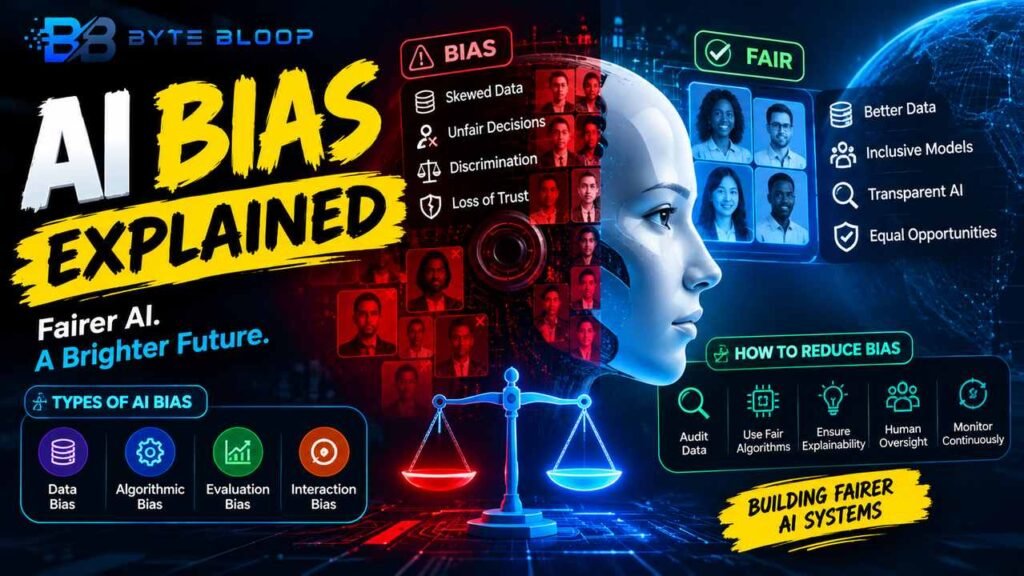
Types of AI Bias
AI bias can be classified in different ways. The exact categories vary between researchers and organizations, but several patterns occur frequently.
1. Data Bias
Data bias occurs when the data used by a model is incomplete, unbalanced, inaccurate, or not representative of the population or situation where the system will be used.
For example, a dataset may contain much more information about one group than another.
A model trained on such data may perform unevenly when deployed in a broader population.
IBM identifies non-representative and historically biased data as important sources of algorithmic bias.
2. Sampling Bias
Sampling bias occurs when the data collection process systematically leaves out certain populations or situations.
For example, a dataset collected only from users of one type of device may not represent users on other devices.
3. Label Bias
Machine-learning systems often depend on labels created by humans or existing systems.
Labels can contain errors, inconsistent judgments, or assumptions from the people or processes that created them.
Those problems can then become part of the model’s behavior.
4. Historical Bias
Historical data can reflect inequalities or patterns that existed in the real world when the data was collected.
Even if a model learns those patterns accurately, reproducing them automatically may lead to undesirable outcomes.
This creates a challenge because improving predictive performance is not always the same as producing fair outcomes.
5. Algorithmic Bias
Algorithmic bias can arise from design decisions, model structures, optimization objectives, thresholds, or other choices made during development.
IBM notes that algorithmic bias can enter through algorithm design as well as data and evaluation.
6. Evaluation Bias
A model may appear highly accurate when evaluated using overall metrics but perform much worse for a specific subgroup.
Microsoft’s Responsible AI tools specifically support analysis of performance and error patterns across different cohorts rather than relying only on aggregate results.
7. Proxy Bias
A model may not explicitly use a sensitive characteristic, but another feature can act as a proxy for it.
For example, a geographic variable may correlate with demographic or socioeconomic characteristics.
Removing one obvious feature does not necessarily eliminate all potential bias.
8. Interaction Bias
Bias can also emerge from how people interact with an AI system.
A system may receive feedback based on user behavior, and that feedback can influence future recommendations or decisions.
This can create feedback loops.
9. Automation Bias
Automation bias occurs when people place too much trust in an automated recommendation simply because it was produced by a computer system.
A human reviewer may accept an incorrect model output without sufficient verification.
This shows that fairness problems are not always caused only by the model itself.
10. Feedback-Loop Bias
An AI system can influence behavior that is later used as training or operational data.
That creates a feedback loop.
For example, if a recommendation system repeatedly promotes certain content, future user interactions may reinforce that pattern.
Over time, the system can become increasingly influenced by its own previous decisions.
Common Causes of AI Bias
Bias can enter an AI system for many reasons.
Unbalanced Training Data
If some groups or situations are underrepresented, model performance may differ across them.
Historical Patterns
Data may reflect past decisions, social conditions, or institutional practices that are not appropriate to reproduce automatically.
Human Labeling
Human annotators can introduce disagreement, assumptions, or stereotypes when creating training labels.
Feature Selection
Developers may select variables that unintentionally act as proxies for sensitive characteristics.
Poor Evaluation Design
Testing only aggregate accuracy can hide differences between subgroups.
Microsoft’s fairness documentation specifically recommends looking at model performance and error metrics across identified cohorts.
Deployment Differences
A model can behave differently in production from how it performed during development because the real-world population, environment, or user behavior differs from the test data.
Incomplete Monitoring
Even a model that performs reasonably at launch can develop problems when data distributions or usage patterns change.
Real-World Examples of AI Bias
AI Hiring Systems
Imagine a resume-screening system trained on historical hiring data.
If historical hiring decisions were heavily concentrated in one demographic group, the model might learn patterns that correlate strongly with that group.
The resulting system could rank candidates differently in ways that are not justified by relevant qualifications.
The exact behavior depends on the model, data, features, and evaluation process.
Healthcare AI
Healthcare systems provide another important example.
A diagnostic model may perform differently across populations if the training or evaluation data does not adequately represent the people who will use it.
Microsoft uses healthcare-related examples when explaining fairness, such as whether an AI system provides similar guidance to people with similar symptoms and circumstances.
Credit and Lending
A lending model may use variables that correlate with income, geography, financial history, or other characteristics.
Even when certain sensitive variables are removed, proxy relationships can remain.
This is why fairness testing should examine outcomes rather than simply checking whether one sensitive attribute appears directly in the model.
Facial and Vision Systems
Computer-vision systems can show different error rates across demographic or environmental conditions when their training and testing data are uneven.
The important measure is not simply overall accuracy but whether performance is reliable across relevant groups and conditions.
Recommendation Systems
Recommendation systems can reinforce existing patterns because user interactions affect what content is shown next.
This can create feedback loops in which certain content receives more exposure and therefore generates more future interaction data.
AI Bias vs AI Hallucination
AI bias and hallucination are different problems.
AI Bias
Bias refers to systematic differences or patterns in model behavior that can affect particular groups, contexts, or outcomes.
AI Hallucination
A hallucination occurs when an AI system generates information that is incorrect or unsupported but presents it as though it were valid.
A model can have:
- Bias without hallucinating
- Hallucinations without obvious group bias
- Both problems at the same time
The mitigation strategies are also different.
Bias requires fairness analysis and subgroup evaluation, while hallucinations often require techniques such as grounding, retrieval, validation, better prompting, or human review.
How to Detect AI Bias
Detecting bias requires more than checking one accuracy number.
Compare Performance Across Groups
Organizations can compare metrics across relevant groups or cohorts.
Useful metrics may include:
- Accuracy
- Precision
- Recall
- Error rate
- False-positive rate
- False-negative rate
- Selection rate
Microsoft’s Responsible AI tooling supports disparity analysis across performance and selection metrics.
Analyze Error Distribution
Instead of looking only at the average error rate, examine where errors occur.
A model with 95% overall accuracy may still have much higher error rates for a particular subgroup.
Microsoft’s error-analysis tools are designed to identify cohorts where model failures are concentrated.
Review the Dataset
Check whether important groups, conditions, or use cases are adequately represented.
Questions to ask include:
- Who is represented?
- Who is missing?
- How was the data collected?
- Are labels consistent?
- Are there historical patterns that could affect the model?
Test Different Scenarios
A model should be tested against realistic variations in users, environments, inputs, and operating conditions.
Monitor Production Behavior
Fairness evaluation should not necessarily stop after deployment.
Changes in users, data, products, policies, or operating environments can change model behavior.
AI Bias Metrics
There is no single fairness metric that works for every AI system.
Different applications can use different metrics.
Examples include:
Selection Rate
Measures the proportion of each group receiving a favorable outcome.
Accuracy by Group
Measures whether the model makes correct predictions at similar rates across groups.
Error Rate by Group
Compares the frequency of errors between groups.
Precision by Group
Measures how often positive predictions are correct for different groups.
Recall by Group
Measures how many relevant positive cases are successfully identified.
Microsoft notes that fairness metrics involve trade-offs and that quantitative metrics alone cannot capture every aspect of fairness, such as justice or due process.
That is an important point: a model cannot be declared fair simply because one metric looks good.
Tools for AI Bias Detection and Mitigation
Developers can use open-source and commercial tools to assess model fairness.
IBM AI Fairness 360
IBM’s AI Fairness 360 toolkit provides algorithms and metrics designed to help developers examine and mitigate bias in machine-learning workflows.
Official resource:
Fairlearn
Fairlearn is an open-source toolkit designed to help practitioners assess and mitigate fairness-related issues in AI and machine-learning systems.
Official website:
Microsoft Responsible AI Dashboard
Microsoft Azure Machine Learning provides a Responsible AI dashboard that combines fairness assessment, error analysis, data exploration, and model interpretability tools.
Official documentation:
What-If Analysis
What-if analysis can help developers examine how changes to inputs affect model predictions.
Microsoft includes counterfactual and model-interpretability capabilities within its Responsible AI tooling.
How to Reduce AI Bias
There is no universal one-click solution.
Bias reduction is usually a combination of technical, organizational, and governance practices.
Improve Data Quality
Use better-quality, more representative data where appropriate.
Review missing populations and problematic data sources before training or deployment.
Review Labels
Where humans create labels, establish clear guidelines and assess disagreement or inconsistency.
Evaluate Across Groups
Do not rely only on overall model performance.
Compare relevant outcomes and errors across groups.
Use Fairness-Aware Methods
Depending on the problem, developers can use methods such as:
- Reweighting
- Resampling
- Threshold adjustment
- Fairness-constrained optimization
- Post-processing
Microsoft documents several mitigation algorithms and parity-based approaches for machine-learning fairness.
Improve Interpretability
Interpretability tools can help developers understand which features influence predictions.
This can reveal unexpected relationships or potential proxy effects. Microsoft includes model interpretability in its Responsible AI dashboard.
Add Human Review
Human review can be particularly important for high-impact decisions.
However, human reviewers should also receive appropriate training and should not automatically trust model recommendations.
Monitor After Deployment
Fairness should be treated as an ongoing process.
Organizations should monitor:
- Model performance
- Group-level outcomes
- Error rates
- Data distribution
- User feedback
- Unexpected behavior
Microsoft’s current responsible-AI guidance emphasizes continuing evaluation and keeping responsible-AI practices active after deployment.
AI Bias and Responsible AI
AI bias is one part of the broader responsible-AI discipline.
Microsoft’s current Responsible AI framework identifies six principles:
- Fairness
- Reliability and safety
- Privacy and security
- Inclusiveness
- Transparency
- Accountability
These principles are intended to cover the AI lifecycle rather than treating fairness as a final check before launch.
For a model to be responsibly deployed, organizations may need to consider all of these areas together.
AI Bias in Generative AI
Generative AI introduces additional challenges.
Large models can learn patterns, associations, stereotypes, or imbalances from their training and evaluation data.
Bias can appear in:
- Text generation
- Image generation
- Speech
- Search
- Recommendations
- Classification
- Content moderation
Generative AI can also produce inconsistent results when prompts are changed.
That means evaluation should include many different prompts, users, contexts, and scenarios rather than relying on a small number of examples.
Responsible-AI guidance increasingly treats fairness, transparency, safety, privacy, and accountability as connected parts of AI system design.
AI Bias and Explainability
Explainability can help developers investigate why a model behaves differently across groups.
For example, a model-interpretability system may reveal that an unexpected feature has a large influence on predictions.
Counterfactual analysis can also show how predictions change when selected input features are modified.
Microsoft’s Responsible AI dashboard includes both model interpretability and counterfactual analysis for understanding model behavior.
Explainability does not automatically eliminate bias.
Instead, it provides evidence that can help teams investigate and diagnose potential problems.
AI Bias and Human Oversight
Human oversight is particularly important when AI outputs can significantly affect people’s lives.
A human reviewer can:
- Question unusual predictions
- Review supporting evidence
- Identify contextual information
- Override incorrect recommendations
- Escalate important cases
However, human review is only useful when reviewers have meaningful authority and the information needed to challenge the system.
Simply placing a person at the end of an automated pipeline does not automatically solve a fairness problem.
Microsoft’s responsible-AI guidance states that people designing and deploying AI systems should remain accountable and maintain meaningful control over highly autonomous systems.
When Should Organizations Act on AI Bias?
Bias should be investigated whenever evaluation reveals a meaningful and unexplained disparity or pattern of harm.
The priority is particularly high when an AI system affects:
- Employment
- Lending
- Healthcare
- Education
- Housing
- Insurance
- Public services
- Other high-impact decisions
Organizations should consider both the measured difference and the real-world consequences of that difference.
A statistically small disparity can still matter greatly in a high-impact application, while a larger difference in a low-risk application may have a different significance.
Common Mistakes When Addressing AI Bias
Looking Only at Overall Accuracy
A high overall accuracy score can hide significant differences between groups.
Removing One Sensitive Feature
Removing gender, ethnicity, age, or another attribute does not necessarily eliminate proxy variables.
Assuming Human Review Solves Everything
Human reviewers can also make mistakes or over-trust automated recommendations.
Testing Only Before Deployment
Model behavior can change after deployment.
Optimizing for One Fairness Metric
Fairness involves multiple dimensions and trade-offs. Microsoft explicitly notes that many fairness metrics cannot all be satisfied simultaneously.
Ignoring the Business Context
A technical metric has to be interpreted in the context of the actual decision and people affected by it.
A Practical AI Bias Audit
Organizations can create a repeatable review process.
Step 1: Define the Use Case
Document what the AI system does and who may be affected.
Step 2: Identify Relevant Groups
Determine which populations or conditions need separate evaluation.
Step 3: Review the Data
Check representation, quality, labels, missing values, and historical patterns.
Step 4: Measure Performance
Calculate relevant performance and fairness metrics.
Step 5: Analyze Errors
Identify cohorts where the system performs unusually poorly.
Step 6: Investigate the Cause
Look at features, labels, training procedures, model architecture, thresholds, and deployment conditions.
Step 7: Apply Mitigation
Choose a mitigation method that fits the use case.
Step 8: Re-Evaluate
Test the updated system again.
Step 9: Monitor After Deployment
Continue measuring performance and group-level outcomes.
Step 10: Document Decisions
Keep records of the tests, results, changes, limitations, and approvals.
AI Bias in 2026
In 2026, AI bias is increasingly treated as part of broader AI governance and system engineering rather than as a problem that can be fixed only by changing training data.
Current responsible-AI tooling includes fairness assessment, error analysis, interpretability, data exploration, and monitoring.
At the same time, organizations deploying increasingly capable AI systems need to consider fairness together with reliability, privacy, security, transparency, inclusiveness, and accountability.
This broader approach matters because a model can be technically accurate while still producing undesirable outcomes in a specific context.
The practical objective is therefore not simply to find a single “fairness score.” It is to understand how the system behaves, who may be affected, what trade-offs exist, and what controls are needed.
Future of AI Bias Management
Several areas are likely to remain important.
Continuous Fairness Monitoring
Organizations can increasingly monitor group-level performance after deployment rather than relying only on pre-launch testing.
Better Evaluation Datasets
More diverse and representative test sets can help reveal performance differences that smaller benchmarks may miss.
Automated Fairness Testing
Testing tools can make it easier to compare metrics across different cohorts during development.
Stronger Documentation
Model cards, evaluation reports, data documentation, and audit trails can improve transparency.
Human-in-the-Loop Systems
More high-impact systems may combine automated predictions with human review and approval.
Responsible AI Governance
Organizations are likely to treat fairness as one component of broader governance covering security, privacy, transparency, accountability, and reliability.
Key Takeaways
- AI bias refers to systematic patterns that can lead to unequal, inaccurate, or undesirable outcomes.
- Bias can enter through data, labels, features, algorithms, evaluation methods, deployment, and feedback loops.
- Overall model accuracy does not reveal every fairness problem.
- Performance and error rates should be evaluated across relevant groups and cohorts.
- Data quality and representation are important parts of bias management.
- Removing a sensitive feature does not automatically eliminate proxy-based bias.
- Fairness metrics involve trade-offs and should be interpreted in context.
- Tools such as IBM AI Fairness 360, Fairlearn, and Microsoft’s Responsible AI Dashboard can help evaluate and investigate AI systems.
- Human oversight can be important for high-impact decisions.
- Bias evaluation should continue after deployment.
- Responsible AI combines fairness with reliability, safety, privacy, security, transparency, inclusiveness, and accountability.
- AI bias management is becoming a continuing engineering and governance process rather than a one-time test.
Frequently Asked Questions
What is AI bias?
AI bias is a systematic pattern in an AI system that can produce unequal, inaccurate, or otherwise undesirable outcomes for certain groups, populations, or situations.
Why does AI bias happen?
AI bias can arise from training data, labels, model design, feature selection, evaluation methods, historical patterns, deployment conditions, and feedback loops.
What are the main types of AI bias?
Common categories include data bias, sampling bias, label bias, historical bias, algorithmic bias, evaluation bias, proxy bias, interaction bias, automation bias, and feedback-loop bias.
Is AI bias always intentional?
No. AI bias can occur even when developers did not intend to create unequal outcomes.
Can AI bias affect healthcare?
Yes. An AI system may perform differently across populations depending on its training data, evaluation data, features, and deployment conditions.
Can AI bias affect hiring?
Yes. Hiring systems can produce unequal results if the data or model captures historical patterns that do not fairly represent the relevant population.
How can AI bias be detected?
Organizations can evaluate model performance across relevant groups, compare error rates, inspect datasets, examine feature behavior, analyze error distributions, and monitor production results.
Microsoft’s Responsible AI tools provide fairness assessment and error-analysis capabilities for this type of evaluation.
What is data bias?
Data bias occurs when training or evaluation data is incomplete, inaccurate, unbalanced, or not representative of the population or environment where the model is used.
What is algorithmic bias?
Algorithmic bias refers to systematic effects that can result from model design, optimization objectives, feature choices, thresholds, or other technical decisions.
What is proxy bias?
Proxy bias occurs when one feature indirectly represents another characteristic and contributes to unequal outcomes.
What is evaluation bias?
Evaluation bias can occur when testing methods or metrics fail to reveal important differences in model behavior across groups.
What is fairness in AI?
Fairness in AI generally involves evaluating whether an AI system produces unjustified or harmful differences across relevant groups or situations. There is no single definition or metric that applies to every system.
Can removing sensitive data remove AI bias?
Not necessarily. Other variables can act as proxies, and bias can enter through data, labels, model design, evaluation, or deployment.
What tools can help detect AI bias?
Examples include IBM AI Fairness 360, Fairlearn, and Microsoft’s Responsible AI Dashboard.
What is AI bias mitigation?
Bias mitigation is the process of identifying and reducing undesirable or unfair differences in AI-system behavior through methods such as improved data, reweighting, threshold changes, fairness-aware algorithms, better evaluation, and human oversight.
Does human oversight eliminate AI bias?
No. Human review can help identify or correct problematic outputs, but humans can also make errors or over-rely on automated recommendations.
Is AI bias the same as AI hallucination?
No. Bias concerns systematic patterns or disparities, while hallucination refers to generating incorrect or unsupported information.
Should AI bias be monitored after deployment?
Yes. Model performance and data can change after deployment, so ongoing monitoring can help identify newly emerging problems.
What is the best way to reduce AI bias?
There is no single best technique. Organizations should first understand the use case, affected groups, data, metrics, and sources of error before selecting an appropriate mitigation approach.
Are fairness metrics enough to prove an AI system is fair?
No. Quantitative metrics provide useful evidence, but fairness also involves context, impact, human judgment, and governance. Microsoft notes that fairness metrics cannot capture every aspect of fairness and that different fairness objectives can conflict.
What is responsible AI?
Responsible AI is a broader approach to designing, evaluating, deploying, and governing AI systems with considerations such as fairness, reliability, safety, privacy, security, transparency, inclusiveness, and accountability.
Conclusion
AI bias explained simply is the study and management of systematic differences in AI behavior that can lead to unequal or undesirable outcomes.
Bias can enter an AI system through many paths, including training data, labels, feature selection, model design, evaluation methods, historical patterns, feedback loops, and deployment conditions.
That is why reducing AI bias is not a one-step process.
Organizations need to evaluate data quality, measure model behavior across relevant groups, investigate error patterns, understand potential proxy relationships, apply suitable mitigation techniques, and continue monitoring the system after deployment.
Tools such as IBM AI Fairness 360, Fairlearn, and Microsoft’s Responsible AI Dashboard can help developers and data scientists perform parts of this work, while human oversight and governance remain important for higher-impact applications.
The most useful approach is to treat fairness as an ongoing part of the AI lifecycle rather than a final checkbox.
As AI systems become more capable and more widely deployed, understanding how they behave across different people and situations will remain an important part of building reliable and responsible technology.
Related Reading
AI Agents Explained
https://bytebloop.com/ai-agents-explained-7/
AI Automation Software Explained
https://bytebloop.com/ai-automation-software-explained/
Adobe Firefly Explained
https://bytebloop.com/adobe-firefly-explained/
ByteBloop AI Guides
https://bytebloop.com/category/ai/
Sources & References
IBM — What Is Algorithmic Bias?
https://www.ibm.com/think/topics/algorithmic-bias
Microsoft — What Is Responsible AI?
https://learn.microsoft.com/en-us/azure/machine-learning/concept-responsible-ai
Microsoft — Machine Learning Fairness
https://learn.microsoft.com/en-us/azure/machine-learning/concept-fairness-ml
Microsoft — Responsible AI Dashboard
https://learn.microsoft.com/en-us/azure/machine-learning/concept-responsible-ai-dashboard
Microsoft — Error Analysis
https://learn.microsoft.com/en-us/azure/machine-learning/concept-error-analysis
Microsoft — Apply Responsible AI
https://learn.microsoft.com/en-us/agents/center-of-excellence/responsible-ai
IBM AI Fairness 360
https://aif360.res.ibm.com/
Fairlearn
https://fairlearn.org/