Artificial General Intelligence: How It Works
Introduction (Artificial General Intelligence How It Works)
Artificial General Intelligence How It Works is a topic worth understanding well. Artificial General Intelligence, or AGI, is the next frontier in artificial intelligence, promising machines that can understand, learn, and apply knowledge across any domain as flexibly as humans. Unlike narrow AI, which excels at specific tasks like image recognition or language translation, AGI seeks to combine reasoning, memory, learning, and decision‑making into a single adaptable system.
The ambition is to create a system that can transfer knowledge from one context to another, reason about novel problems, and improve itself over time without human intervention. This capability would enable breakthroughs in fields ranging from medicine to climate science, where complex, interdisciplinary challenges demand holistic understanding. The journey toward AGI involves overcoming significant technical hurdles, including integrating diverse cognitive functions and ensuring safe, ethical deployment.
Understanding how AGI works requires a look at its core components, the architectures that aim to realize them, and the research milestones that guide the field. Below we break down the key mechanisms, current approaches, and practical implications of AGI, offering a clear roadmap for anyone curious about this transformative technology.
Core Cognitive Functions of AGI
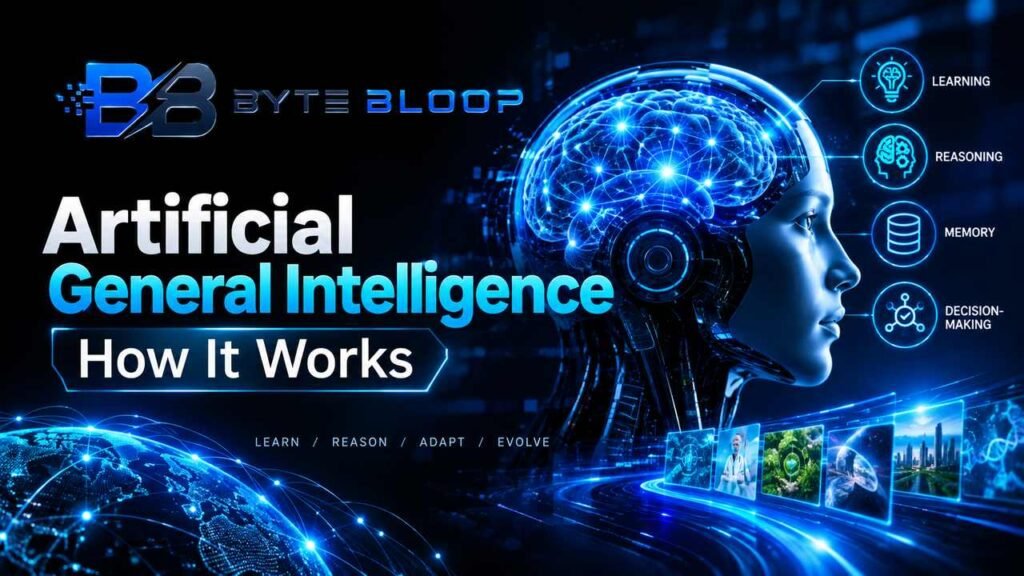
At its heart, AGI must emulate four primary human cognitive abilities: learning, reasoning, memory, and decision‑making. According to the article “Artificial General Intelligence: Future & Challenges,” these functions must be unified into a single adaptable system capable of handling diverse tasks without task‑specific tuning. Learning allows the system to acquire new knowledge from data or experience. Reasoning enables it to draw inferences and solve problems. Memory stores learned information for later retrieval, while decision‑making translates insights into actions. The interplay of these functions is what distinguishes AGI from today’s specialized AI models.
Architectural Approaches
Several architectural paradigms are being explored to achieve this integration. One popular route is the neuro‑symbolic architecture, which blends neural networks’ pattern recognition strengths with symbolic reasoning’s logical rigor. This hybrid approach, discussed in the “Artificial General Intelligence: Concept, State of the Art and Future Prospects” paper, seeks to allow a system to learn from raw data while also applying formal rules when needed. Another direction is the transformer‑based meta‑learning framework, where large language models are trained to adapt quickly to new tasks by learning how to learn. The “What Is Artificial Intelligence” guide notes that transformer models have shown remarkable zero‑shot and few‑shot capabilities, hinting at the potential for broader generalization.
This matters directly for anyone exploring artificial general intelligence how it works.
Learning Paradigms
AGI research emphasizes continuous learning—the ability to update knowledge incrementally without catastrophic forgetting. Techniques such as replay buffers, elastic weight consolidation, and modular networks are employed to preserve previously acquired skills while integrating new information. Additionally, reinforcement learning remains a key driver, enabling agents to explore environments and refine policies based on feedback. The “Artificial General Intelligence (AGI): A Beginner’s Guide” article highlights that combining reinforcement learning with supervised and unsupervised signals can accelerate skill acquisition across domains.
Getting artificial general intelligence how it works right can make a real difference.
Memory Systems
Robust memory is essential for AGI to recall past experiences and apply them to novel situations. Researchers are experimenting with episodic memory modules that store contextual snapshots and semantic memory networks that encode generalized knowledge. These systems allow an AGI agent to retrieve relevant facts when faced with unfamiliar challenges, mirroring how humans draw on past lessons. The “Artificial General Intelligence: Future & Challenges” source notes that memory consolidation across multiple timescales is a critical research area for achieving long‑term adaptability.
That is a core part of understanding artificial general intelligence how it works.
Decision‑Making and Planning
Decision‑making in AGI involves selecting actions that maximize expected outcomes while considering constraints and uncertainties. Techniques such as Monte Carlo tree search, policy gradient methods, and hierarchical planning are integrated to enable strategic thinking. The “Future of Artificial General Intelligence” article emphasizes that effective planning must balance exploration (trying new strategies) and exploitation (using known best actions). This balance is crucial for AGI to navigate complex, real‑world environments.
Many readers look into artificial general intelligence how it works for exactly this reason.
Safety and Ethical Considerations
As AGI approaches practical deployment, safety becomes paramount. Researchers propose alignment frameworks that embed human values into the objective functions guiding AGI behavior. Transparency mechanisms, such as interpretable models and audit trails, are also being developed to ensure accountability. The “Artificial General Intelligence: Future & Challenges” source stresses that early safety research is essential to prevent unintended consequences.
It is worth revisiting artificial general intelligence how it works as things develop.
Practical Use Cases
While AGI remains largely theoretical, potential applications are already being envisioned. In healthcare, an AGI system could integrate genomic data, imaging, and patient history to propose personalized treatment plans. In climate science, it could synthesize vast datasets to model complex feedback loops and suggest mitigation strategies. The “Artificial General Intelligence (AGI): A Beginner’s Guide” article outlines that such cross‑domain problem solving is the hallmark of AGI’s promise.
Artificial General Intelligence How It Works remains highly relevant here.
Current Milestones and Roadmap
Recent progress includes large language models that demonstrate emergent reasoning abilities and modular AI systems that can transfer skills between tasks. However, full AGI requires further breakthroughs in integrating these capabilities seamlessly. The “Artificial General Intelligence: Concept, State of the Art and Future Prospects” paper identifies three main research milestones: 1) unified learning and reasoning frameworks, 2) scalable memory architectures, and 3) robust safety protocols. Achieving these milestones will likely span the next decade, with incremental steps driven by interdisciplinary collaboration.
This is a key consideration when it comes to artificial general intelligence how it works.
Key Takeaways
- AGI unifies learning, reasoning, memory, and decision‑making into a single adaptable system.
- Neuro‑symbolic and transformer‑based meta‑learning are leading architectural approaches.
- Continuous learning and memory consolidation are critical for long‑term adaptability.
- Safety and alignment frameworks are essential to prevent unintended AGI behavior.
- Potential applications span healthcare, climate science, and beyond.
- Progress hinges on integrating diverse cognitive functions and ensuring ethical deployment.
Frequently Asked Questions
What is Artificial General Intelligence?
Artificial General Intelligence, or AGI, refers to a hypothetical AI system that can understand, learn, and apply knowledge across any intellectual task at a level comparable to or exceeding human capabilities.
This matters directly for anyone exploring artificial general intelligence how it works.
What are the key features of AGI?
AGI combines learning, reasoning, memory, and decision‑making into a single adaptable framework, enabling it to transfer knowledge between domains and solve novel problems without task‑specific tuning.
Getting artificial general intelligence how it works right can make a real difference.
What are the best use cases for AGI?
Potential use cases include personalized medicine, climate modeling, autonomous systems that adapt to new environments, and any domain requiring interdisciplinary knowledge synthesis.
That is a core part of understanding artificial general intelligence how it works.
What are the pros and cons of AGI?
Pros include unprecedented problem‑solving flexibility and accelerated scientific discovery. Cons involve significant technical challenges, safety risks, ethical concerns, and the potential for misuse if alignment is not ensured.
Many readers look into artificial general intelligence how it works for exactly this reason.
Conclusion
Based on the available information and industry analysis, Artificial General Intelligence represents a transformative leap in machine cognition, integrating learning, reasoning, memory, and decision‑making into a unified framework. While current research has yielded promising architectures and incremental capabilities, achieving true AGI will require sustained advances in continuous learning, memory consolidation, and safety alignment. As the field progresses, interdisciplinary collaboration and rigorous ethical oversight will be essential to harness AGI’s potential responsibly.
Related Reading
- The Rise of Neuro‑Symbolic AI: Bridging the Gap Between Data and Logic
Sources & References
- Artificial General Intelligence: Future & Challenges
- Artificial general intelligence
- What Is Artificial Intelligence (AI)? A Complete Guide to…
- (PDF) Artificial General Intelligence: Concept, State of the …
- Artificial General Intelligence (AGI): A Beginner’s Guide to …
- What Is Artificial General Intelligence (AGI)?
Related Articles