AI Research: How It Works
Introduction (Ai Research How It Works)
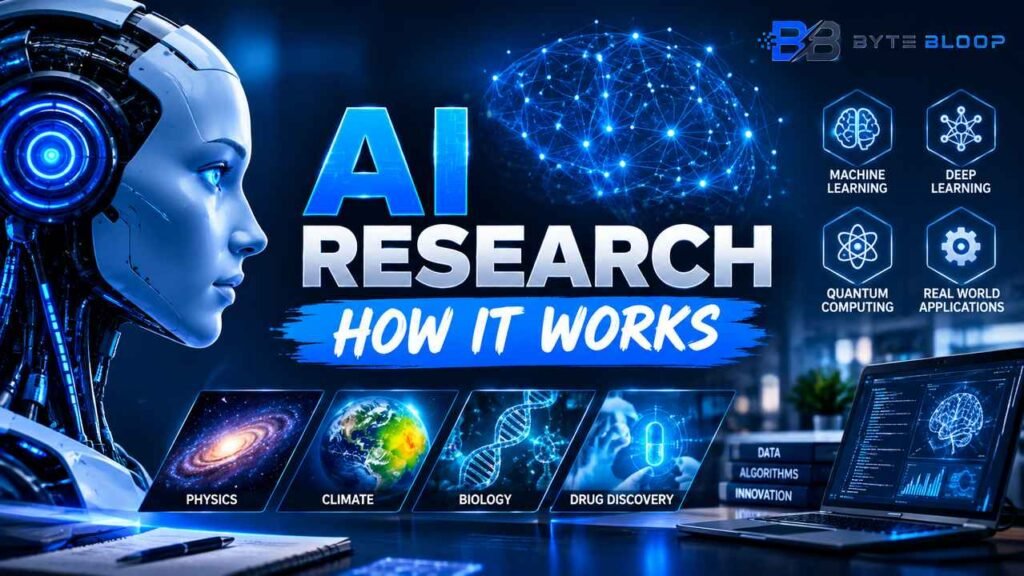
Ai Research How It Works is a topic worth understanding well. Artificial intelligence research has evolved from theoretical curiosity to a cornerstone of modern science and industry. At its heart, AI seeks to emulate human perception, cognition, and decision‑making through algorithms that learn from data. Researchers now combine deep learning, symbolic reasoning, and quantum computing to tackle problems that were once computationally infeasible. This interdisciplinary effort fuels advances in physics simulations, climate modeling, and drug discovery, reshaping how we understand and interact with the world.
As AI models grow in complexity, the research community faces new challenges in explainability, data bias, and ethical governance. Yet the promise of automated hypothesis generation and rapid prototyping keeps the field vibrant and highly sought after. In this guide, we unpack the core components of AI research, illustrate practical examples, and highlight emerging trends that will shape the next decade.
Foundations of AI Research
AI research typically follows a cycle of data collection, model development, training, evaluation, and deployment. Researchers gather large, high‑quality datasets—often curated from sensors, satellites, or public repositories—then design architectures that can extract meaningful patterns. According to the 2026 AI Index Report, multimodal reasoning models that process text, images, and sensor data simultaneously are becoming standard for complex scientific tasks.
Training involves optimizing a loss function that measures the discrepancy between the model’s predictions and ground truth. Gradient‑based methods, such as stochastic gradient descent, adjust millions of parameters to minimize error. The resulting models can then generalize to unseen data, enabling predictions in new scenarios. Researchers also employ transfer learning, where knowledge from one domain is adapted to another, reducing the need for massive labeled datasets.
This matters directly for anyone exploring ai research how it works.
Key Research Paradigms
1. Deep Learning – Neural networks with many layers capture hierarchical representations. They excel in image classification, natural language processing, and time‑series forecasting. 2. Symbolic AI – Logic‑based systems encode domain knowledge explicitly, aiding interpretability. 3. Hybrid Models – Combine neural and symbolic components to leverage strengths of both. 4. Quantum‑Inspired Algorithms – Use principles of quantum mechanics to accelerate combinatorial optimization.
Getting ai research how it works right can make a real difference.
Applications Driving Scientific Discovery
AI research is pushing the boundaries of discovery in several fields. In physics, simulation models that run in seconds can predict particle interactions that would take classical supercomputers millennia. Climate scientists use AI to generate high‑resolution weather forecasts and assess carbon‑capture strategies. In biology, AI identifies biomarkers for early disease detection and designs novel therapeutics. A Google AI blog notes that scaling AI research has helped reduce aviation’s climate impact by optimizing flight paths and predicting maintenance needs.
That is a core part of understanding ai research how it works.
Emerging Trends for 2027 and Beyond
According to IBM’s insights, open‑source reasoning models are gaining traction, allowing researchers to share and build upon complex architectures. AI sovereignty concerns are prompting the development of region‑specific models that respect data privacy. Efficient computing, including edge AI and neuromorphic chips, is enabling real‑time inference in resource‑constrained environments. The intersection of AI with sustainability—managing water resources, biodiversity, and disaster risk—illustrates the technology’s potential to address global challenges.
Many readers look into ai research how it works for exactly this reason.
Challenges and Ethical Considerations
Data bias remains a critical issue; models trained on skewed datasets can perpetuate inequities. Explainability is essential for scientific validation—researchers must understand why a model makes a particular prediction. Regulatory frameworks are evolving to ensure AI systems comply with safety and privacy standards. Funding disparities also influence research trajectories, with well‑resourced institutions dominating breakthroughs.
It is worth revisiting ai research how it works as things develop.
Key Takeaways
- AI research blends deep learning, symbolic reasoning, and quantum techniques to solve complex problems.
- Large, high‑quality datasets and transfer learning accelerate model development.
- Hybrid models offer a balance between performance and interpretability.
- AI is already transforming physics, climate science, and biology by enabling rapid simulations and predictions.
- Ethical concerns like bias, explainability, and data sovereignty shape future research priorities.
Frequently Asked Questions
What is AI research?
AI research studies how to build systems that learn from data to perform tasks like perception, reasoning, and decision‑making.
Ai Research How It Works remains highly relevant here.
What are the key features of AI research?
Core features include data collection, model architecture design, training with optimization algorithms, evaluation, and deployment, often incorporating deep learning, symbolic logic, or hybrid approaches.
This is a key consideration when it comes to ai research how it works.
What are the best use cases for AI research?
Use cases span scientific discovery—physics simulations, climate modeling, drug design—plus industrial automation, healthcare diagnostics, and sustainability monitoring.
What are the pros and cons of AI research?
Pros: rapid hypothesis generation, scalability, and new insights across domains. Cons: data bias, explainability challenges, high computational costs, and ethical concerns.
Conclusion
Based on the available information and industry analysis, AI research continues to accelerate scientific discovery by enabling rapid, data‑driven modeling across physics, biology, and climate science. Its integration with emerging technologies such as quantum computing and edge AI promises even greater efficiency and accessibility, while ongoing attention to bias, explainability, and governance will shape its responsible deployment in the coming decade.
Related Reading
- AI in Climate Modeling: A New Frontier
Sources & References
- The future of AI: trends shaping the next 10 years
- The 2026 AI Index Report | Stanford HAI
- What Is Artificial Intelligence (AI)? A Complete Guide to…
- Artificial intelligence: A powerful paradigm for scientific …
- Computer Science & AI Latest Trends 2026
- Building AI to accelerate science and improve lives
Related Articles